
The Fiat 500 Erina and the Zanella Brothers Who Built It
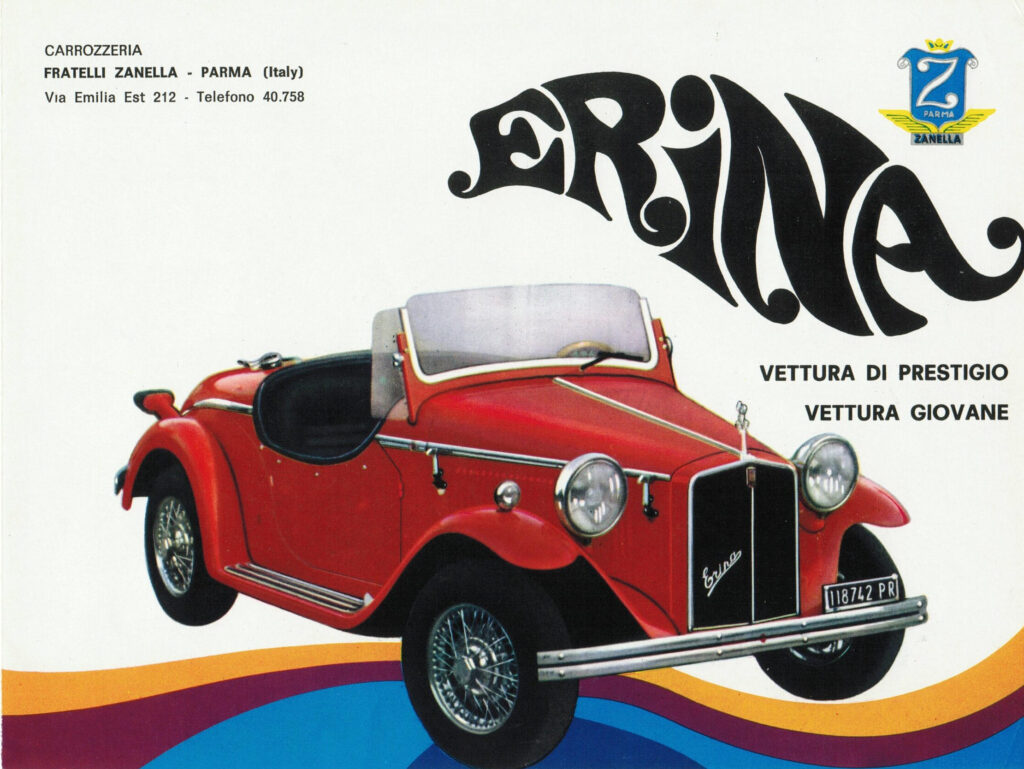
In the middle of the 1960s, a family coachbuilder turned Fiat’s smallest car into a two-seat roadster with the manners of another age. Its story leads from workshop drawings and Turin show stands to an American invoice, an unexpected rival from Vignale, and the unresolved question of how many were actually made.
Four brothers in Parma
By the time the Erina appeared, Carrozzeria Zanella had already spent more than two decades learning the very different disciplines hidden behind the word *carrozzeria*. The family business began in Parma in 1943, when the brothers Gino, Luigi, Guido and Giuseppe Zanella established a workshop in Via Zarotto, then known as Via Traversètolo. It was not a celebrated Turin design house with a succession of international show cars to its name. It was the sort of independent Italian establishment that repaired, rebuilt, adapted and occasionally reinvented the vehicles on which people and businesses depended. Its work ranged from passenger-car bodies and estate conversions to commercial vehicles and advertising commissions. Such experience mattered when the family decided to manufacture a small automobile of its own: a body that looks simple in a photograph still requires skilled metalwork, structural judgment, weather protection, trim and the patience to make parts fit repeatedly.
The workshop’s development reflected the prosperity and industrial changes around Parma. According to the family history by Roberto Zanella, the firm acquired land for a new industrial site on Via Emilia in 1955. A later Erina brochure gave its address as Via Emilia Est 212. These are not incidental addresses: they place the car within the working life of a business whose bread-and-butter activities differed greatly from the fashionable image of an exclusive sports-car atelier. Zanella knew the Fiat 500 not as a distant design inspiration but as a practical, inexpensive machine familiar to mechanics, owners and repairers across Italy. The question was whether the same mechanical package could support something personal, playful and commercially distinct.
This was also the era in which the Italian custom-body trade was struggling to redefine its place. The major manufacturers increasingly controlled the design and manufacture of their own bodies, while new safety, homologation and production requirements made one-off coachwork less straightforward. At the other end of the scale, the small Fiat was becoming a platform for a remarkably wide variety of experiments. Some were utilitarian, others sporting, others designed for seaside resorts. Zanella took a less obvious route: a little roadster with proportions and details intended to recall the open cars of the 1930s. It was not an exercise in outright performance. Its attraction depended on the distance between its old-fashioned appearance and the modern, affordable mechanics underneath.
Paperina becomes Erina
Roberto Zanella dates the beginnings of the project to 1966. The family’s account describes an affectionate, almost whimsical design, with a visual connection to the fictional vintage Fiat driven by Donald Duck. An early proposed name, *Paperina*, gave way to *Erina*, reportedly chosen by Gino Zanella in relation to his wife Irene. The explanation is charming, but it should remain what it is: a family recollection rather than a detail demonstrated by a surviving design contract. There is, however, firmer contemporary evidence that the Erina was not a name invented years later. A specialist catalogue of period motoring literature lists two Italian Zanella Erina brochures dated 1966, one of two pages and another of four. Their cataloguing supports the existence of promotional material bearing that date, although it does not by itself establish when the first customer car was finished or delivered.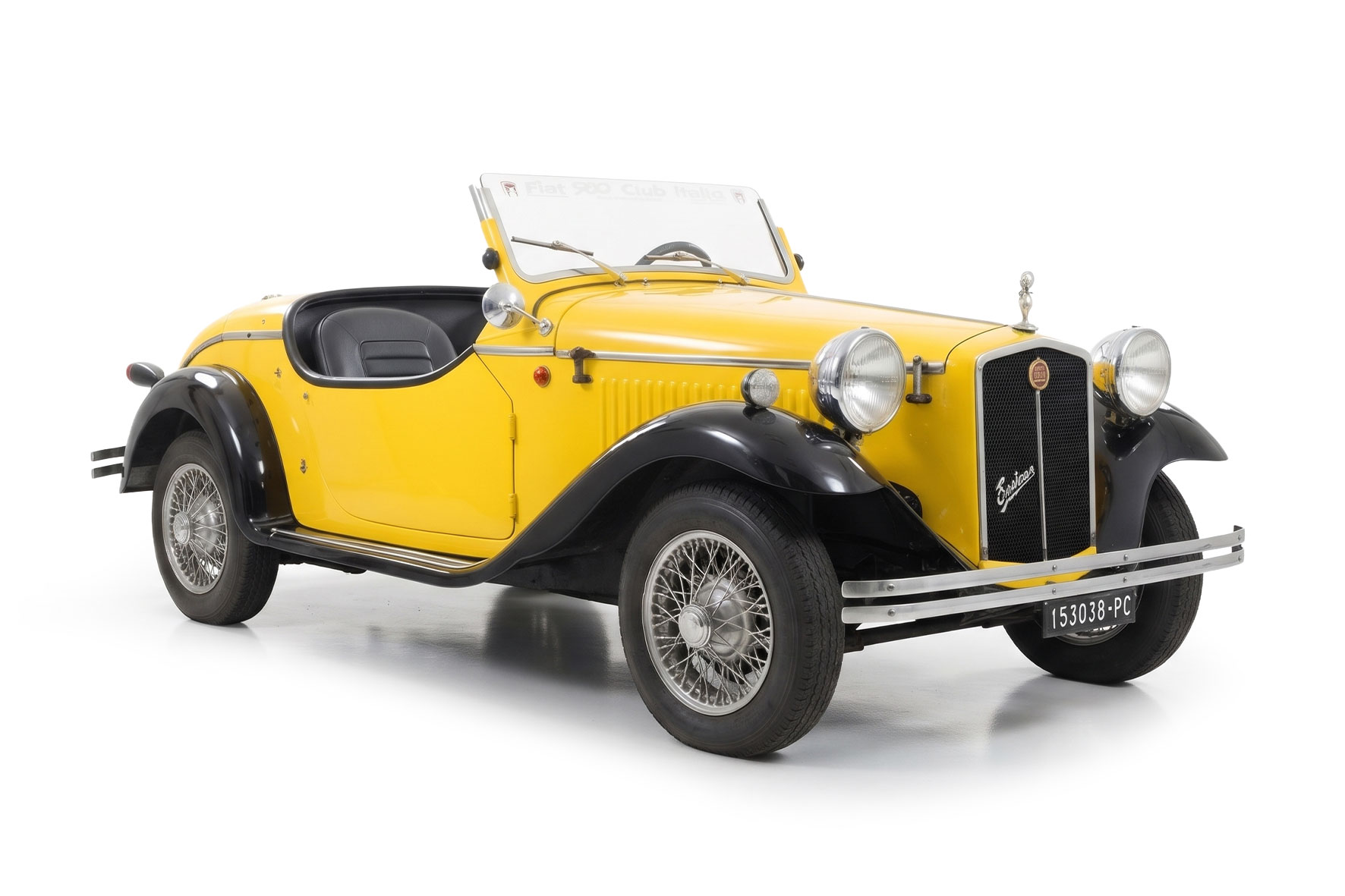
What emerged was a strict two-seater. Its upright grille, separated wings, long-looking front bonnet and narrow passenger compartment were intended to evoke a period roadster, yet the proportions remained those of a very small rear-engined car. This is an important qualification. The Erina was not a revived Alfa Romeo, nor a scale replica of any single pre-war machine. Roberto Zanella’s account presents it as a deliberate evocation of the era rather than a copy. The temptation to attach it to a particular Alfa Romeo 1750 Gran Sport should be resisted unless a drawing, a designer’s testimony or a period statement demonstrates that precise source. The general resemblance to the language of vintage open cars is clear enough without promoting a stylistic analogy into an attribution.
Nor should a designer be invented simply because the finished body has such an individual face. The identity of the person responsible for the Erina’s detailed exterior styling remains inadequately documented in the material examined. Gino Zanella is associated with the original idea and the name; the family workshop with the construction. Those are two related but different roles. The design drawings reproduced in the family monograph demonstrate that the car went beyond an improvised conversion, but they do not automatically identify a single stylist. The distinction matters in coachbuilding history, where owners, body makers, craftsmen and outside designers too often become interchangeable in retrospective accounts.
A 500 beneath the costume
Beneath the nostalgic outline was the mechanical heart of the Fiat 500 F. That choice determined both the Erina’s character and many of its limitations. The little two-cylinder engine remained at the rear; its compact dimensions made the basic car inexpensive and familiar to service. A reproduced approval document gives 499.5 cc, with a 67.4 mm bore and 70 mm stroke, and quotes 18.2 CV at 4,600 rpm. These figures describe the documented Fiat-based specification, not an unidentified tuned engine and certainly not a performance claim that can be assigned uncritically to every individual Erina. Four forward gears and reverse were retained. An original Erina sales leaflet describes the machine as a Fiat 500 F mechanically, with the essential difference found in the structure and passenger accommodation.
That difference was substantial. Removing the regular 500’s roof and reshaping its body required careful reinforcement, particularly along the longitudinal members. Period technical descriptions refer to strengthened and boxed side structures, while workshop drawings examine the converted car’s weight distribution and internal packaging. In a roadster of this scale, the placement of the fuel tank, spare equipment and luggage could not be settled as an afterthought. Roberto Zanella describes the tank being moved rearward to make room for a modest front luggage area. The drawings reproduced with the original brochure also locate items such as the hood, battery, tool storage and chassis-number position. These details reveal engineering and packaging work that the car’s almost theatrical front view does not immediately suggest.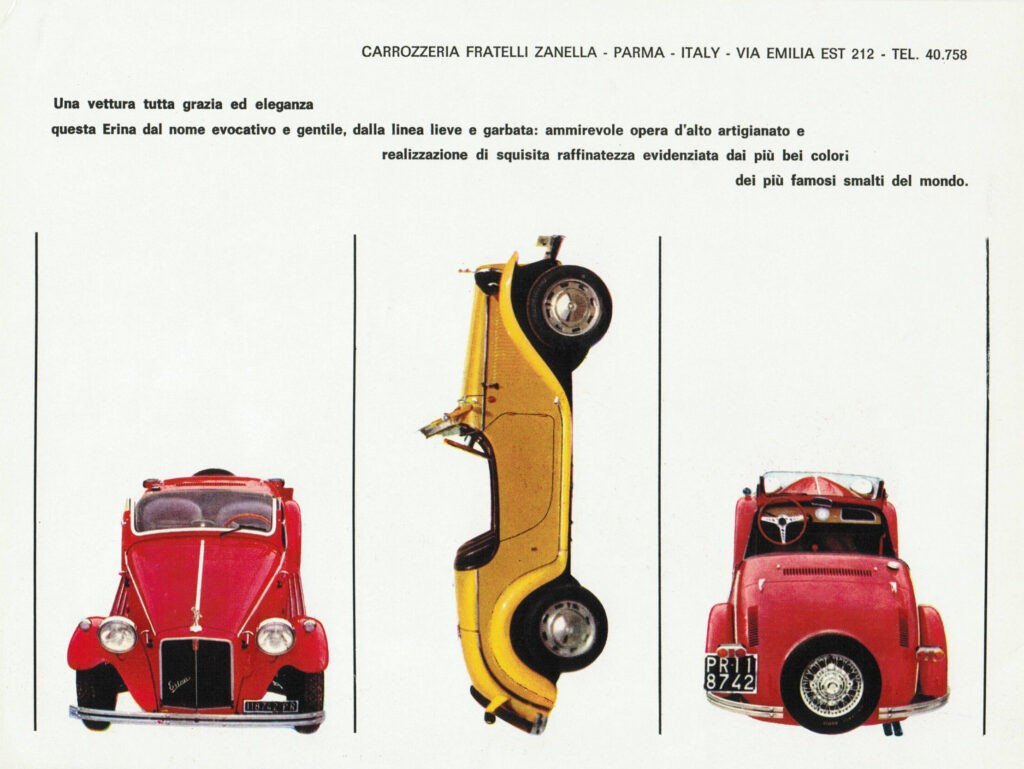
Even the steering wheel was reconsidered. A universal joint fitted at the steering-box output allowed its position to be lowered, according to the promotional description. Inside, a deliberately sparse wooden dashboard carried the Fiat speedometer, while padded details, stainless accents and Skai-covered seats gave the passenger compartment a bespoke air. A folding waterproof fabric hood used a tubular frame and could be tucked behind the seats; detachable side protection completed the weather equipment. These were not luxuries in the sense of a large grand tourer, but they were individual solutions that a mass-produced Fiat did not provide. The period brochure also offered wire wheels as an extra-cost alternative to more ordinary wheels, an old-fashioned visual touch that suited the body without changing the car’s modest mechanical purpose.
The measurements underline how compact the Erina really was. The brochure quotes a length of 2,970 mm, a width of 1,390 mm and a running weight around 510 kg, with the standard Fiat 500 wheelbase of 1,840 mm. A separate approval drawing gives a length of 2,960 mm and a height of 1,120 mm. Neither difference needs to be hidden: they may reflect measurement practice, drawings at a particular stage, or a different body specification, but the surviving evidence does not yet explain which. The promotional maximum speed of 100 km/h likewise differs from the approval calculation of 96.3 km/h. A brochure’s rounded promise and a regulatory calculation answer different questions; treating one as a definitive road-test result would misrepresent both.
On the stands at Turin
The small roadster moved from family experiment to public spectacle through an unexpected opportunity. Roberto Zanella recounts that the paint manufacturer Glasurit requested the Erina for its stand at the 1967 Turin Motor Show. The car was an effective exhibit for a finishing specialist: small enough to attract attention, distinctive enough to be remembered, and closely associated with the craft of painted metal. Period photographs reproduced in the family history place members of the Zanella workshop beside it. Contemporary press material from the show, including an issue of *l’Automobile* dated 12 November 1967, supplies more than the retrospective memory of a successful display. It establishes that the Erina attracted attention in the contemporary motoring world, although detailed press captions must still be matched carefully to individual cars.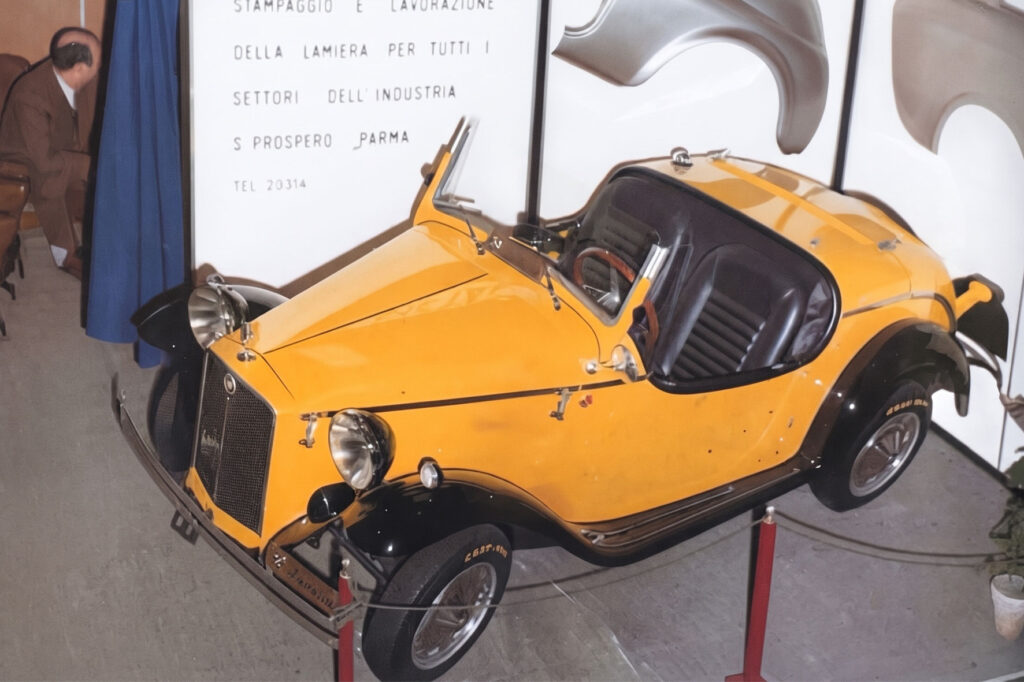
An additional exhibition is recorded for Turin in 1968. This time the Erina appeared on the stand associated with F.A.M.S. Italia, finished in yellow with contrasting black mudguards. The family account says the displayed car was purchased by Francesco Stola, whose name brings another important Italian coachbuilding family into the Erina’s story. That is a meaningful historical connection, but without a chassis number attached to the transaction it should not be used to identify a surviving car solely by colour or later ownership. A photograph can demonstrate what stood at an exhibition; it cannot establish an uninterrupted chain of title on its own.
The movement between a paint company’s stand, an industry-associated exhibition space and a private customer illustrates the fragile commercial life of the car. Zanella did not possess Fiat’s distribution network or the resources of an established volume manufacturer. The family’s history describes exploratory contacts about a possible supply of Fiat 500 F chassis and engines, including an approach connected with Gianni Agnelli. The available account does not establish a signed contract or an authorised factory programme. The most defensible reading is that Zanella was considering how a workshop-built novelty could become a repeatable small series and that access to donor vehicles was a practical obstacle in that ambition.
An invoice bound for America
One surviving document makes the Erina’s commercial history unusually tangible. A signed Zanella invoice dated 14 November 1967 describes a used Erina 500 F two-seat spider with a cloth hood and cover. It identifies chassis **717581367** and prices the vehicle at **US$1,750**, with a further **US$160** for a wooden sea-freight crate: a total of **US$1,910**. The purchaser is identified in the accompanying export documentation as James Robert Neal Jr. Here, for once, the story has moved beyond a general narrative about ‘cars exported to America’. It has a date, a price, a description and an individual chassis identity. The date of a sales document does not, however, prove the precise date on which the car arrived, cleared customs, was registered or first used on American roads.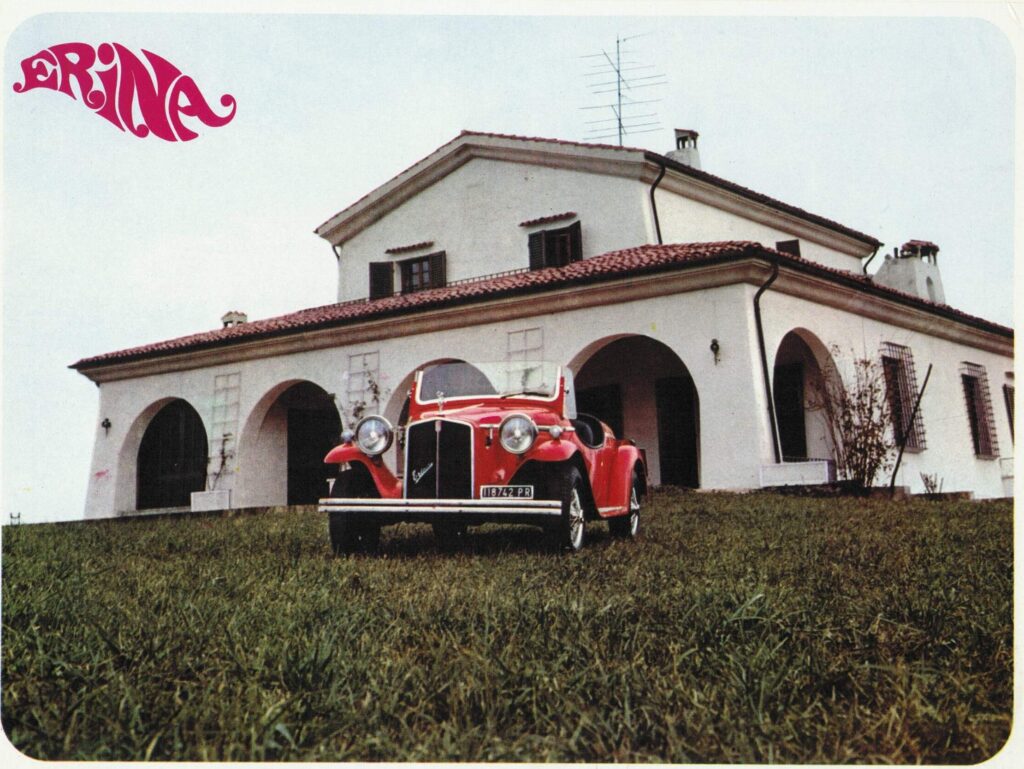
Related paperwork includes American regulatory and shipping correspondence, and a consular declaration concerning an intended special registration arrangement. These are valuable traces of the work required to move such an unusual motor car across borders in the late 1960s, but they must not be compressed into an invented export success story. A later account links a car reportedly sold by Neal with Cheese van der Zee, and a photograph shows a red Erina carrying registration **118742 PR**. The relationship is worth pursuing; it is not enough to establish that the pictured red roadster is indisputably chassis 717581367. The invoice belongs to one car. The plate and photographic history belong to the evidence attached to another identity until a connecting document is found.
The American price is also useful precisely because it cannot be mistaken for a universal price list. It was attached to a car described as used and invoiced in dollars for export. Elsewhere the family history gives a contemporary Erina asking price of approximately **925,000 lire**, a notable sum against the ordinary Fiat 500. A 1968 advertisement for the German market quotes **DM 5,975** ex works in northern Italy and a further **DM 325** for wire wheels. The three figures belong to different markets and documentary circumstances: a domestic quoted price, a foreign advertisement and an individual sales invoice. None is evidence of the same transaction, and none should be silently converted into a modern value as though exchange rates, duties and specifications were identical.
The other tiny roadster: Vignale’s Gamine
At almost the same moment, a more famous coachbuilder was exploring a related idea. Alfredo Vignale‘s Fiat 500 Gamine appeared at the 1967 Paris Motor Show. It, too, borrowed the underpinnings of the Fiat 500 F and transformed a humble utility car into a two-seat spider recalling pre-war motoring. The comparison is irresistible, but the differences are as instructive as the similarities. Vignale approached the project through the resources and public identity of an established Turin carrozzeria. Zanella approached it from a Parma workshop whose work was divided among repairs, specialised conversions and commercial commissions. One became a recognised emblem of its maker; the other survived on the margins of historical memory.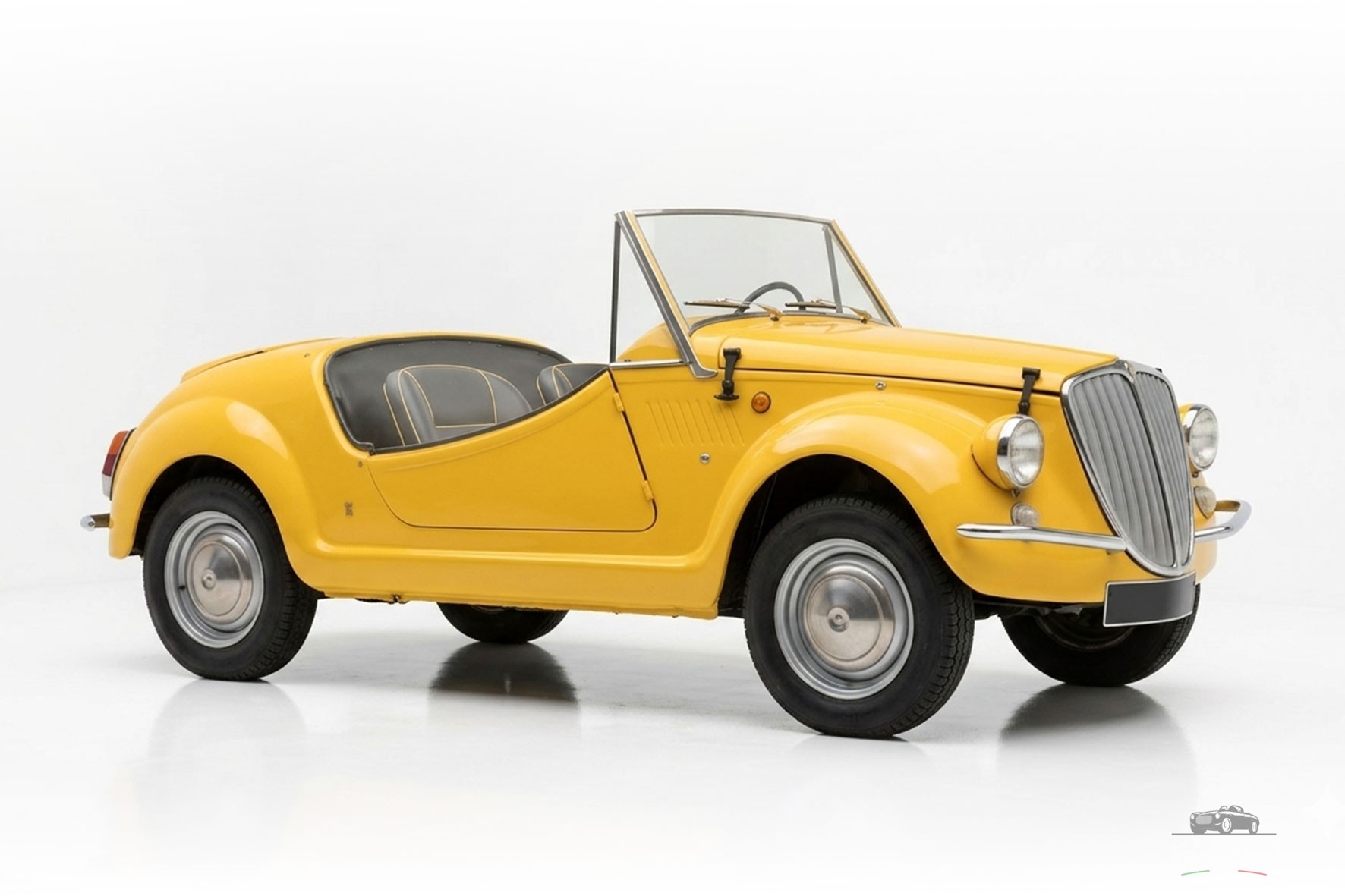
Both cars used the deliberately theatrical details of early motoring: individual wings, an upright front treatment, a low windscreen and a body that seemed older than the mechanical parts it concealed. The Gamine has frequently been compared with the Fiat 508 Balilla Coppa d’Oro. The Erina’s vocabulary was less tightly tied to a single identifiable ancestor. The shape of each car tells us about the mid-1960s appetite for nostalgia, not by itself about a line of design influence running from Parma to Turin or the other way around. The Erina’s 1966 brochure references and the Paris presentation of the Gamine in 1967 justify speaking of overlapping development. They do not demonstrate that Vignale studied Zanella’s design, nor that the smaller workshop was responding to a completed Gamine.
Fiat’s own Heritage organisation gives the Gamine’s production as 400 examples between 1967 and 1971, although period-market accounts and specialist catalogues sometimes propose different totals. Its reinforced platform, too, was a necessary consequence of the open body rather than a purely decorative change. For the Erina, the mechanical specification preserved in the Zanella brochure is less powerful than some figures routinely repeated for the Gamine; comparing performance claims without checking their source and measurement would be misleading. What can be said with confidence is that both belonged to the same imaginative category: coachbuilt Fiat 500s sold chiefly on individuality, not speed. For the Gamine’s independent history, including its foreign distribution, the existing feature The Vignale Gamine: The Little Car That Dreamed Big offers the natural next chapter rather than another retelling here.
The Gamine’s survival in photographs, auction catalogues and collections may make it appear to have dominated this niche from the outset. Yet the Erina reminds us how easily the commercial record of a small firm can disappear. If the story were written solely from showroom publicity or present-day popularity, the Parma car would scarcely feature. Its promotional leaflet, approval calculations and signed export invoice expose a different reality: a much smaller business was working through the same design fashion, with its own technical solutions, very close to the same moment. Parallel ideas were common in a country where coachbuilders looked to the same historical forms and the same inexpensive Fiat mechanical package.
Fifty-eight, twenty-nine, or seven?
Production has become the Erina’s most persistent historical puzzle. In his history of the workshop, Roberto Zanella reports 58 examples, including seven intended for the United States, two for Spain and one for Greece. It is a specific family-source statement and should be reproduced with that attribution, not presented as a verified factory ledger. Other published estimates differ sharply. A 2021 article in *La Gazzetta dello Sport* suggests 29, while a later English-language account in *Auto Italia* speaks of a mere seven. A register assembled from identifiable photographs and registration numbers lists seven known cars. That last figure is especially liable to misunderstanding: seven individually recorded vehicles are not necessarily the total that left the works.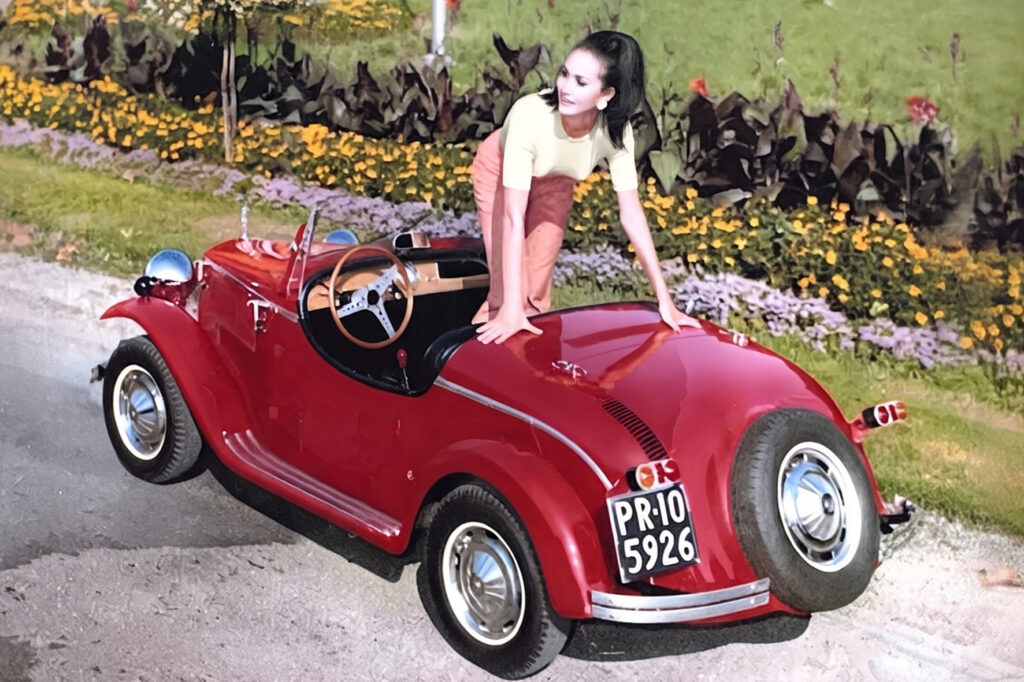
The discrepancy may arise from different definitions or incomplete information: bodies completed, cars ordered, cars exported, cars surviving, or individual examples currently traceable. Those are possibilities, not a solution. The materials examined do not include a consecutive production register that reconciles all three figures, and it would be wrong to choose the smallest number simply because the Erina is rare today. The better approach is chassis-led. The 1967 invoice provides one firmly numbered example. The car displayed at the Turin stand, the car reportedly owned by Francesco Stola, and the cars recorded with various Italian plates are further documentary groups, not automatically separate chassis and not automatically the same car. Each identification requires corroboration through chassis stamps, original registration papers, period photographs or sale documents.
A register of seven known Erinas records cars under partially obscured registrations beginning AL-84, BA-2648, PA-2216, PC-1530, SI-1358 and TO-A742, together with an example for which no plate is known. Some may be restorations, repaints or later incarnations of vehicles seen in older images. The record becomes meaningful when dates, body details, chassis numbers and owners are connected. One entry identifies a car from 1968; another is linked with photographs from the Bologna Auto e Moto d’Epoca exhibition in October 2024. Such sightings show that the Erina did not disappear altogether, but they must not be transformed into new production units without identity checks.
A little car with a long afterlife
The Erina was sometimes grouped with Italian spiaggine, the stripped-down leisure vehicles that flourished around holiday resorts. There is a practical basis for this description: it is small, open and deliberately lighthearted. But its fitted hood, period-roadster detailing and more elaborate vintage bodywork make it different from the simplest beach cars. It was not merely a standard Fiat 500 with its doors removed. Its makers reworked the underlying structure, cockpit and external appearance to give a familiar mechanism another identity. Whether prospective buyers saw it as a fashionable runabout, a collector’s curiosity or an alternative to a motorcycle and sidecar is harder to establish from the surviving evidence.
Its commercial difficulty is easier to understand. An artisanal body, careful assembly and special trim could make a small car unusually expensive without giving it the acceleration, luggage room or year-round utility of larger rivals. That contradiction was visible across the world of coachbuilt Fiat derivatives. The Erina offered affection and individuality but could not offer the economies of industrial production. The family history places its moment in the late 1960s, a period in which the financial conditions for small coachbuilders were changing fast. Yet the eventual fate of the business should not be attributed solely to one model without accounting records. A fascinating car does not necessarily explain a workshop’s balance sheet.
The Erina’s historical value now lies in what remains to be identified. The family photographs and technical sheets describe the workmanship; the shows and promotional leaflets explain its intended audience; the American invoice gives one chassis a definite documentary anchor. Against the better-known Vignale Gamine it stands not as an inferior copy, nor as an unproven prototype of the same design, but as a parallel experiment that emerged from a very different kind of Italian coachbuilding enterprise. Its narrow body, improbable little grille and rear-mounted Fiat engine still pose a question worth answering with documents rather than guesswork: how many cars left Via Emilia Est, and which of them can be traced today?

ABOUT THE AUTHOR
Andreas Scheidl
Italian classic car enthusiast with German roots. Renowned as a respected figure in the classic car community, he serves as a jury member at various international concours d'elegance, including the Classic Gala Schwetzingen and Mantova. As a content creator, Andreas passionately shares his profound knowledge and appreciation for vintage automobiles. His heart beats for cars designed by Giovanni Michelotti, showcasing his discerning taste and dedication to preserving the timeless elegance of automotive history.
More stories by Andreas Scheidl ↗CONTINUE READING
Posts You Might Like
Blue in Turin, Red-Brown in Germany: The Long Life of Bertone’s Ferrari 166 Inter
One Ferrari chassis, one Bertone cabriolet, and a history divided between the show stands of postwar Italy, German classified advertisements and rival design attributions. A blue Ferrari among the saloon cars The…
Read story
The Pegaso That Missed New York: The Z-102 Thrill
The 1953 Pegaso Z-102 Thrill missed New York, dazzled Turin and survived a remarkable journey. Explore Touring’s design team and chassis 0133.
Read story
Abarth 1500 Biposto: Why Packard Gave It Away
A Letter from Detroit On 10 July 1953, James J. Nance, president of the Packard Motor Car Company, wrote to Richard Austin…
Read story
Alfa Romeo Canguro: Giugiaro’s Lost Bertone Coupé and the Long Road Back
Built on a Giulia TZ racing chassis, Bertone’s extraordinary 1964 one-off was wrecked at Monza, left to deteriorate and finally restored four decades later. Its story is as remarkable as its shape.…
Read story
THE CONVERSATION
Comments 0
Share a memory, a period photograph or a documented detail about this story.