
The Pegaso That Missed New York: The Z-102 Thrill
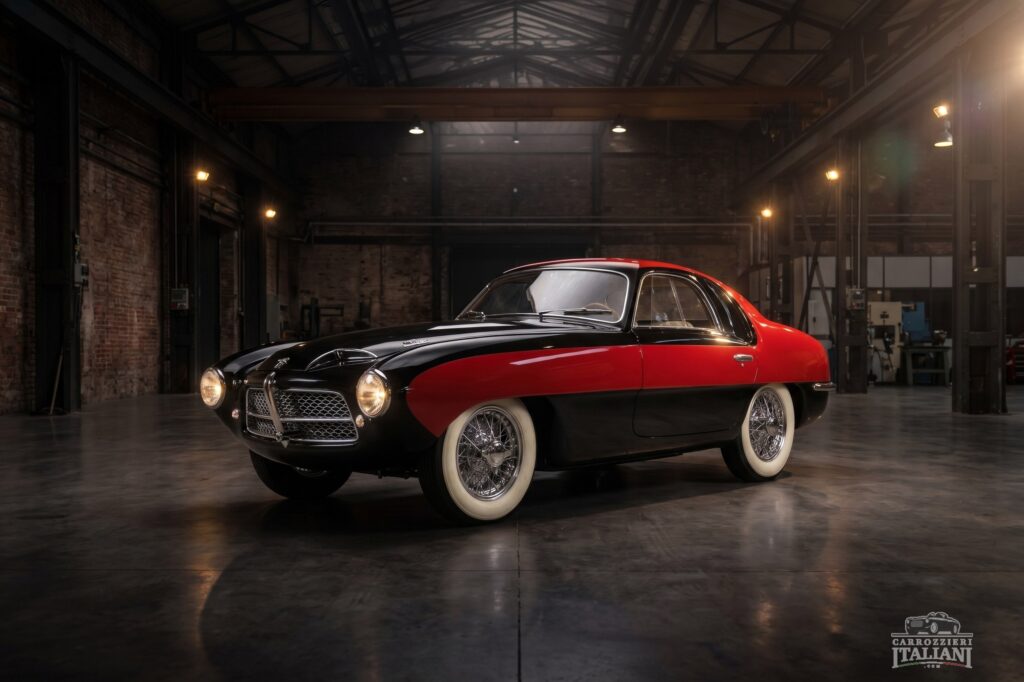
Touring’s 1953 Thrill, the men behind its flying buttresses, and the long life of chassis 0133
A car for a city it never reached
In February 1953, a sports-car exhibition took over Madison Square Garden. Fred Pittera’s World Motor Sports Show was the sort of New York occasion for which a newcomer could arrive without an established reputation and leave with one. Spain’s Pegaso had good reason to attend. Its parent company made trucks, its engine department had built an astonishing V8, and its new grand tourers cost sums normally associated with the most exalted Italian and British marques. On the Pegaso stand stood a Cúpula, a Touring spider and an exposed chassis to demonstrate the engineering. The most startling car was missing. In Milan, a black-and-red two-seater called Thrill had not been finished in time to cross the Atlantic.
It would be tempting to write that a single missed shipment decided Pegaso’s fate. The company’s difficulties were much deeper, and neither Touring nor ENASA left a commercial forecast that allows such certainty. What the absence did change was the car’s first encounter with its public. Instead of debuting before prospective American buyers, the Thrill would make its entrance at the 1953 Turin Motor Show, the European gathering where Italian coachbuilders could measure themselves against each other at close quarters. The delay created a different sort of spectacle: the Spanish car that turned up among the most experimental bodies of Turin.
That first exhibition is only the opening chapter of a remarkably well-documented one-off. Chassis 0102.150.0133 can be followed through the workshop, European salons, a concours victory with disputed prize terminology, Spanish road use, modification in California and a restoration before Pebble Beach. The documents also reveal more than the usual single-name design attribution. They lead into the drawing office, the production department and the relationship between a Spanish engineering organization and a Milanese bodybuilder whose shared ambitions went beyond one spectacular coupé.
Ricart’s unlikely flagship
The Z-102 began with Wilfredo Ricart, the engineer who had worked at Alfa Romeo before returning to Spain after the war. He had known the industrial and racing culture around Portello, including a period in which Enzo Ferrari was active there, but the task facing him at ENASA was entirely different. Empresa Nacional de Autocamiones was a state-owned industrial undertaking whose business centred on commercial vehicles. In the constrained economy of early Franco-era Spain, a costly high-performance car was intended to serve as a statement of technical competence, not simply another product for a crowded luxury market. Pegaso needed to appear sophisticated abroad even while the Spanish automobile industry was struggling to establish itself at home.
Ricart’s solution was not an ordinary truck maker’s excursion into elegant upholstery. The Pegaso Z-102 used a compact steel platform structure, torsion-bar suspension, independent front wheels and a De Dion rear axle. Its front-mounted V8 had light-alloy construction, twin overhead camshafts for each bank and gear-driven valve timing. A five-speed transmission delivered power to the rear wheels. Such equipment demanded skilled manufacture and painstaking maintenance; it also made the car more complicated and expensive than conventional continental grand tourers. The machinery would attract engineers and drivers, but a complete Pegaso also needed a body that wealthy clients could imagine buying.
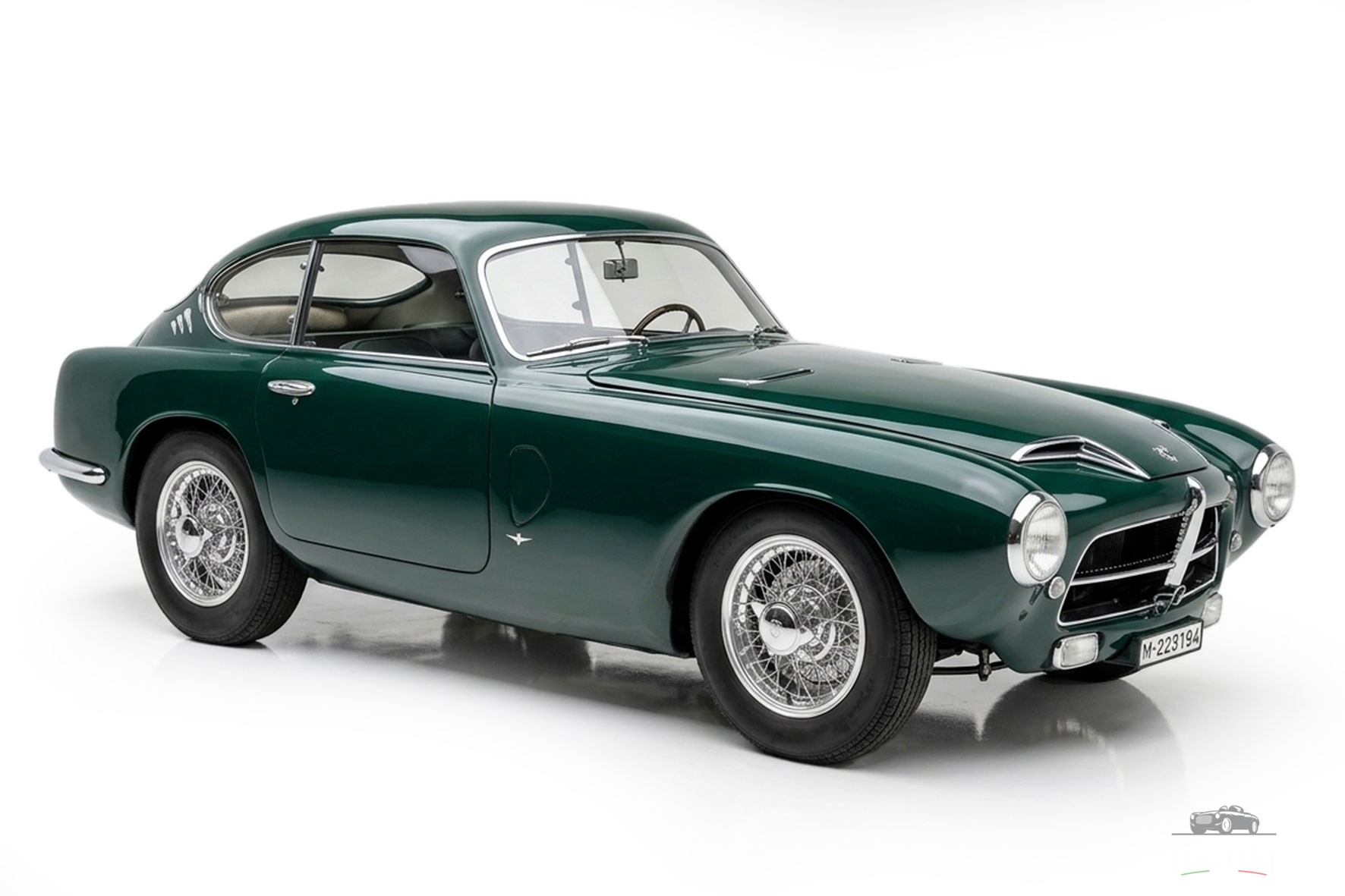
An expanding family of Touring-bodied Pegasos answered that requirement. Italian coachbuilding had already become an international business, and Touring was particularly well placed to make a lightweight aluminium body with more room for technical imagination than a mass-production contract allowed. The relationship with Ricart was not a meeting of strangers. Through the prewar Alfa Romeo milieu, Ricart and the Bianchi Anderloni family had long been acquainted. In 1952, Touring produced a Pegaso spider; the more theatrical Thrill followed as a deliberate display of what the partnership might achieve.
The engine in the Thrill is usually described as the 2.8-litre Z-102 V8, rated around 170–175 horsepower in period-derived accounts. The difference between those published figures should not be disguised by converting both into a single supposedly definitive output. The March 2017 technical sheet in Automobilismo d’Epoca gives approximately 2,816 cc and 175 metric horsepower, whereas another specialist set of specifications lists 2,815 cc and 170 brake horsepower; its much lower weight figure also conflicts with the magazine’s 1,270 kg. An actual factory build card or contemporaneous weighing record would be needed before declaring every numerical detail final for chassis 0133. The larger truth is secure: the machine under the body belonged to a technically ambitious family with a racing-engine character.
The drawing office and the workshop
Touring’s name was often presented to the public through Carlo Felice Bianchi Anderloni. He had assumed responsibility for the firm’s technical and stylistic direction after the death of his father Felice in 1948, working alongside co-founder Gaetano Ponzoni. In descriptions written years later, the Thrill is regularly credited simply to Carlo Felice, as though the company director personally performed every sketch, layout and full-size alteration. That language tells us who led the firm, but little about how the car took shape on the floor of the factory in Via Ludovico da Breme.
A period photograph reproduced in the Bianchi Anderloni family history shows the Touring group gathered with the completed Pegaso shortly before Turin opened. Four named figures restore the chain of responsibility: M. Colombo, identified as workshop chief; Carlo Felice Bianchi Anderloni, the owner and technical leader; Aquilino Gilardi, responsible for the project; and Ponzoni, a co-founder with an organizational and business role. These were not interchangeable occupations. An unusually shaped aluminium panel needed a supervisor to build it; a production project needed dimensional control; a coachbuilding firm needed someone to finance, plan and deliver the work. The photograph documents precisely that division of labour.
There is a fifth name in the design record. Federico ‘Mimmo’ Formenti, one of Touring’s most gifted yet least publicly celebrated stylists, produced drawings of the air channels around the Thrill’s cabin. Those studies, reproduced with the historical article, join visual invention to a workable Superleggera structure. Formenti had joined Touring in 1946, introduced to the company through his brother-in-law Gilardi. He learned alongside stylist Giuseppe Belli while becoming unusually adept at moving between drawing, proportion and three-dimensional modelling. Later recollections from colleagues, recorded by David Rodríguez Sánchez with assistance from Mario Favilla, Franco Rabaioli and Patrick O’Brien, place him behind a remarkable range of Touring designs, including this Pegaso.
The surviving evidence therefore supports a collective attribution rather than the erasure of either man: a Touring design directed by Carlo Felice Bianchi Anderloni, with original styling work documented for Formenti and project responsibility attributed to Gilardi. It does not yet establish which particular line was invented at which meeting, nor does the mere appearance of Ricart in the commission make him its body stylist. Ricart’s primary role was the car programme and its engineering foundation; the body was developed and constructed in Milan. That distinction remains important when comparing the Thrill with Bertone’s Alfa Romeo B.A.T. 5, presented in the same Turin season with the more clearly identified styling hand of Franco Scaglione.
Two fins that were not tailfins
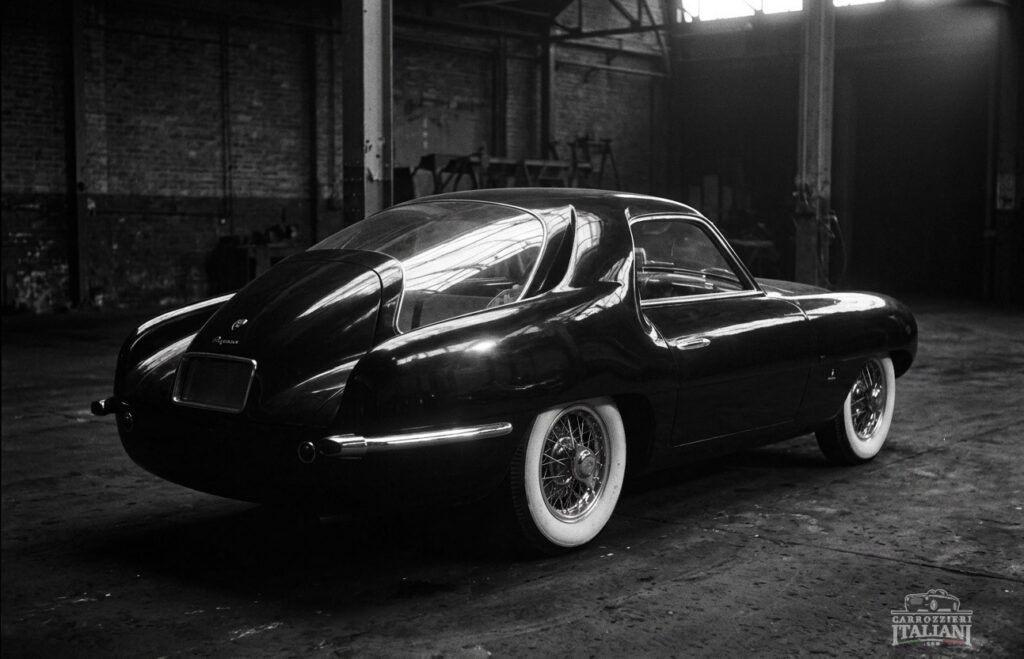
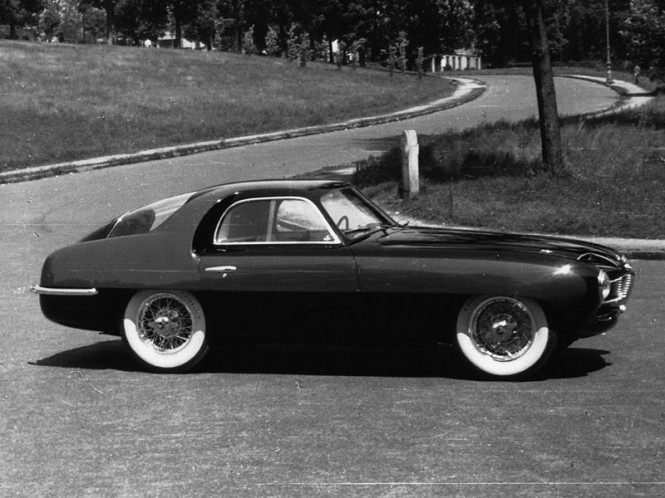
Look closely at the Thrill in profile and the source of its strangeness becomes clear. The familiar low nose, crossed grille and forward cabin of a sports GT give way to two broad arches stretching from the roof area toward the rear wings. Between those outer structures and the passenger compartment are channels open to the passing air. The rear window wraps around a luminous passenger cell; the tail tapers and the black and scarlet paint separates the body’s visual masses. The fins are not simply ornamental projections fitted to the boot. They participate in the car’s entire side elevation and in the unusual shape of its roof.
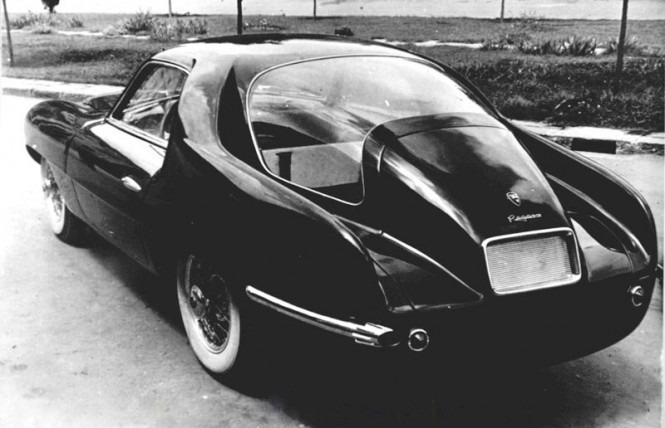
Touring described the channels as an aerodynamic idea, intended to guide air along the cabin and reduce unwanted turbulence behind it. The structural emphasis also invited an interpretation of the arches as additional protection around the occupants. These propositions are evidence of design intention, not proof that the finished body achieved a measured decrease in drag or a certified rollover strength. No contemporary wind-tunnel chart or test protocol has been demonstrated for this particular chassis. It is perfectly possible for the channels to have made aerodynamic sense while also serving as an arresting visual advertisement for the coachbuilder. One need not invent a percentage improvement to appreciate their technical ambition.
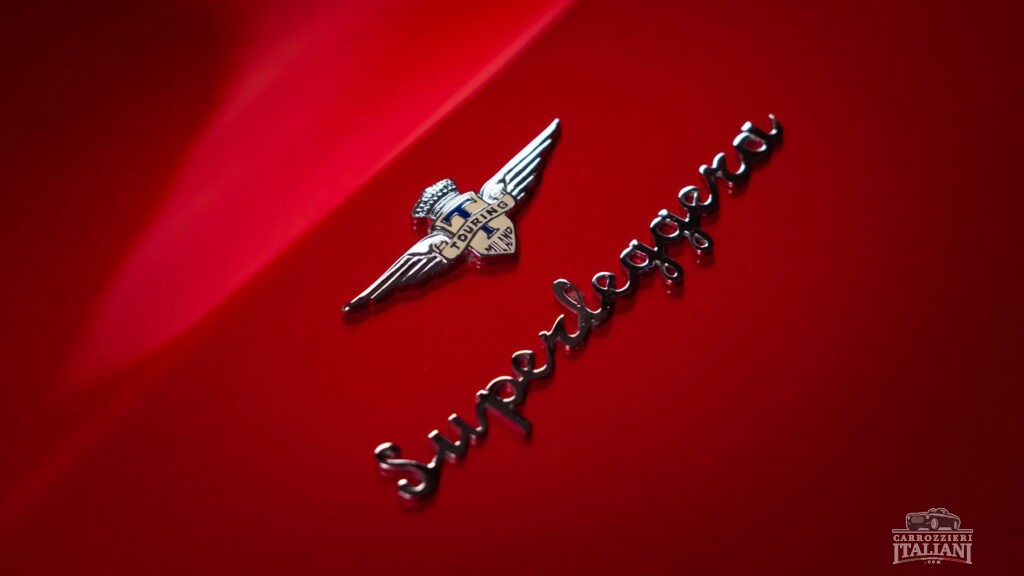
The construction underneath is equally revealing. Touring’s Superleggera method used small-diameter tubular members to establish the shape of the body, covered by carefully worked light-alloy panels. The term is frequently misunderstood as a complete lightweight chassis designed by Touring. Here the chassis engineering belonged to Pegaso, while the Milanese company supplied its body structure and exterior skin. The air-channel sketches attributed to Formenti address how an unorthodox surface could actually be supported and made. Body engineering and chassis engineering met at the same car, but they did not become the same discipline.
Even the cabin challenged the expectation that a flamboyant show car would make comfort an afterthought. White upholstered bucket-style seats sat over vivid red carpets, surrounded by perforated door panels, Jaeger instrumentation bearing ENASA markings and a broad wooden-rimmed steering wheel. Seat belts appeared in the period display photographs, with a hostess demonstrating their use; a fire extinguisher was among the provisions identified in the historical description. Such details belonged to the intended message: Pegaso’s speed was to be presented with the manners and equipment of a highly developed road car. The apertures in the doors and the bright interior were as conspicuous as the external fins, but they served different purposes from the V8 and the suspension carrying the car.
One can see a family resemblance between the Thrill’s buttressed rear and later automobiles with open channels behind the cabin, including the Ferrari 599 GTB. A resemblance is not a documented design descent. There is no need to imply that Ferrari’s later engineering team copied this particular Pegaso unless a designer’s testimony or project record establishes that link. The more defensible observation is that the Thrill explored a recognizable aerodynamic and formal problem more than half a century earlier, with its own very different constraints and construction.
Turin, Barcelona, Stresa
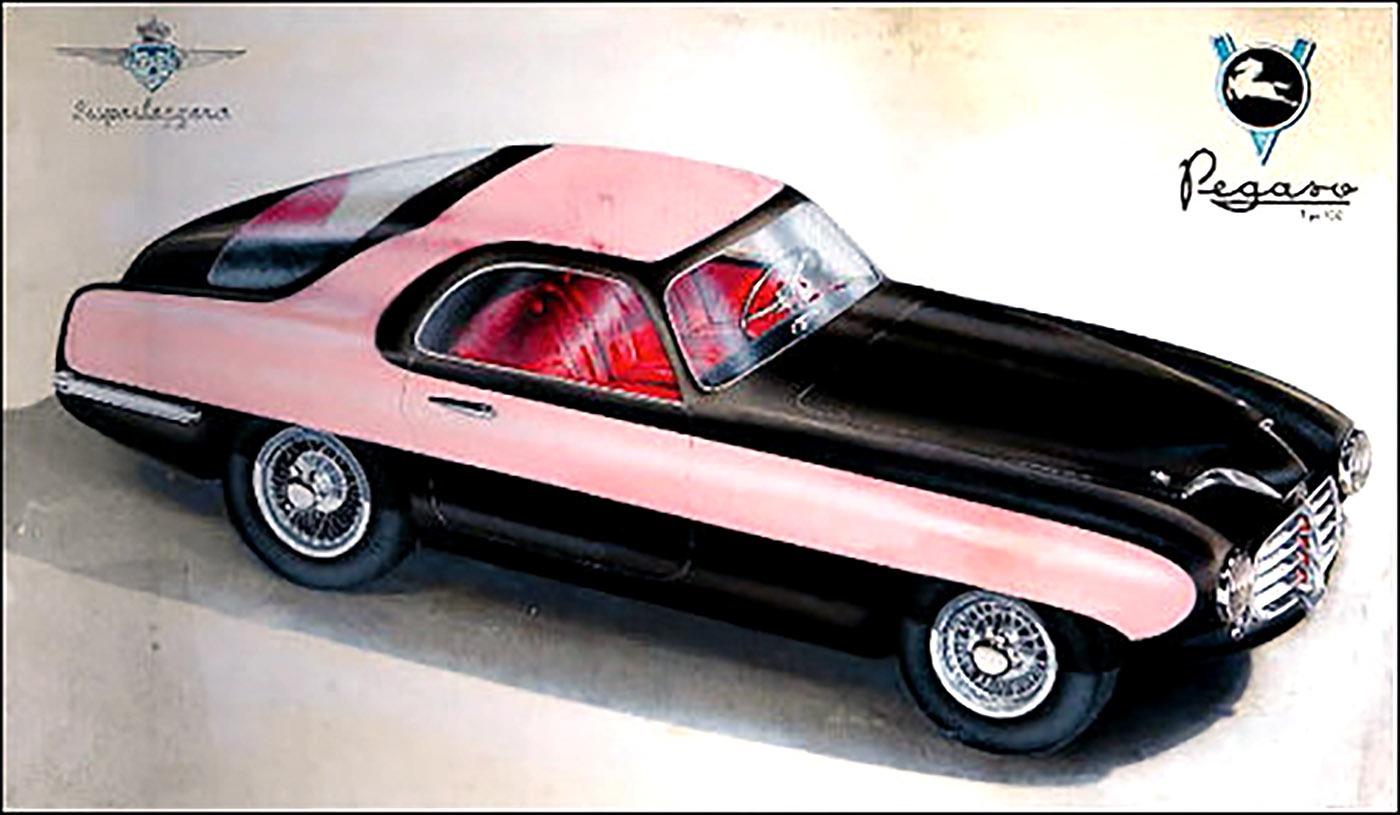
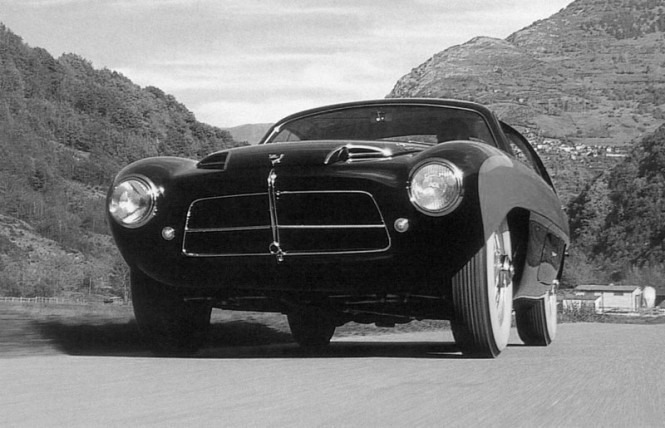
By April 1953, the car that had missed America was ready for Turin. The two-tone machine appeared alongside Bertone‘s B.A.T. 5, one of a series of experimental Alfa Romeos that would redefine the way a motor-show audience pictured streamlining. The juxtaposition makes a useful reminder about authorship: Scaglione’s Bertone car and the Formenti–Anderloni Touring project emerged from competing studios, both interested in airflow, but they answered different briefs. The Pegaso’s front grille retained a distinctive identity for a Spanish manufacturer, and its substantial coupé cabin promised travel rather than laboratory experiment alone.
The Thrill then went to Barcelona in June. Subsequent images show three small round openings in the front wings, additions reportedly made by ENASA after that Spanish appearance and before the 1953 Stresa concours. This is more than a trivia detail for anyone comparing photographs. A Turin photograph without the openings and a later photograph with them are not necessarily pictures of two cars. The bodywork was revised while the single chassis continued its European show itinerary. The internal identity of chassis 0102.150.0133 must remain separate from changes in its appearance.
The Stresa record is both unusually good and untidy. A photograph published with the Bianchi Anderloni family material shows Anna Solera Bianchi Anderloni, Carlo Felice’s wife, associated with the presentation of a ‘Gran Premio d’Onore’. Touring-related and later specialist accounts repeat that award designation. Other event records, however, include a generic special prize or best-of-show description, and a competing claim of a Gran Premio d’Onore for an MG TD Vignale complicates the exact hierarchy. The car’s presence and a major award are supported. The official prize classification, whether shared, differently grouped or subsequently abbreviated, deserves to remain open until the original Stresa programme and results are reconciled.
The same year’s itinerary continued to Paris and London. What had been intended as an American launch became an extended European appearance programme, with each display adding publicity for both Pegaso and Touring. These exhibitions do not establish a production run of Thrill-bodied Pegasos. They describe one show car, repeatedly photographed, occasionally modified and presented in different contexts. More restrained Touring Z-102 berlinettas and spiders existed, but their bodies should not be counted as duplicate Thrills merely because they share a mechanical family or the coachbuilder’s emblem.
A Spanish bodybuilding plan that never started
For Giovanni Bianchi Anderloni, who later examined the correspondence and material preserved by his family, the most revealing part of the Pegaso relationship was not the flying buttresses. He reported that the Italian and Spanish partners had considered a company arrangement under which Touring-style coachwork could be built directly in Spain. The attraction was practical: import duties made the movement of completed bodies across the frontier expensive, while local manufacture might have supported a broader Pegaso programme. An emblem combining the identities of the two firms was even prepared, according to his account.
The plan did not become a running factory. Giovanni associated its failure with the Spanish company’s financial difficulties. It would be wrong to describe the proposed organization as an operating joint venture, or to assign it a production total, without formation papers, workshop records and evidence of completed bodies. What the account does establish is the breadth of the original discussions. Touring and ENASA were considering more than the delivery of one prestigious exhibition body. Behind the show stand lay the possibility of an industrial relationship that might have changed how Spanish sports-car coachwork was produced.
It also explains the stakes for the Turin firm. In the early 1950s, its first great run of Ferrari bodies was no guarantee of permanent business, and manufacturers were increasingly deciding which models required individually crafted structures and which could be standardized. Pegaso offered an attractive but precarious avenue: a small maker willing to commission adventurous work, yet dependent on industrial policy and costs unlike those faced by a private Italian customer. The Thrill was simultaneously a car, a visual calling card and a possible beginning for more work. Its first purpose was demonstrable; the larger business project remained unrealized.
The number beneath the paint
A body as distinctive as the Thrill seems impossible to confuse, yet chassis documentation still matters. The most widely used full identity is 0102.150.0133, sometimes shortened to 0133 or divided differently in Pegaso specialist registers. A period-derived technical description adds engine number 0102-017-0133 and Touring body number 3716; another register abbreviates the engine identifier to 017-0133. These are not necessarily competing cars, but different numbering conventions need explicit treatment. The three identities—chassis, engine and coachwork—should not be merged into a single undifferentiated serial number.
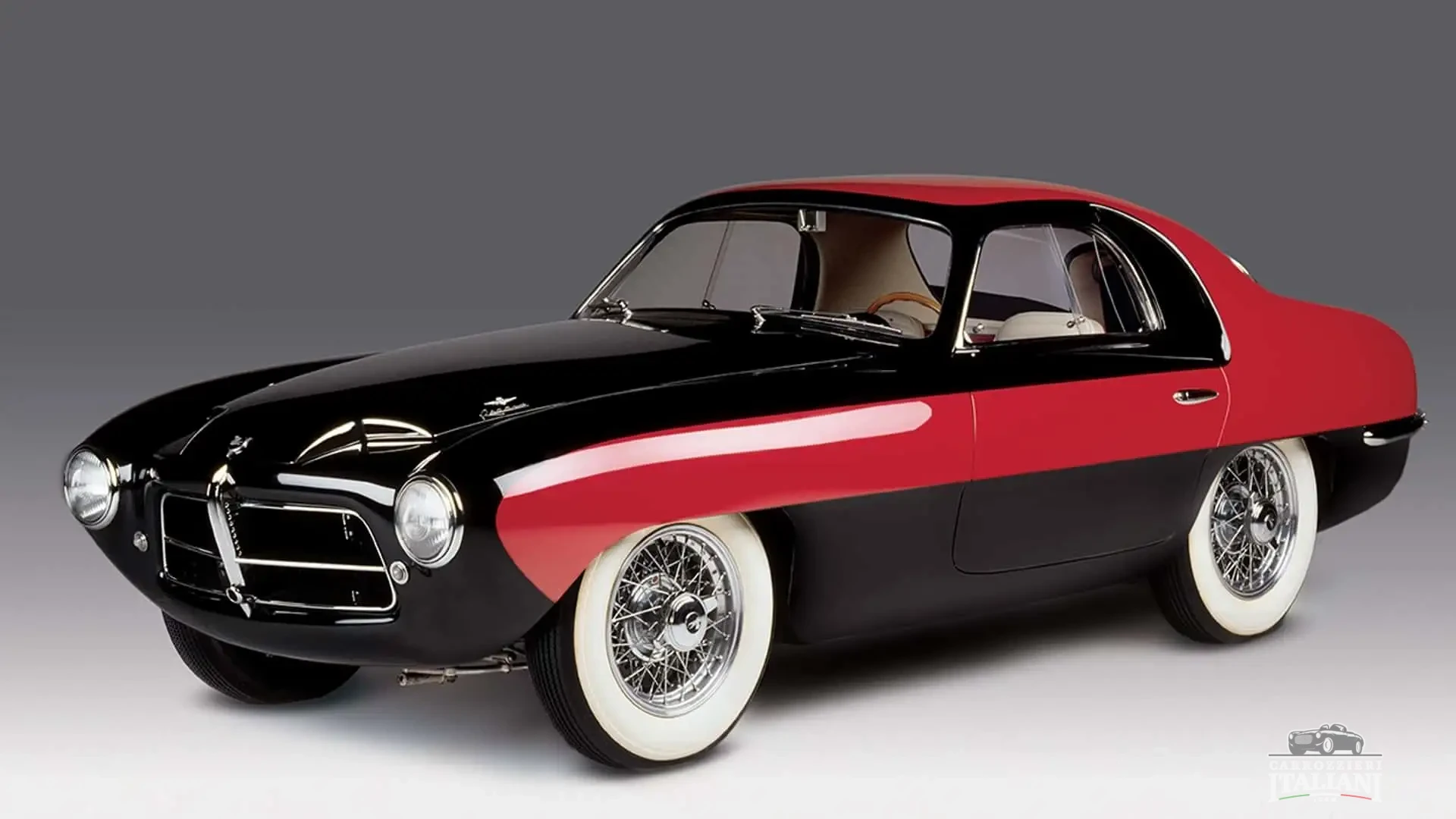
The difference between the chassis number and the Touring body number becomes particularly useful when a car has later alterations. The opening of wheel arches, a revised shift gate or the rebuilding of an aluminium panel cannot alone show that the car was replaced. Nor can a paint change demonstrate that an entirely new example was made. The Thrill remains a one-off, while its individual components and presentation changed over its long life. The surviving reports do not supply every intermediate workshop invoice, so any absolute claim that every installed part today is the one delivered in 1953 would exceed what the evidence establishes.
Published dimensional figures also require care. One technical compilation lists a wheelbase of 2,340 mm, a 2,815 cc engine and 990 kg weight; the March 2017 magazine technical summary lists approximately 2,816 cc and 1,270 kg. Both are reported figures, not two different chassis. The weight discrepancy in particular could reflect different definitions, equipment or source errors; the available reports do not decide which. A published claimed maximum speed around 225 km/h similarly should not be mistaken for an independently verified speed test of this actual surviving body in its original configuration. It is better to preserve these distinctions than make an elegant but inaccurate specification table.
Huarte, Creus and a car actually driven
The familiar story that Francisco Franco ordered the Thrill as a present for Eva Perón has a problem more serious than its absence from a confirmed purchase invoice: Eva died on 26 July 1952, months before the car’s 1953 debut. The anecdote appears in later retellings, but a contemporary commission record has not been produced. It is possible that stories about official Pegaso gifts, political patrons and other Touring-bodied cars were later mixed together. Until documents surface, the Franco–Evita story belongs among the unresolved and chronologically suspect legends surrounding the car, not in its ownership chain.
A much firmer sequence begins in 1954 with Félix Huarte Goñi, the Navarrese building contractor whose business had strong links to the large works of Franco’s government. The Thrill carried Spanish registration NA-7445. Historical reporting says Huarte’s wife took the red-and-black car to a San Sebastián concours and won an award. Her event entry and the exact prize designation would benefit from an original programme, but the registration and Huarte’s ownership are supported by specialist records. Political connections surrounding a buyer are not proof that the head of state personally acquired, commissioned or bestowed the automobile.
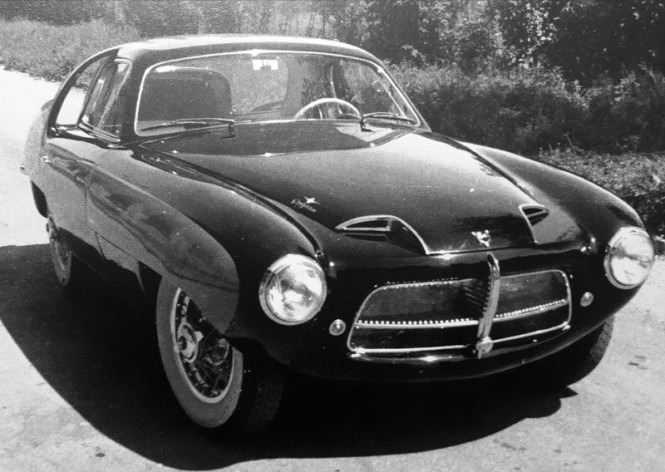
The next owner, Antonio Creus, gives the Thrill a life beyond the show catalogue. Creus was a competition-minded Spanish driver who had used several Pegasos and spoke about them with specific mechanical affection. In an interview later carried in the specialist press, he recalled journeys across Europe, his experience of other Z-102s in competition and the demands of the cars’ brakes and suspensions. Of this one, he remembered at least 100,000 kilometres, not a few restrained outings to concours lawns. His recollection is testimony given years after the events rather than an odometer-certified log, but it changes the scale of the story. An expensive and conspicuous one-off was also transportation.
By the end of the 1950s, according to the reconstructed sequence, Creus sold the car to Demetrio del Val. Its subsequent route led away from Spain and, in or around 1961, into the world of Californian collector Bill Miller. Miller was fascinated by Pegaso; his enthusiasm would eventually extend to an unrealized personal design project connected with Vignale and Giovanni Michelotti. The Thrill therefore passed between enthusiasts who were attracted not only by its appearance but by the singular engineering and workshop culture behind it. The essential order of owners is reasonably established; the precise transfer date for every step awaits registration and transaction paperwork.
California changes, California rescue
Miller’s Horse and Buggy ranch in California was hardly the setting imagined for a Touring salon prototype in 1953. The car’s appearance and mechanisms altered during its American years. Specialist accounts record larger 15-inch wheels requiring changes to the arches, and work to rearrange the unconventional Pegaso shift pattern. Some retellings describe these as attempts to make the car easier to use; others document them simply as changes. An owner has every reason to adapt a machine to local driving conditions, but modifications can confuse the apparent originality of a later auction exhibit.
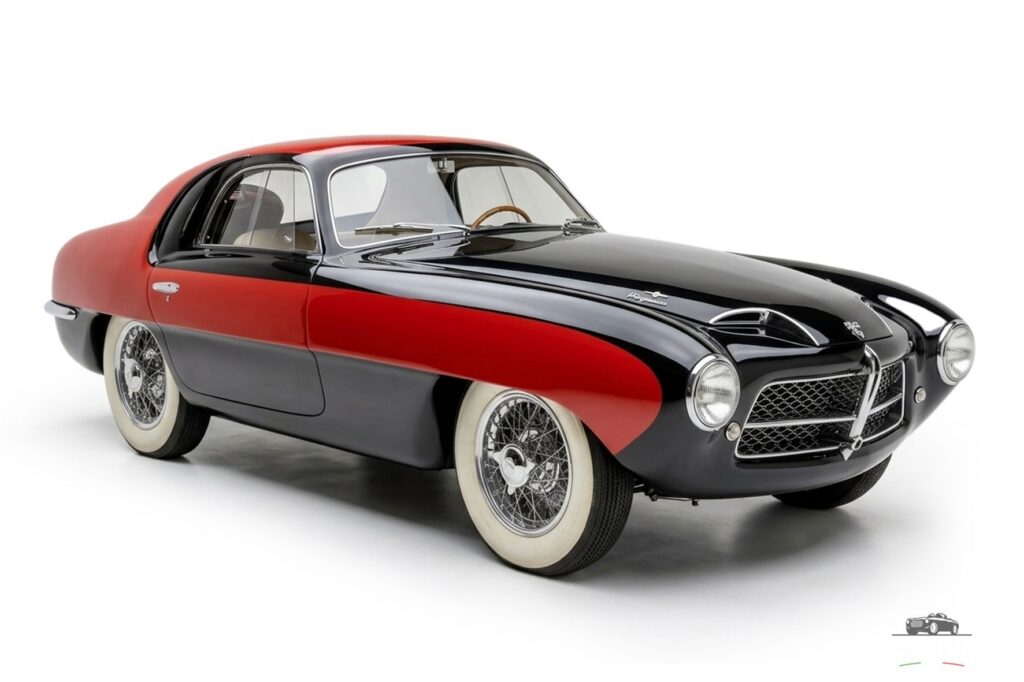
The next transaction contains a genuine date discrepancy. A history published in Automobilismo d’Epoca places a Christie’s sale in Los Angeles in 1979, when Wasken Manasian acquired the Pegaso with a lot of engines and original components. Raffi Minasian, recounting the episode from his own family’s experience, dates the purchase to 1978 and describes a $50,000 winning bid after Miller had sought a $48,000 reserve. The difference cannot be resolved by quietly selecting whichever year appears in more websites. A Christie’s catalogue and invoice would settle it. Until then, the safest statement is that the Manasian family bought the Thrill at a Los Angeles auction in the late 1970s.
Raffi’s account is valuable precisely because it comes from somebody who knew the car before its modern reconstruction. He remembered his father Wasken’s enthusiasm and the negotiations with Miller, and later became closely involved with the Pegaso after Wasken’s death. The restoration programme, associated in published accounts with Stephen Block, sought to return the Thrill toward its early configuration, including correcting modifications accrued in California. Such work is part of the car’s provenance, not an inconvenience to be omitted from a supposedly uninterrupted original condition. A restored body may be historically faithful without every inch of its metal retaining the form in which it left Milan.
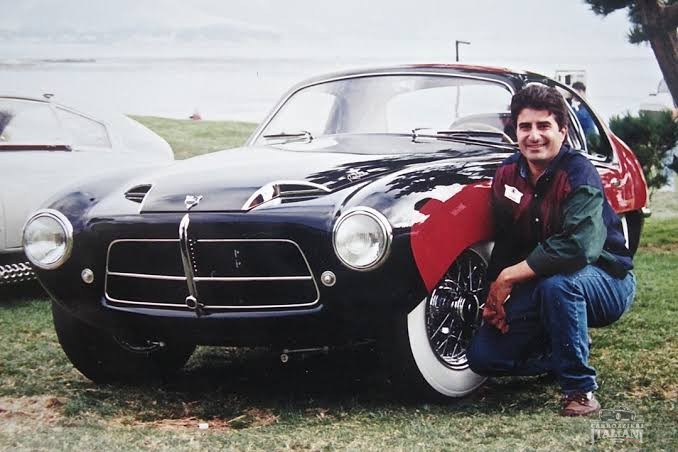
The restored Pegaso appeared at the 1994 Pebble Beach Concours d’Elegance in the company of other rare Z-102s. One firsthand retrospective reports a class award, while more general histories emphasize its participation in the gathering; the exact classification should be checked against the official Pebble Beach results before adding an unquestioned best-in-class field. The car was sold in 1995 and returned to Europe. Later public appearances, including those associated with the Touring revival, testify to its continuing visibility, but successive private European holdings require a separate dated chain of deeds rather than inference from photographs.
The other Pegasos, and the unanswered questions
There was never a production series of the Thrill with its complete red-and-black flying-buttress body. There were, however, related Pegasos shaped by Italian firms, including the more conventional Touring berlinettas, open cars and coachwork created outside Milan. Each offered a different answer to the same fundamental issue: how to dress Ricart’s expensive, fast and intricate Spanish chassis for customers who expected something distinguished. The Thrill departed from the road-car formula, and the quieter examples reveal how far its designers were prepared to go when commercial restraint was temporarily lifted.
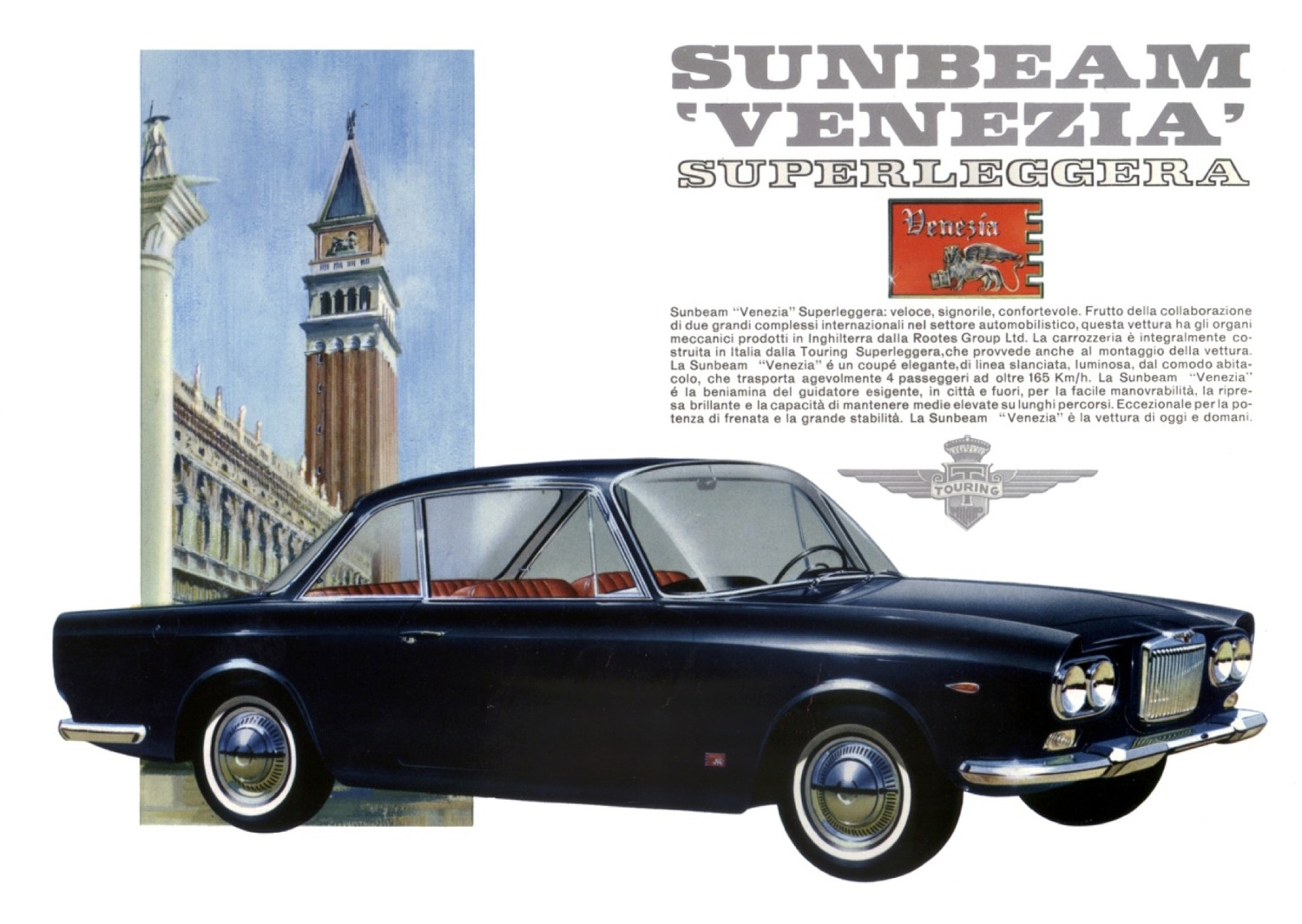
Touring’s later work would be remembered through better-known clients, from the Aston Martin DB4 to production-bodied grand tourers such as the Sunbeam Venezia that reached far more customers. Formenti’s career also extended beyond the shuttering of Touring, into Alfa Romeo’s design organization and the technical work behind racing and road bodies. That later history makes the Pegaso more, not less, interesting. Here was a car in which a director, a stylist, a project chief, a body shop and a Spanish engineering department can all be seen distinctly, before public memory compressed their work into one famous coachbuilder’s badge.
The strongest unanswered questions are concrete ones. Where are the ENASA orders and any surviving Touring job sheets describing the original colour decisions? What precisely did the 1953 Stresa jury award, and how did the results relate to the other cars credited with an honour of similar wording? Can the family’s planned Spanish joint venture be traced to signed agreements rather than a preparatory design for a badge? Can the original Christie’s catalogue settle the 1978–79 auction date, and can the engine and coachwork numbers be checked directly against the vehicle? The answers could refine an already substantial history without altering the identity of the red-and-black machine that missed New York and arrived in Turin instead.

ABOUT THE AUTHOR
Andreas Scheidl
Italian classic car enthusiast with German roots. Renowned as a respected figure in the classic car community, he serves as a jury member at various international concours d'elegance, including the Classic Gala Schwetzingen and Mantova. As a content creator, Andreas passionately shares his profound knowledge and appreciation for vintage automobiles. His heart beats for cars designed by Giovanni Michelotti, showcasing his discerning taste and dedication to preserving the timeless elegance of automotive history.
More stories by Andreas Scheidl ↗CONTINUE READING
Posts You Might Like
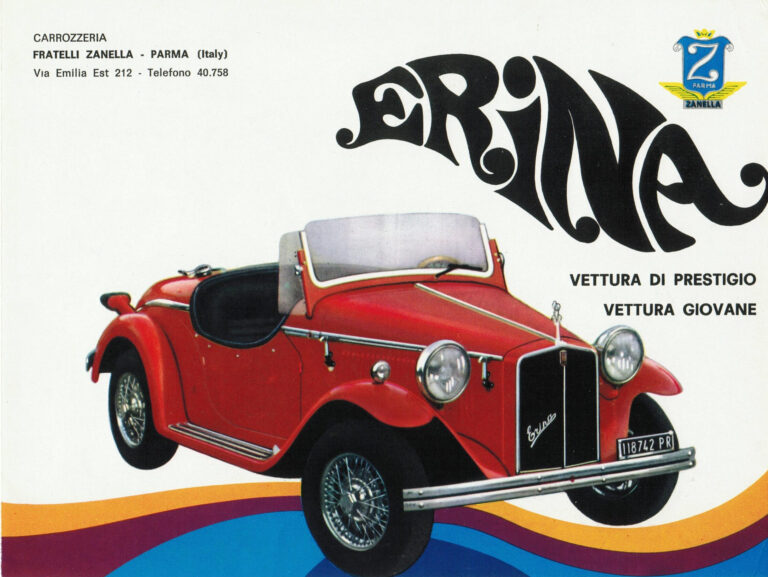
The Fiat 500 Erina and the Zanella Brothers Who Built It
The Zanella brothers turned the Fiat 500 F into a two-seat roadster in Parma. Trace the Erina’s Turin show debut and the mystery of how many were built.
Read story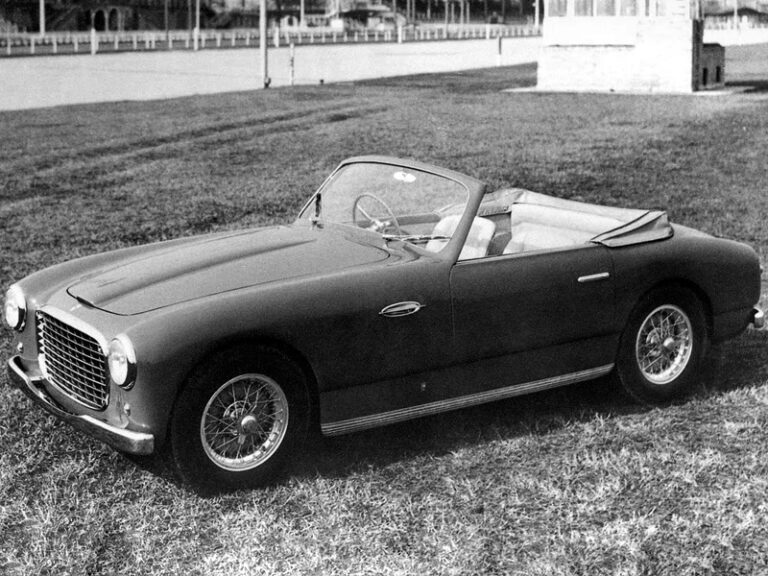
Blue in Turin, Red-Brown in Germany: The Long Life of Bertone’s Ferrari 166 Inter
One Ferrari chassis, one Bertone cabriolet, and a history divided between the show stands of postwar Italy, German classified advertisements and rival design attributions. A blue Ferrari among the saloon cars The…
Read story
Abarth 1500 Biposto: Why Packard Gave It Away
A Letter from Detroit On 10 July 1953, James J. Nance, president of the Packard Motor Car Company, wrote to Richard Austin…
Read story
Alfa Romeo Canguro: Giugiaro’s Lost Bertone Coupé and the Long Road Back
Built on a Giulia TZ racing chassis, Bertone’s extraordinary 1964 one-off was wrecked at Monza, left to deteriorate and finally restored four decades later. Its story is as remarkable as its shape.…
Read story
THE CONVERSATION
Comments 0
Share a memory, a period photograph or a documented detail about this story.