
Emanuele Bomboi
AT A GLANCE
- Born
- 1975
- Birthplace
- Rome
- Nationality
- Italian
- Occupation
- Automotive designer and design director
- Active from
- 1990s
- Based in
- Turin / Piedmont, Italy
THE STORY
Overview
Emanuele Bomboi (born in Rome in 1975) is an Italian automotive designer whose professional work has included the Fiat Group, Stile Bertone, the revived Viotti organisation and ATS. His principal documented design credits encompass the Fiat Bravo programme, the 2014 Willys AW 380 Berlineta, the ATS GT and the Giannini 350GP4. His work spans industrial-scale passenger-car development and low-volume sports-car programmes. Design responsibility, business leadership and the manufacture of each vehicle are distinct roles.
Education and Fiat Group
Bomboi moved from Rome to Turin in 1996 to pursue an automotive design career. He studied transportation design at the Istituto Europeo di Design in Turin before working for approximately ten years within Fiat Auto’s design organisation. The contemporary Stile Bertone announcement of 20 April 2009 identifies him as a chief designer responsible for a group reporting to Fiat design vice-president Lorenzo Ramaciotti. It records contributions to programmes for Fiat and other Fiat Group brands, alongside work connected with Iveco, joint ventures involving PSA and operations in Brazil. These organisational responsibilities do not establish sole personal authorship of every model developed by those brands.
His best-documented production-car contribution from this period is the Fiat Bravo, introduced as a production model in 2007. Stile Bertone specifically described him in its 2009 corporate announcement as directly responsible for the programme’s design work. Other contemporary career summaries associate Bomboi with the Abarth S2000 rally-car programme. Those accounts place him within the broader Fiat design organisation, whose model development involved multiple stylists, engineers and senior managers. The design of an entire model line should not be reduced to an individual’s credit without project-specific documentation.
Stile Bertone
After his Fiat career, Bomboi joined Stile Bertone at Caprie, near Turin. On 20 April 2009 the company publicly identified him as Chief Designer, within a design team headed by Design Director Jason Castriota. This contemporary document establishes his title and the chain of responsibility at that date more precisely than later summaries which describe him more generally as deputy director of the styling centre. Stile Bertone also noted that he and Castriota had collaborated on research projects during their careers and that Bomboi was working on projects for emerging Chinese manufacturers.
The distinction between studio employment and personal design authorship is important in this period. The 2009 Bertone Mantide, for example, was designed by Jason Castriota, although Bomboi belonged to the contemporary Stile Bertone team. The company’s subsequent concepts and client programmes involved multiple designers and changes in management. Their existence cannot by itself establish that Bomboi was the individual author of each project.
Viotti, Maggiora and the Willys AW 380
Bomboi subsequently worked with the modern revival of the Viotti name and Maggiora on specialist automotive projects. This revived business identity must be distinguished from the historical Carrozzeria Viotti, founded in the early twentieth century and closed during the 1960s. The modern partnership sought to develop bespoke and small-series sports cars rather than simply resume the continuous operation of the original coachbuilding concern.
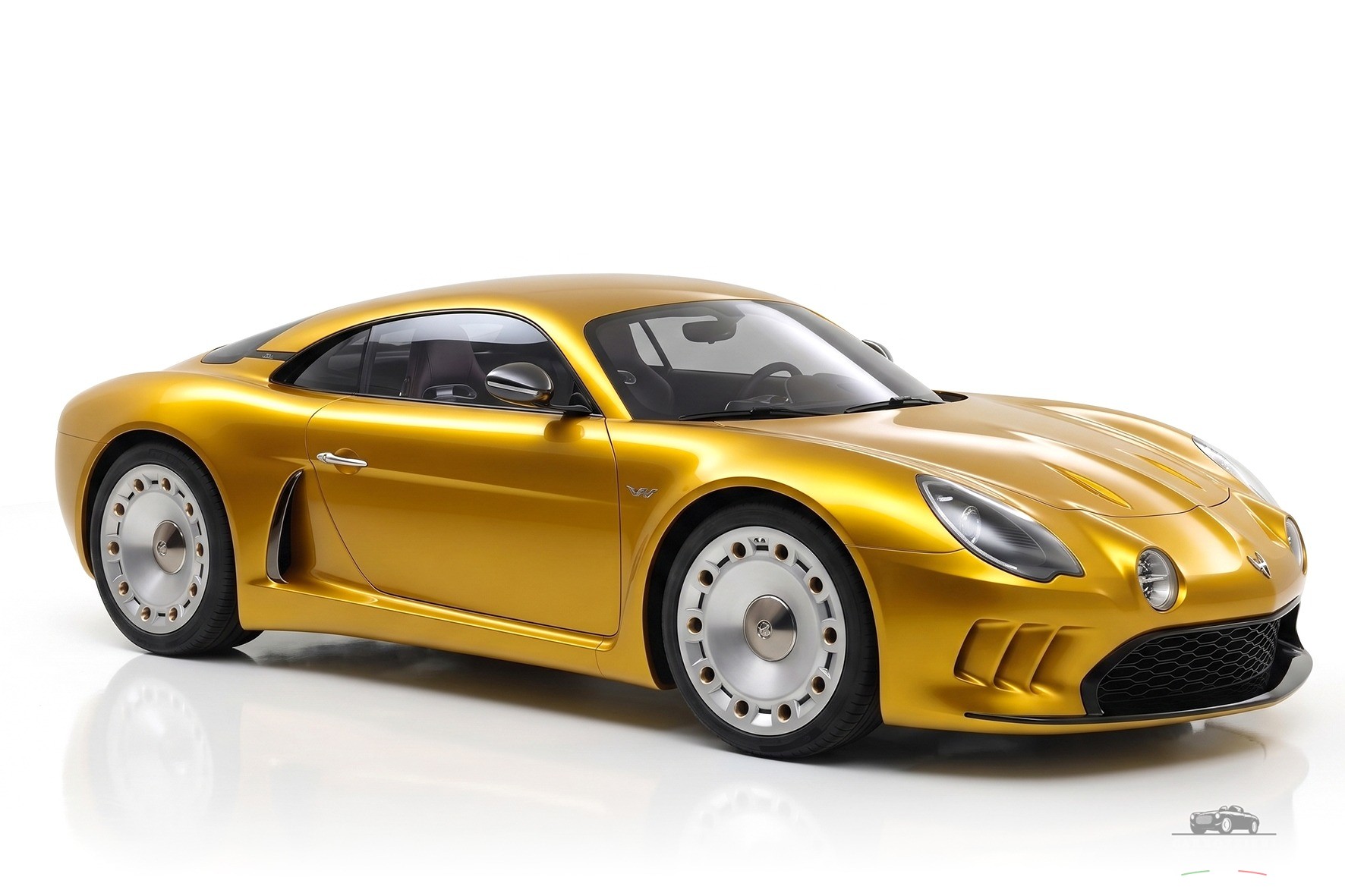
His most securely documented work in this phase is the Willys AW 380 Berlineta, introduced at the 2014 Bologna Motor Show. Contemporary ANSA reporting specifically credits its exterior design to Bomboi and identifies the contribution of Viotti and Maggiora. The prototype recalled the Willys Interlagos, the Brazilian-built sports car descended from the Alpine A108 family, without representing a continuation of that vehicle’s original production programme. Its bodywork and engineering specifications were announced as part of a modern sports-car project.
At the Bologna presentation the promoters proposed a series of 110 vehicles, an initial price of €380,000 and production beginning in 2015. These were launch plans, not evidence that 110 cars were manufactured or sold. Subsequent historical research treats the project as a prototype and does not substantiate production of the announced series. The body of the AW 380 and its identity as a specific prototype must not be confused with subsequent ATS cars or with the original Brazilian Willys Interlagos.
ATS and the development of the ATS GT
Bomboi became involved in the renewed ATS (Automobili Turismo e Sport) project with entrepreneur Daniele Maritan. The modern business drew historical inspiration from the original ATS of the early 1960s but was a separate later initiative. Contemporary accounts trace the association between Maritan and Bomboi to their encounter around the 2014 Bologna Motor Show, where the Willys prototype was exhibited. Bomboi’s participation in the later ATS organisation is documented by the 2017 presentation of the ATS GT and by subsequent manufacturer-focused accounts.
The ATS GT, presented in 2017, was designed by Bomboi as a modern mid-engined grand touring coupé recalling the historical ATS 2500 GT. The later car used a carbon-fibre architecture derived from the McLaren 650S platform rather than a surviving chassis of the 1960s ATS. Its exterior combined sculpted side surfaces, restrained roof proportions and details inspired by the earlier Italian GT tradition. The development of the finished vehicle depended on a separate team of engineers and manufacturing specialists. Early announcements envisaged twelve examples; a December 2021 account reported four vehicles built. These dates and quantities describe the modern ATS GT programme and cannot be transferred to either the 1960s ATS or the Willys AW 380.
Bomboi was also associated with the ATS Corsa RR Turbo, a lightweight track-oriented car introduced later in the renewed ATS programme. Contemporary reporting credits him with its exterior design while naming Andrea Tosetti as responsible for the engineering and mechanical development of the racing version. The RR Turbo is a distinct vehicle and technical programme rather than a body variation of a particular ATS GT chassis. Manufacturer specifications and production claims for either car require their own model-specific records.
Giannini 350GP and 350GP4
The revived Giannini name provided another setting for Bomboi’s work in specialist small-series automotive design. The Giannini 350GP was a substantially modified compact sports-car programme developed with GRAM Torino Engineering. A subsequent four-wheel-drive, four-seat evolution was identified as the 350GP4. A GRAM press release issued for the 2019 Parco Valentino event explicitly credits the 350GP4’s design to Emanuele Bomboi. The technical and mechanical development remained the responsibility of the engineering team. This contemporary attribution supports the designer credit without treating Bomboi as the manufacturer or engineer of every component.
Additional career summaries associate him with concepts such as the Stanguellini Anita and a Ferrari FF study. Such mentions require individual project records and documentation of the exact scope of Bomboi’s participation before they can be turned into confirmed design credits or new structured vehicle relationships.
Teaching, design practice and attribution
Career biographies published during the ATS GT period record Bomboi’s involvement with transportation-design education in Turin, including coordination of a master’s programme at IED. His professional record is characterised by movement between high-volume industrial design, design consultancy and modern specialist manufacturers. Work with major manufacturers did not necessarily imply that those manufacturers commissioned or built every subsequent independent concept associated with his name.
His individual contributions are particularly well documented by the April 2009 Stile Bertone announcement, contemporary reports of the 2014 Willys presentation, the 2017 ATS GT launch and the 2019 GRAM Giannini 350GP4 press release. Those documents establish distinct dates, project responsibilities and organisations. Attribution must retain the separation between the design of a model, its engineering, coachbuilding, industrial production and subsequent commercial plans.
THE NETWORK
Shared vehicle credits

CONTINUE EXPLORING

THE CONVERSATION
Comments 0