
Giovanni Michelotti
Giovanni Michelotti was a prolific Italian automotive designer whose independent Turin studio produced coachwork and production-car designs for Vignale, Triumph, BMW and numerous other manufacturers.
Explore record ↗
1970
THE VEHICLE AT A GLANCE
THE PEOPLE BEHIND THE CAR
Giovanni Michelotti was a prolific Italian automotive designer whose independent Turin studio produced coachwork and production-car designs for Vignale, Triumph, BMW and numerous other manufacturers.
Explore record ↗Founded in Turin by Giovanni Michelotti, Studio Michelotti developed original automotive styling, full-scale models and prototypes for international manufacturers and specialist coachbuilders.
Explore record ↗01 / THE STORY
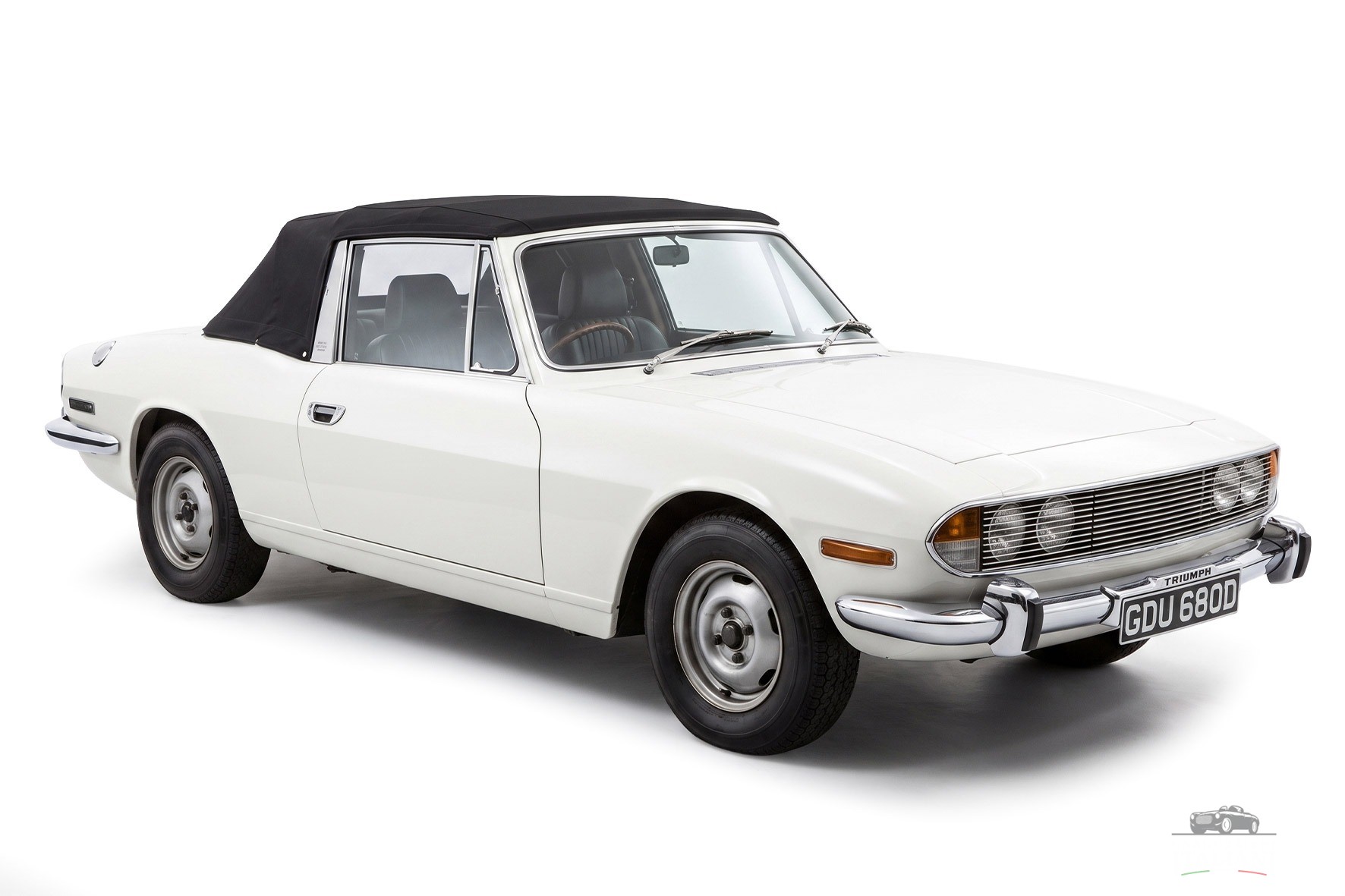
The Triumph Stag is a four-seat British grand touring convertible produced by Standard-Triumph from 1970 to 1977. Its body was styled by Giovanni Michelotti, whose work with Triumph extended across several production models and experimental projects. The Stag combined a two-door open body, a fixed T-shaped roof support and a Triumph-built 2,997 cc V8 engine. This record concerns the production Stag model, not a particular chassis or the original one-off styling prototype.
The project began in 1965 when Michelotti obtained a Triumph 2000 saloon from engineering director Harry Webster for an independent styling study. The donor had previously served Triumph’s competition programme, including support work associated with the 1965 Le Mans Spitfires. At Studio Michelotti in Turin, the saloon’s floorpan was shortened and transformed into a two-door convertible while retaining elements of its running gear. The proposed show car was intended for Geneva in 1966, subject to Triumph’s first refusal of the design. Webster and the company’s directors approved the completed study, and it returned to Coventry in the summer of 1966 for evaluation and development rather than appearing on Michelotti’s stand.
The original styling study had neither the final production engine nor the characteristic roof structure of the later car. It is therefore important to distinguish its straight-six Triumph 2000 mechanical basis from the Stag launched in 1970. The subsequent Triumph TR5 Ginevra was a separate Michelotti prototype shown in 1968, not an alternative designation for the production Stag. The name Stag, initially an internal project code, was retained for the production car.
The production body preserved Michelotti’s low bonnet line, long horizontal front grille and restrained two-door proportions, but required substantial engineering revisions. Triumph incorporated a permanent T-shaped roll-over and roof support structure to increase body stiffness and reduce vibration in the open passenger compartment. A folding fabric hood was used, while a detachable hardtop could also be specified. The cabin accommodated four people, distinguishing the model from Triumph’s smaller two-seat TR roadsters.
Production coachwork was built, painted and trimmed at Triumph’s Speke plant in Liverpool, with final vehicle assembly at Canley, Coventry. These manufacturing arrangements should not be confused with Michelotti’s construction of the earlier styling prototype. The production design also influenced the front and rear styling of the revised Triumph 2000 and 2500 saloons launched before the Stag itself.
The production Stag used a front-mounted, water-cooled 90-degree V8 developed by Triumph, with a displacement of 2,997 cc, a single overhead camshaft on each cylinder bank, a cast-iron block and aluminium cylinder heads. The standard British specification was rated at approximately 145 bhp. The engine used twin Zenith-Stromberg carburettors; compression ratios and carburettor details changed according to market and model year. Earlier engineering studies considered smaller capacities and alternative fuel systems, but those should not be presented as equipment fitted to every production car.
Power was delivered to the rear wheels through a four-speed manual gearbox, with Laycock overdrive available, or a Borg-Warner three-speed automatic transmission. The 2,540 mm wheelbase derived from the shortened Triumph 2000 platform. The car employed independent front strut suspension, rear semi-trailing arms, front disc brakes, rear drums and power-assisted rack-and-pinion steering. Published dimensions were approximately 4,420 mm long and 1,612 mm wide; the commonly cited 1,258 mm height refers to the hardtop configuration.
Early production cars are conventionally grouped as Mark I models. The Mark II revisions introduced for 1973 included changes to engine specification, trim and equipment. Later automatic cars used a different Borg-Warner transmission. Individual technical figures, particularly compression ratio, gearbox and fuel-tank capacity, therefore require the production year and market to be specified when attached to a particular chassis.
The Stag was introduced to the public in June 1970, although factory production had begun in late 1969. Production ended on 24 June 1977. Factory-derived annual figures published by Stag specialist organisations total 25,939 vehicles, of which 17,819 were allocated to the British market and 8,120 to export markets. A different total appears in some secondary references and should be assessed against the factory records rather than silently combined.
Stag production cars can be distinguished through their commission numbers and associated engine, body and gearbox identifiers. The LD prefix generally denotes non-Federal vehicles and LE identifies later United States Federal specification cars; neither prefix establishes the identity or provenance of the earlier Michelotti prototype. The development programme and subsequent production history are discussed in the related article on Michelotti’s collaboration with Triumph.
02 / TECHNICAL IDENTITY
03 / DESIGN, BODY & SUPPLIERS
Coachbuilder / Design studio
Founded in Turin by Giovanni Michelotti, Studio Michelotti developed original automotive styling, full-scale models and prototypes for international manufacturers and specialist coachbuilders.
Explore record ↗Designer
Giovanni Michelotti was a prolific Italian automotive designer whose independent Turin studio produced coachwork and production-car designs for Vignale, Triumph, BMW and numerous other manufacturers.
Explore record ↗Become a Pro member to see the full details in this section.
Membership is not available yet.
View membership options04 / CHRONOLOGY
07 / GALLERY
CONTINUE EXPLORING
CONTINUE READING
The history of Triumph in the 20th century is inseparable from the creative genius of Giovanni Michelotti, one of the most influential automotive designers of his time. Triumph, established as the sports…
Read story

THE CONVERSATION
Comments 0