Unveiled on Bertone’s stand at the Turin Motor Show on 28 October 1970, the Lancia Strato’s Zero was a fully operational one-off created to explore how far the proportions of a sports car could be reduced. Marcello Gandini developed the design for Carrozzeria Bertone, which undertook the construction independently of a conventional production-car programme. The exceptionally low, uninterrupted wedge, the narrow bands of lamps and the steeply inclined windscreen made the Zero an uncompromising study in geometry rather than a proposal for a practical series-built coupé. Its body was originally finished in metallic bronze, a colour later reinstated during restoration.
The Zero was not merely a static styling model. The surviving prototype, chassis C/1160 with engine number 818540 2126, combined a purpose-built Bertone chassis with mechanical components from a Lancia Fulvia HF. Its mid-mounted 1,584 cc narrow-angle V4, fed by two twin-choke Solex carburettors, was rated at 115 bhp in the 2011 auction catalogue and drove the rear wheels through a five-speed gearbox. The wheelbase measured 2,220 mm, while the body rose to approximately 84 centimetres. Independent suspension and four-wheel disc brakes were adapted to this unusual layout. The occupants entered through the forward-opening windscreen; the steering column moved to ease access to a cockpit with nearly reclining seats and an instrument display offset towards the driver.
The car’s importance went beyond its radical appearance. By demonstrating Bertone’s engineering and design ambitions to Lancia, the Zero helped establish the collaboration that produced the distinct Lancia Stratos HF prototype of 1971 and, eventually, the rally and road cars. The later Stratos did not use the Zero’s chassis or Fulvia V4 engine. In the wider evolution of Gandini’s work, the Zero can also be considered alongside Bertone’s earlier Autobianchi Runabout, another independent experiment in low, sharply defined forms. Their historical relationship is one of design exploration, not shared identity.
The Zero remained in the Bertone collection for decades. Stile Bertone restored it in 2000, returning the body to its original bronze appearance after an intervening silver finish. On 21 May 2011 it was sold by RM Auctions at Villa d’Este for €761,600; the sale catalogue identifies the actual chassis and engine numbers, making this a documented transaction for the prototype rather than a market estimate for later Stratos models. Entered by collector Phillip Sarofim at the 2024 Pebble Beach Concours d’Elegance, the Zero won its early wedge-concept class and the Gran Turismo Trophy, and was selected among the four finalists for Best of Show. It did not receive the overall Best of Show award.

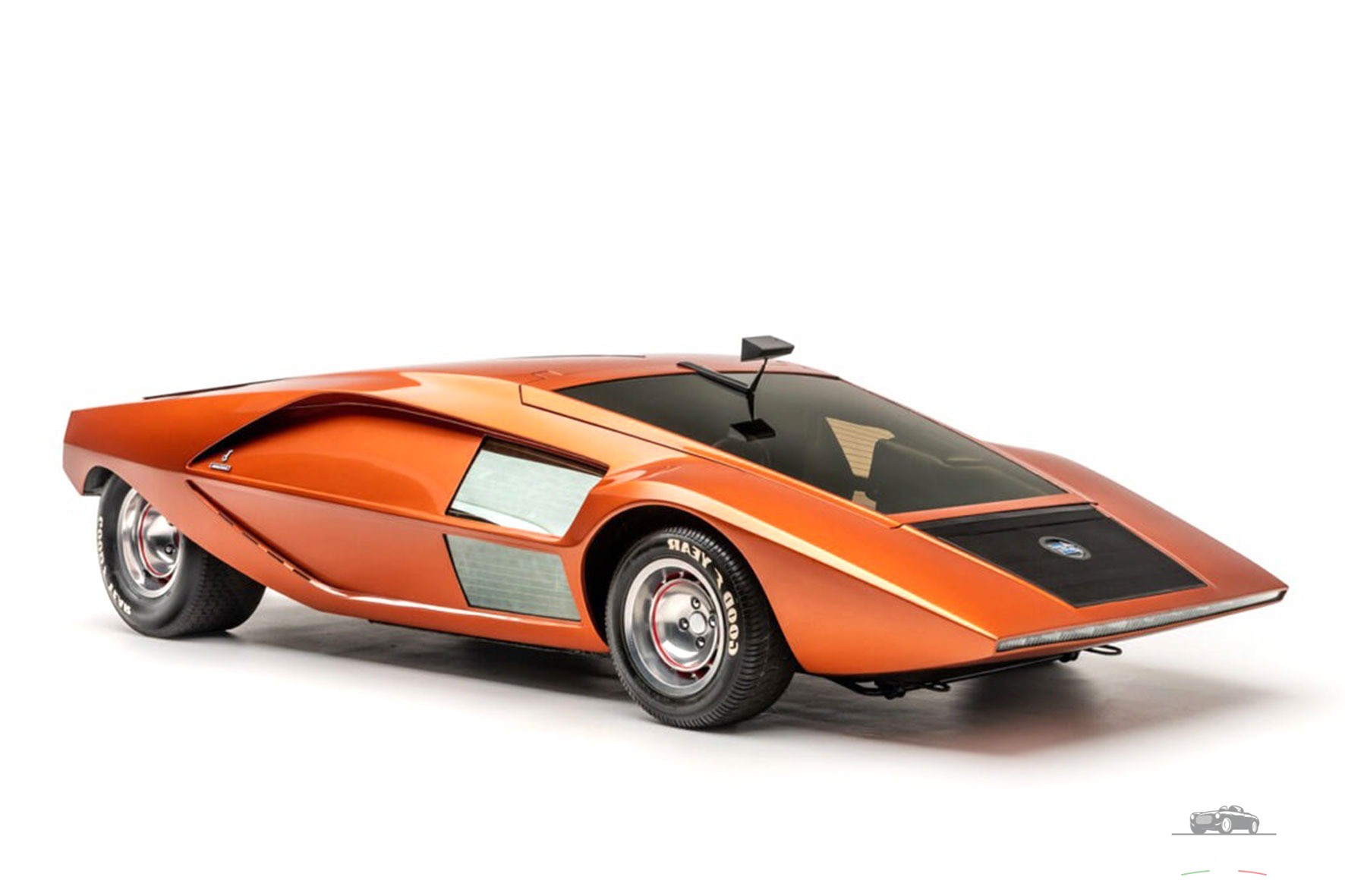


The windscreen as an entry point is the idea that makes the Zero memorable. I am less convinced by it as a way into a car you would actually want to use every day.
That is exactly why it works for me as a concept. Once normal doors come back, the low wedge loses some of the logic that makes it so striking.