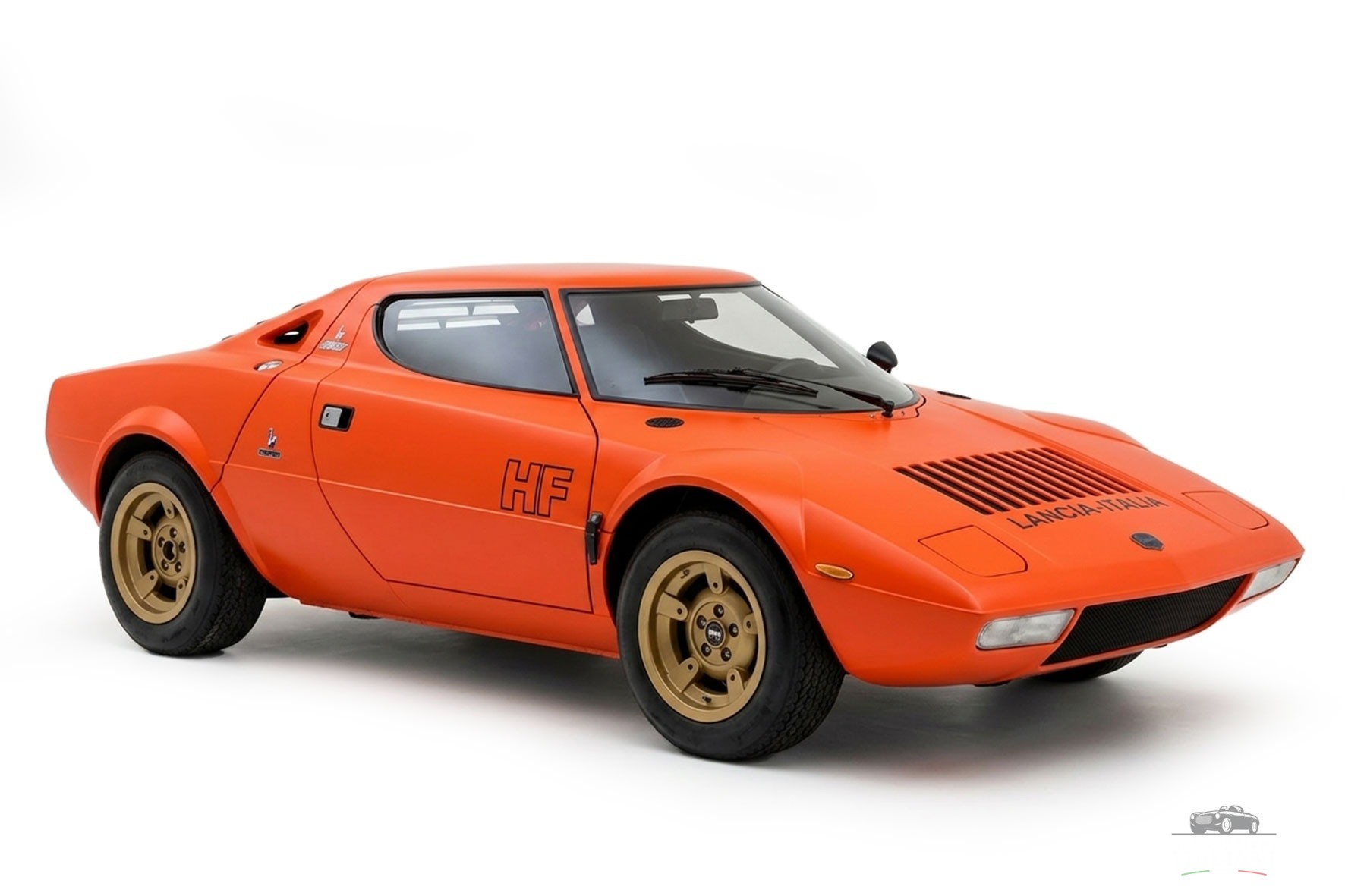
The Lancia Stratos HF prototype shown on Bertone’s stand at the 1971 Turin Motor Show marked the transformation of a radical styling experiment into a purposeful rally-car programme. A year earlier, Marcello Gandini’s Strato’s Zero had astonished visitors with its extremely low wedge-shaped body and Fulvia-derived mechanical layout. The new Stratos HF retained the experimental spirit but adopted an entirely different, more practical form, developed through cooperation between Bertone and Lancia’s competition department. Specialist documentation identifies the fluorescent-red 1971 show prototype as chassis 1240; it should not be confused with the earlier Zero, chassis C/1160, or with the subsequent series-built Stratos.
Gandini’s two-seat berlinetta was shaped around rally use rather than conventional grand-touring expectations. Its broad, curved windscreen wrapped around the sides of the cockpit, while the short overhangs and opening front and rear body sections gave the car a compact, purposeful silhouette. A contemporary report in La Stampa described unusual practical details, including a sliding passenger seat, helmet storage within the doors, adjustable suspension and detachable wheel-arch extensions intended to accommodate different tyres. These were working design ideas for a competition machine, not merely decorative show-car features.
The engine fitted to the 1971 display car has sometimes been misreported. Gianni Tonti, Lancia’s later competition technical director and a participant in the programme, recalled that the Turin prototype carried a mid-mounted Ferrari Dino engine, even though the accompanying press material left open the possibility of a different engine for the definitive car. His chronology also records that negotiations over the supply of production Dino units continued into 1972. Specialist specifications for the 1971 prototype describe a transverse 2,418 cc Ferrari V6, a five-speed gearbox and rear-wheel drive, with a 2,160 mm wheelbase. Figures for output and body construction require care because development configurations and the later production model are frequently conflated.
The prototype established the visual and engineering direction of the production Lancia Stratos, but it remained a distinct physical car. The road-going and competition versions that followed were further developed for homologation and rally service, eventually delivering Lancia’s celebrated world championship successes. The 1971 prototype is therefore best understood as the pivotal intermediate stage between Bertone’s 1970 design provocation and the competition car that entered production, rather than as a standard Stratos Stradale or a car with an independently documented competition record.



THE CONVERSATION
Comments 0