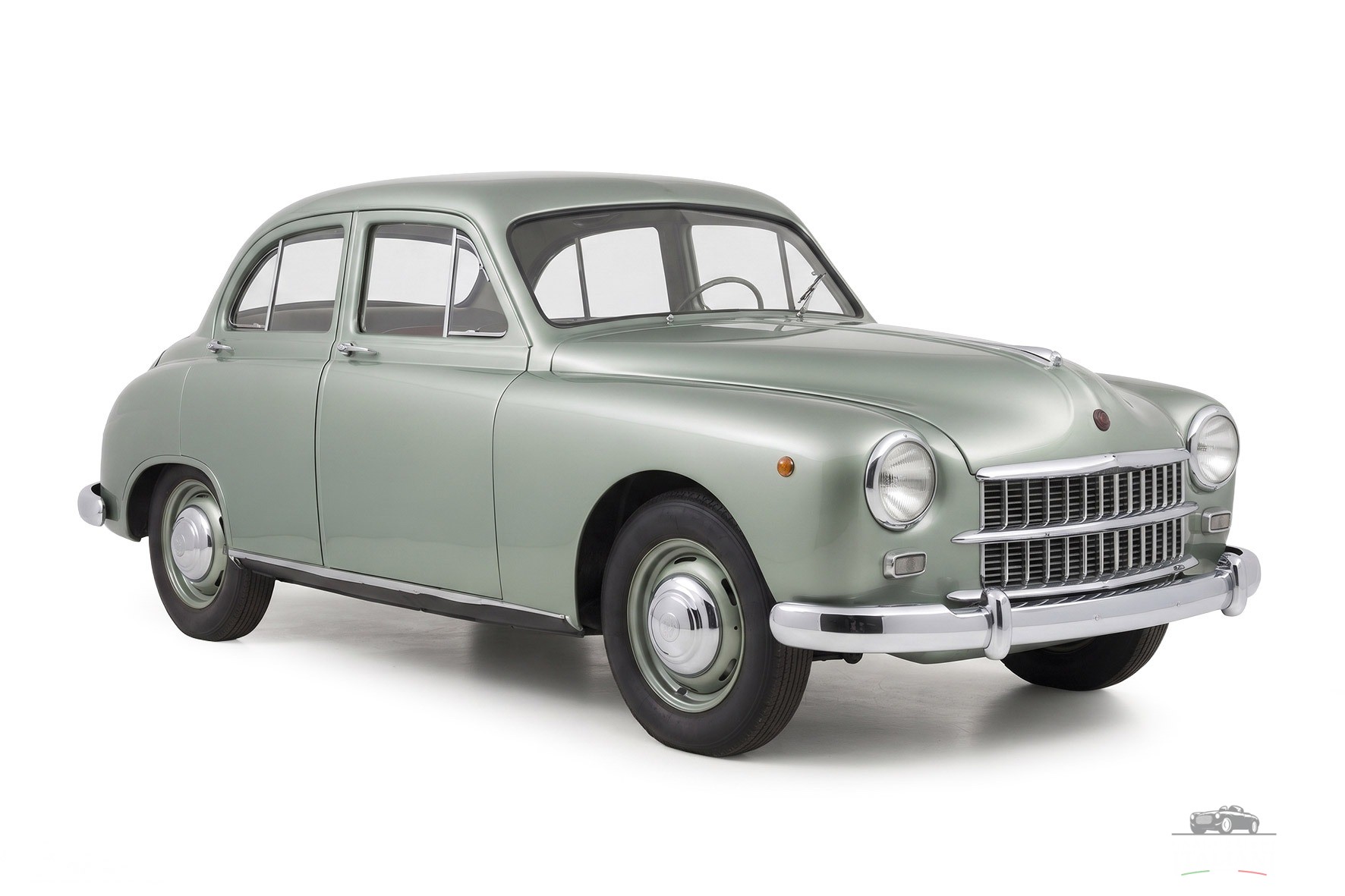
The CEMSA Caproni F11 was designed to enable Caproni Industries (active before and during World War II in aircraft construction) to enter the automotive market in the aftermath of the war. The F.11 featured innovative solutions (such as front-wheel drive) but, due to the company’s financial difficulties, could not be mass produced. It is considered the progenitor of the Lancia Flavia, which would bring the front-wheel-drive formula to success in the 1960s. Engineer Antonio Fessia had worked 20 years for Fiat, contributing to the design of cars such as the Balilla, 500 “Topolino” and 1100, before being hired by CEMSA in 1946. CEMSA, founded in 1925 by engineer Nicola Romeo and Credito Italiano as Costruzioni Elettro Meccaniche di Saronno, had been heavily affected by the economic crisis of 1929 and was then absorbed by Gianni Caproni’s Caproni in 1936, being converted to the production of war material and being renamed, in 1941, as Caproni Elettro Meccanica di Saronno; in the aftermath of World War II, the firm was forced to abandon the production of weapons and bullets in order to enter the civilian market. The CEMSA Caproni F11 (whose name was actually derived from Fessia) represented the Caproni group’s attempt to cope with the post-war crisis by exploring the automotive field, while other projects were pursued by the company in the motorcycle and civil aviation fields. This was a very innovative car, featuring front-wheel drive, a 4-cylinder boxer engine, a gearbox with a lever on the steering wheel, and independent-wheel front and rear suspension. The prototype mounted a 1 100-cfm engine capable of developing 40 hp at 4 400 rpm, although a 1 250-cfm engine with 46 hp at 4 400 rpm was planned for series production. The 4-door body was designed by Bertone. The F11, designed and built in the first specimens over the course of a few months, was unveiled at the 34th Paris Motor Show (Oct. 23-Nov. 5, 1947), attracting considerable interest from representatives of several nations. In particular, Preston Tucker’s U.S.-based Tucker Corporation made arrangements with Caproni to import about 1,000 examples to America; however, with Tucker’s bankruptcy in 1949, the initiative fell through. Caproni nevertheless began to invest in Fessia’s car, preparing its factories (including the one in Taliedo, which had long manufactured airplanes and was now to build the F11’s bodywork instead) for mass production. In 1948 the car was also presented at the Turin Motor Show, where it received significant praise. However, also in the course of the year 1949, the difficulties in which the Caproni group had found itself since the war period worsened and eventually resulted in the closure of CEMSA and the cancellation of the F11 program. The seven pre-series examples that had been built in the meantime were liquidated along with the company itself; one was acquired by the Belgian car manufacturer Minerva, which had also made arrangements to purchase the machinery and license to produce the F11 but, after exhibiting a prototype in 1953 at the 36th Brussels Motor Show (January 17-28, 1953) had not then materialized this hypothesis. Another example remained at Tucker, while two others remained in Italy: the first is currently exhibited at the aeronautical museum (closely linked to the history of the Caproni group) in Volandia; the second is exhibited in the Museo delle Industrie e del Lavoro del Saronnese, 5 examples overhauled by a Saronno workshop were sold to private individuals in the Saronno area with a second spare engine, they came out of Cemsa with wooden wheels and tires by the aforementioned workshop. In 1955 Antonio Fessia moved on to Lancia, where he was able to use the experience gained from the F11 project to make the Flavia, which from 1960 onward was among the first front-wheel-drive cars to enjoy commercial success.


THE CONVERSATION
Comments 0