Giovanni Michelotti
Giovanni Michelotti was a prolific Italian automotive designer whose independent Turin studio produced coachwork and production-car designs for Vignale, Triumph, BMW and numerous other manufacturers.
Explore record ↗
1962
THE VEHICLE AT A GLANCE
THE PEOPLE BEHIND THE CAR
Giovanni Michelotti was a prolific Italian automotive designer whose independent Turin studio produced coachwork and production-car designs for Vignale, Triumph, BMW and numerous other manufacturers.
Explore record ↗Founded in Turin by Giovanni Michelotti, Studio Michelotti developed original automotive styling, full-scale models and prototypes for international manufacturers and specialist coachbuilders.
Explore record ↗01 / THE STORY
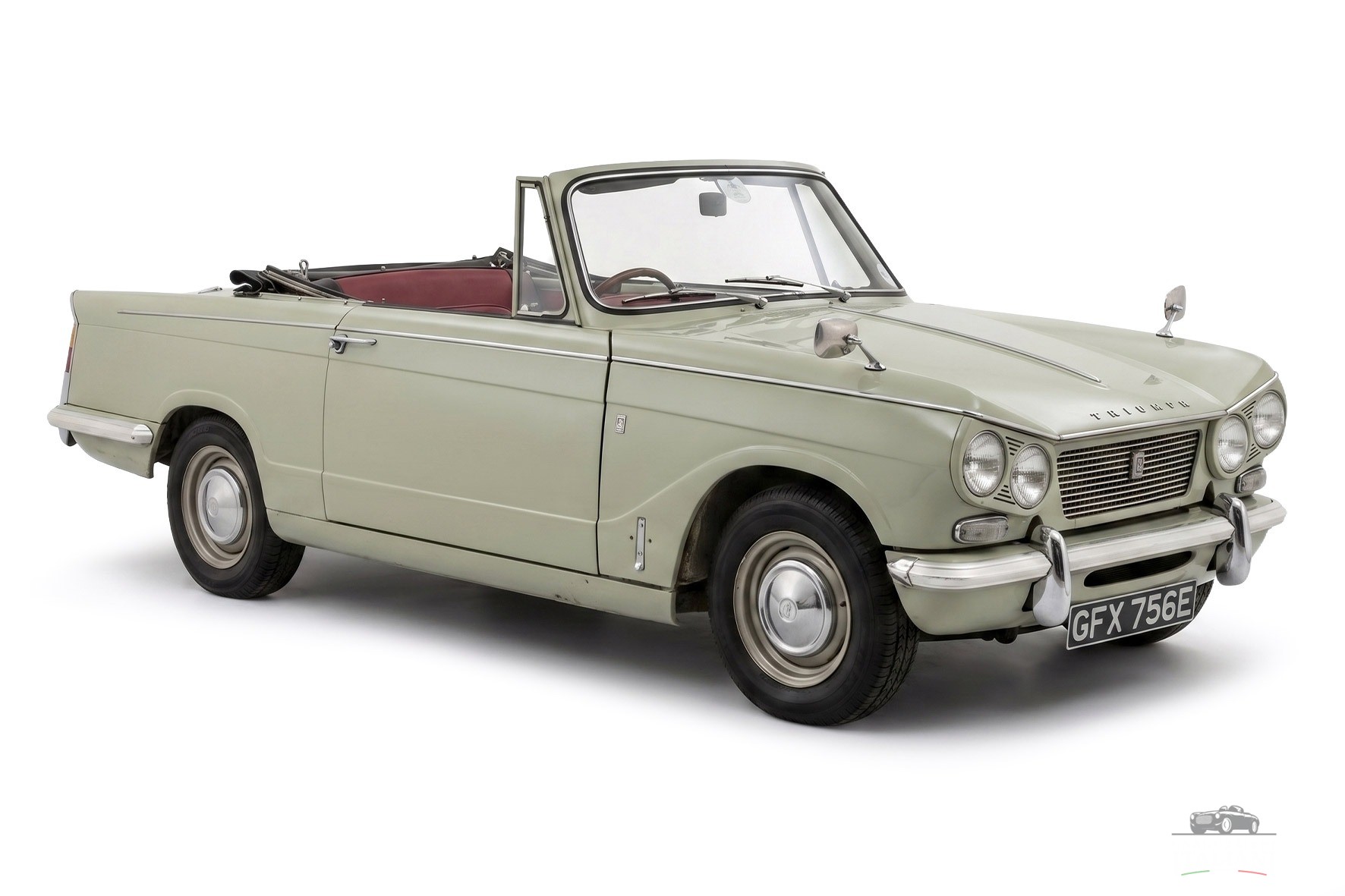
The Triumph Vitesse 1600 Convertible (1962–1966) was the four-seat, two-door open version of Standard-Triumph’s first six-cylinder Vitesse range. It combined the separate-chassis construction of the Triumph Herald with a longer six-cylinder engine and a revised front end designed by Giovanni Michelotti. Introduced in 1962 alongside the Vitesse Saloon, the convertible was a regular factory-production body style rather than an individually coachbuilt special. The series is also recorded in the production-car register of Studio Michelotti.
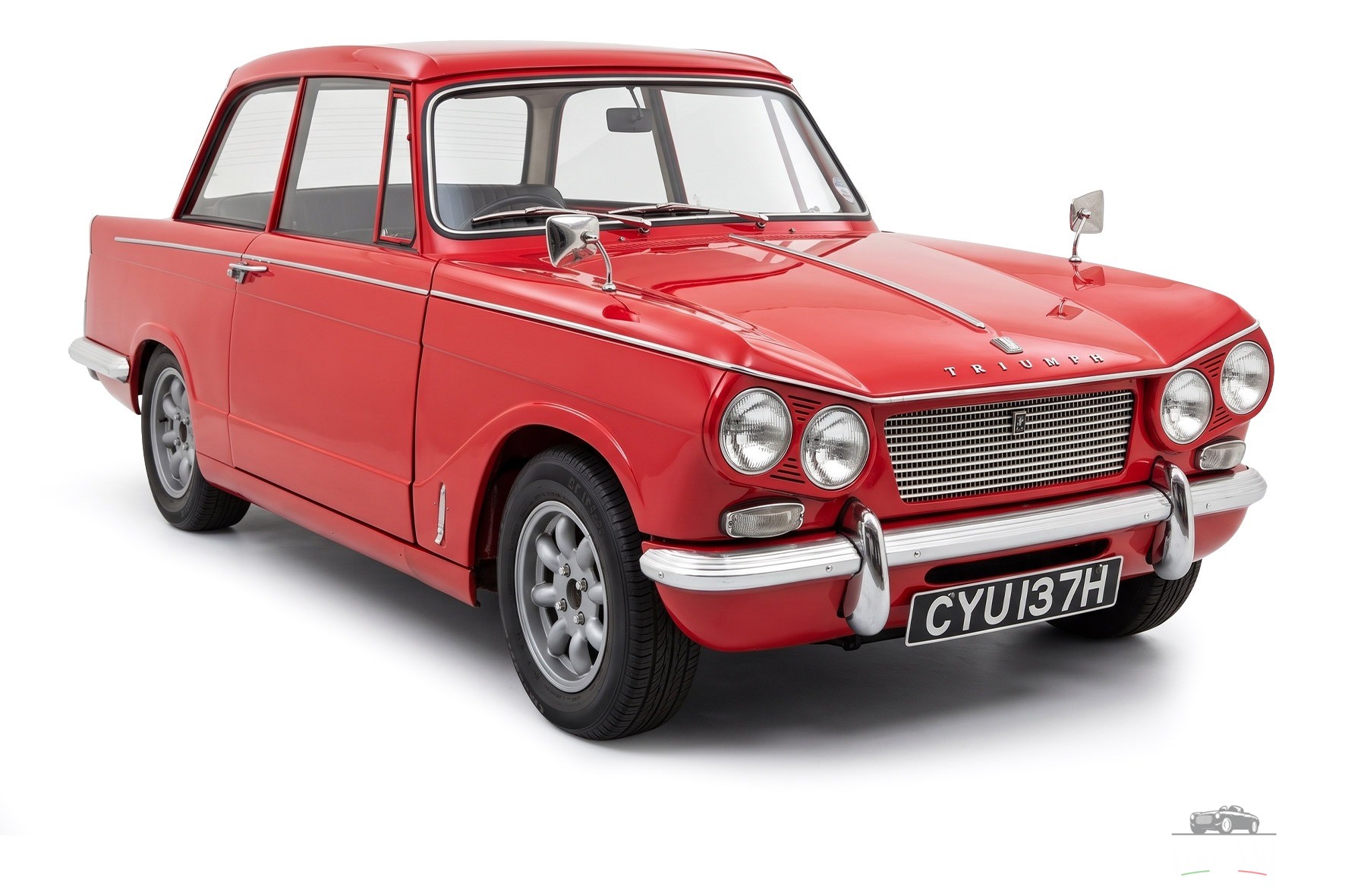
The Vitesse retained the Herald’s general body architecture but received a distinctive nose incorporating four headlamps mounted in two inclined pairs, together with a reshaped bonnet and grille. The elongated front accommodated the inline-six engine, while the convertible body retained two doors, a folding fabric hood and rear seats. Its basic construction consisted of a separate steel backbone-type chassis and steel body panels. The front assembly tipped forward to provide access to the engine and suspension, a characteristic inherited from the Herald family.
The open body was developed as a production companion to the saloon, not as a derivative of the separately recorded Michelotti Vitesse 1600 GT show car. Although the two body styles shared major mechanical components, their roof structures and body configurations were distinct. The relationship with the preceding Herald programme is examined in the history of the Triumph Herald.
The original Vitesse 6 used a longitudinal 1,596 cc six-cylinder engine with overhead valves and a bore and stroke of 66.75 × 76 mm. Early cars were fitted with twin Solex carburettors and were rated at approximately 70 bhp at 5,000 rpm. The adoption of twin Stromberg carburettors in the later 1600 production period brought a higher power rating, reported as 82 PS in the contemporary model specification. Accordingly, the original 70 bhp figure should not be taken as the output of every car built between 1962 and 1966.
Power was transmitted to the rear wheels through a four-speed manual gearbox. A Laycock de Normanville D-type overdrive was available as an option, operating on third and fourth gears. The independent front suspension used coil springs and wishbones; the rear had swing axles and a transverse leaf spring. Braking was by front discs and rear drums, with rack-and-pinion steering. These arrangements were developed from the Herald platform and reinforced or revised for the six-cylinder installation.
Published specifications for the Vitesse 1600 give a wheelbase of 2,325 mm, overall length of 3,885 mm, width of 1,525 mm and convertible height of about 1,335 mm with the hood raised. Figures quoted for weight, equipment and performance vary according to measurement convention and production date; they do not identify any particular surviving example.
Production references derived from Graham Robson’s Triumph records give 8,447 Vitesse 1600 convertibles built between 1962 and September 1966, including 679 cars marketed in the United States as the Sports 6. The contemporaneous Vitesse 1600 saloon accounted for 22,814 cars and is recorded separately. Factory Vitesse 1600 commission numbers fall within the HB series; the CV suffix identifies a convertible, with additional suffixes reflecting equipment or steering configuration. This record describes the production variant as a whole and is not associated with a specific chassis, engine number or individual owner.
Inside, the Vitesse offered seating for four, with wood-finished trim and instrumentation revised during the production run. Later cars could feature a tachometer and separated auxiliary gauges rather than the original central instrument arrangement. In September 1966 the Vitesse 1600 was succeeded by the 1,998 cc Vitesse 2-Litre, followed in 1968 by the further revised Mk II. Those subsequent six-cylinder convertibles form separate production groups and their engine outputs, chassis ranges and production totals are not included in the 8,447 figure recorded here.
02 / TECHNICAL IDENTITY
Become a Pro member to see the full details in this section.
Membership is not available yet.
View membership options03 / DESIGN, BODY & SUPPLIERS
Coachbuilder / Design studio
Founded in Turin by Giovanni Michelotti, Studio Michelotti developed original automotive styling, full-scale models and prototypes for international manufacturers and specialist coachbuilders.
Explore record ↗Designer
Giovanni Michelotti was a prolific Italian automotive designer whose independent Turin studio produced coachwork and production-car designs for Vignale, Triumph, BMW and numerous other manufacturers.
Explore record ↗07 / GALLERY
CONTINUE EXPLORING
CONTINUE READING
Born from crisis and drawn in minutes, the Triumph Herald is the story of pressure, ingenuity, and the people who refused to miss a deadline.
Read story

THE CONVERSATION
Comments 0