
Padane
Officine Padane emerged in Modena during the 1940s from the Orlandi bodybuilding tradition and became a specialist producer of buses and coaches on a range of commercial chassis.
Explore record ↗
1975
THE VEHICLE AT A GLANCE
THE PEOPLE BEHIND THE CAR
Officine Padane emerged in Modena during the 1940s from the Orlandi bodybuilding tradition and became a specialist producer of buses and coaches on a range of commercial chassis.
Explore record ↗01 / THE STORY
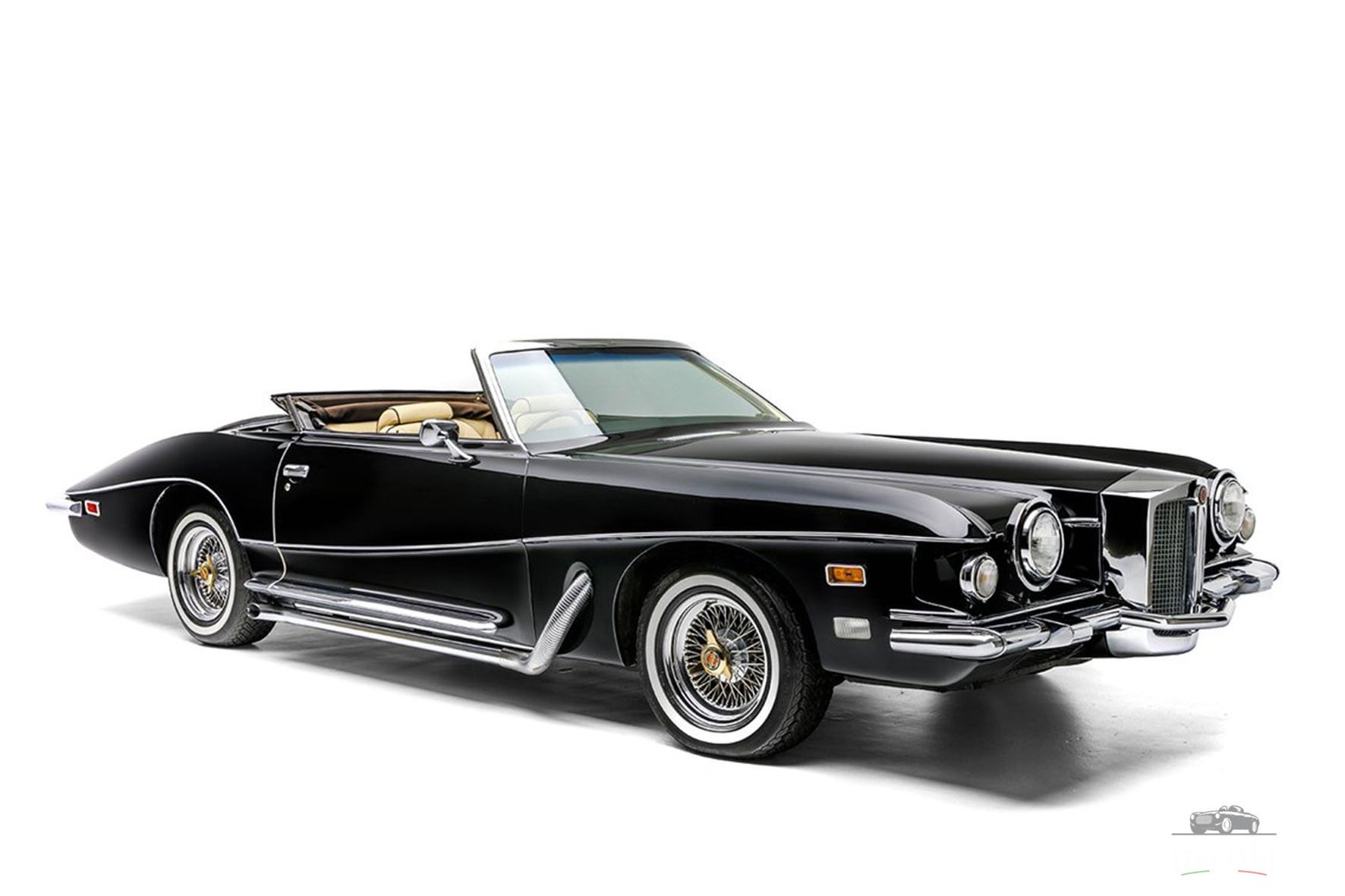
The Stutz D’Italia is a one-off convertible automobile produced in 1975 as a variant of the Stutz Blackhawk. Developed in the United States and based on the Pontiac Grand Prix platform, the vehicle was modified under the direction of Dan Steckler, an associate of the Stutz Motor Car of America. The D’Italia was created during a period when the company explored expanding its range beyond the coupe format traditionally associated with the Blackhawk series. The D’Italia retained the standard mechanical layout of the Blackhawk, including a front-mounted, 7.5-liter (455 cubic inch) Pontiac V8 engine paired with a three-speed automatic transmission. The drivetrain delivered power to the rear wheels. Standard equipment included power steering, power brakes, and air conditioning, aligning the model with contemporary expectations for personal luxury automobiles. The principal modification involved the removal of the fixed roof to create a fully open cabriolet configuration. The bodywork, originally crafted in Italy by Officine Padane, and reflecting the brand’s neoclassical aesthetic, was altered in California to accommodate the design change. Distinctive exterior features such as the upright grille, freestanding headlamps, exposed spare wheels, and extensive use of chrome were retained. Structural reinforcements were added to maintain chassis integrity in the absence of a roof. The Stutz D’Italia was introduced in May 1976 at the Beverly Hills Hotel. Its retail price of $100,000 made it the most expensive American automobile offered at the time. The vehicle was acquired by Evel Knievel and later owned by entertainer Wayne Newton. Following a collision during film production, the car was repaired and repainted by customizer Gene Winfield. The D’Italia is presently housed in the Petersen Automotive Museum in Los Angeles. As a singular production example, the Stutz D’Italia represents a rare instance of convertible adaptation within the revived Stutz marque. It reflects the brand’s commitment to individualized luxury and its appeal to high-profile clientele. The vehicle is notable for its combination of American mechanical components, Italian-influenced styling, and low-volume coachbuilt execution during a period marked by broader industry retreat from open-top models.
02 / TECHNICAL IDENTITY
03 / DESIGN, BODY & SUPPLIERS
Coachbuilder / Design studio
Officine Padane emerged in Modena during the 1940s from the Orlandi bodybuilding tradition and became a specialist producer of buses and coaches on a range of commercial chassis.
Explore record ↗05 / PEOPLE, COLLECTIONS & MUSEUMS
07 / CHASSIS REGISTER
08 / GALLERY
THE CONVERSATION
Comments 0