Giovanni Michelotti
Giovanni Michelotti was a prolific Italian automotive designer whose independent Turin studio produced coachwork and production-car designs for Vignale, Triumph, BMW and numerous other manufacturers.
Explore record ↗
1962
THE VEHICLE AT A GLANCE
THE PEOPLE BEHIND THE CAR
Giovanni Michelotti was a prolific Italian automotive designer whose independent Turin studio produced coachwork and production-car designs for Vignale, Triumph, BMW and numerous other manufacturers.
Explore record ↗Founded in Turin by Giovanni Michelotti, Studio Michelotti developed original automotive styling, full-scale models and prototypes for international manufacturers and specialist coachbuilders.
Explore record ↗01 / THE STORY
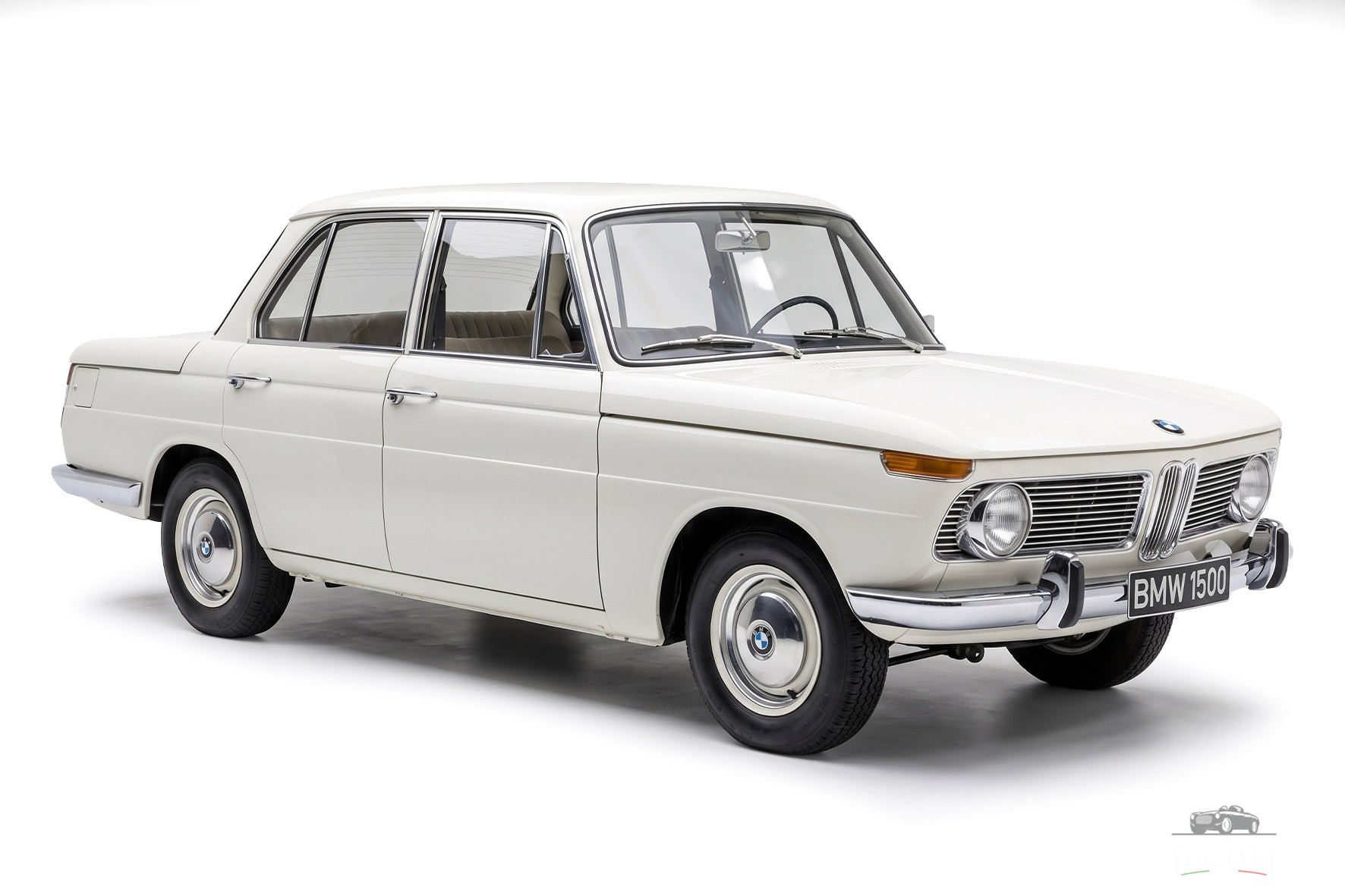
The BMW 1500 was the first model of the Neue Klasse series, introduced in 1961 and placed into production in 1962. It was conceived as a mid-size family sedan intended to reposition BMW in the post-war automotive market. The car marked a departure from the manufacturer’s prior emphasis on economy and luxury models, establishing a new segment for compact executive vehicles with sporting characteristics. The 1500 featured a monocoque chassis and a modern suspension layout. At the front, MacPherson struts were employed, while the rear incorporated independent semi-trailing arms. Braking was managed by front disc brakes and rear drums. The powertrain consisted of a 1,499 cc inline four-cylinder engine designated M10, developed under the direction of Alexander von Falkenhausen. It utilized a single overhead camshaft and was fed by a single Solex carburetor. In its initial form, the engine delivered 80 PS (59 kW) at 5,700 rpm. Power was transmitted to the rear wheels through a four-speed manual gearbox. The body was a three-box, four-door saloon, characterized by restrained styling and a functional layout. Design work was overseen by Giovanni Michelotti. The model introduced key elements of BMW’s later design language, including the Hofmeister kink at the C-pillar and a forward-thrusting front profile. Passenger accommodation was arranged for five occupants, with a focus on interior space and visibility. Production commenced in late 1962 and continued until the model’s replacement by the BMW 1600 in 1964. A total of 23,807 examples were built. The car was produced at BMW’s Munich facility and assembled using modernized manufacturing processes aligned with increasing demand and export growth. The BMW 1500 holds significance as the vehicle that redefined BMW’s market identity. It laid the mechanical and conceptual foundation for subsequent Neue Klasse models, including the 1600, 1800, and 2000 sedans, as well as the 02 Series that followed in 1966. It is regarded as the pivotal model in the company’s transition to volume production of driver-oriented sedans, introducing the mechanical layout and design approach that would persist across several decades of BMW engineering.
02 / TECHNICAL IDENTITY
03 / DESIGN, BODY & SUPPLIERS
Attributed coachbuilder / design studio
Founded in Turin by Giovanni Michelotti, Studio Michelotti developed original automotive styling, full-scale models and prototypes for international manufacturers and specialist coachbuilders.
Explore record ↗Designer
Giovanni Michelotti was a prolific Italian automotive designer whose independent Turin studio produced coachwork and production-car designs for Vignale, Triumph, BMW and numerous other manufacturers.
Explore record ↗07 / GALLERY

THE CONVERSATION
Comments 0