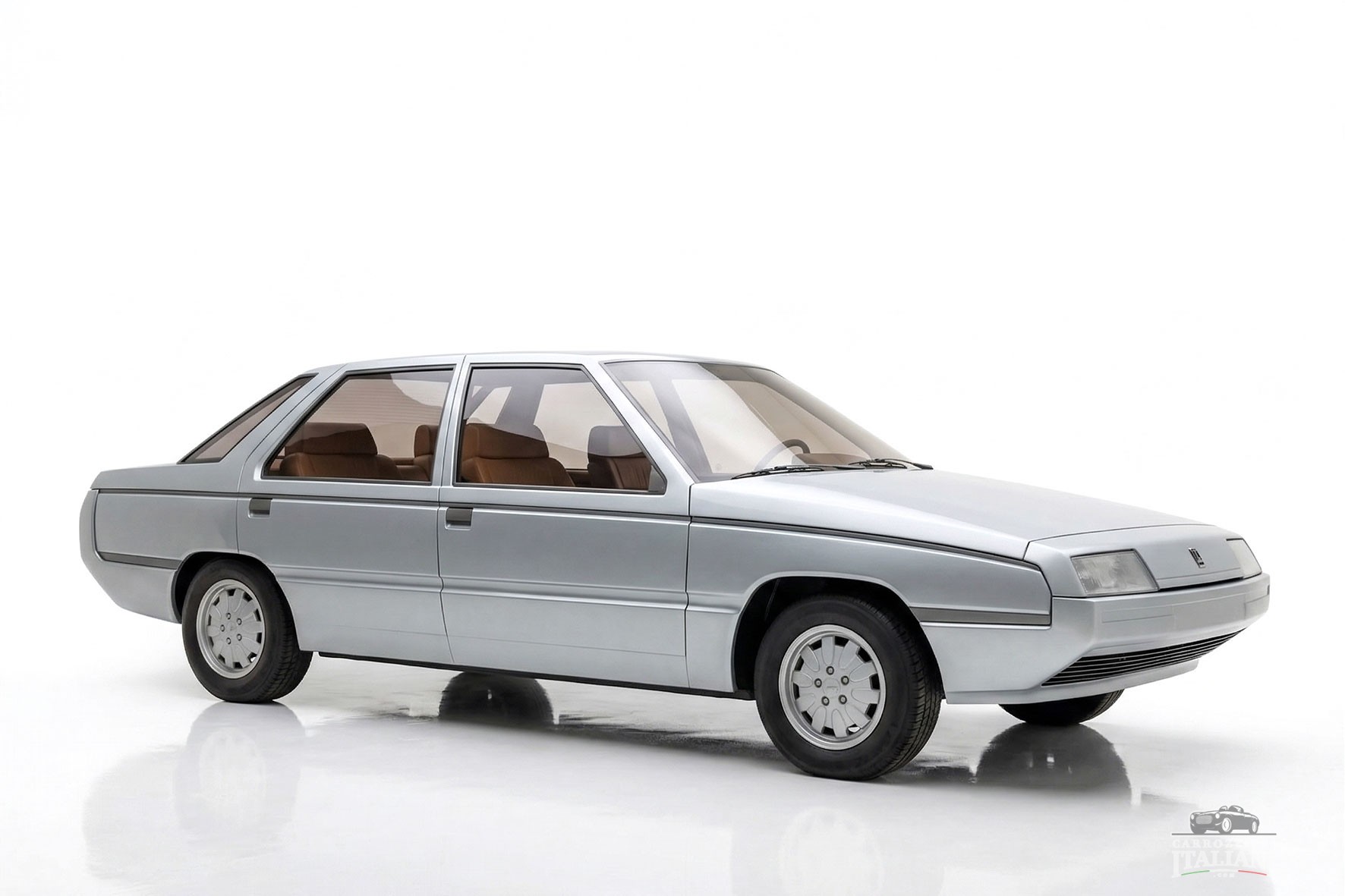
The Rover Bravo was a full-scale saloon prototype developed circa 1980 by Bertone for Rover, during the period in which Rover operated within British Leyland. The project arose while British Leyland was simultaneously engaged in multiple in-house programs, including the Austin Metro, LM10 and LM11 ranges, Triumph sports cars, and continued Range Rover development, creating conditions in which external design proposals were considered. The Bravo was styled under the direction of Marc Deschamps, then head of design at Bertone. The body was a large four-door saloon defined by flat planes, sharp edges, and a strong horizontal emphasis typical of early-1980s European design. The front treatment showed clear visual continuity with the Rover SD1, particularly in the grille and headlamp layout, indicating an attempt to align the proposal with Rover’s established design language rather than present a radical departure. The prototype appears to have been developed as a production-feasible study rather than a purely conceptual exercise. Proportions, glazing, and door architecture suggest compliance with contemporary manufacturing constraints. No verified technical specifications have been published, but the packaging indicates compatibility with either rear-wheel-drive or front-wheel-drive layouts under evaluation within Rover at the time. The Rover Bravo was constructed as a complete prototype and photographed at Bertone’s facilities but was never publicly presented by Rover nor adopted for production. Its designation as “Bravo” is derived from later secondary sources rather than confirmed factory documentation.


THE CONVERSATION
Comments 0