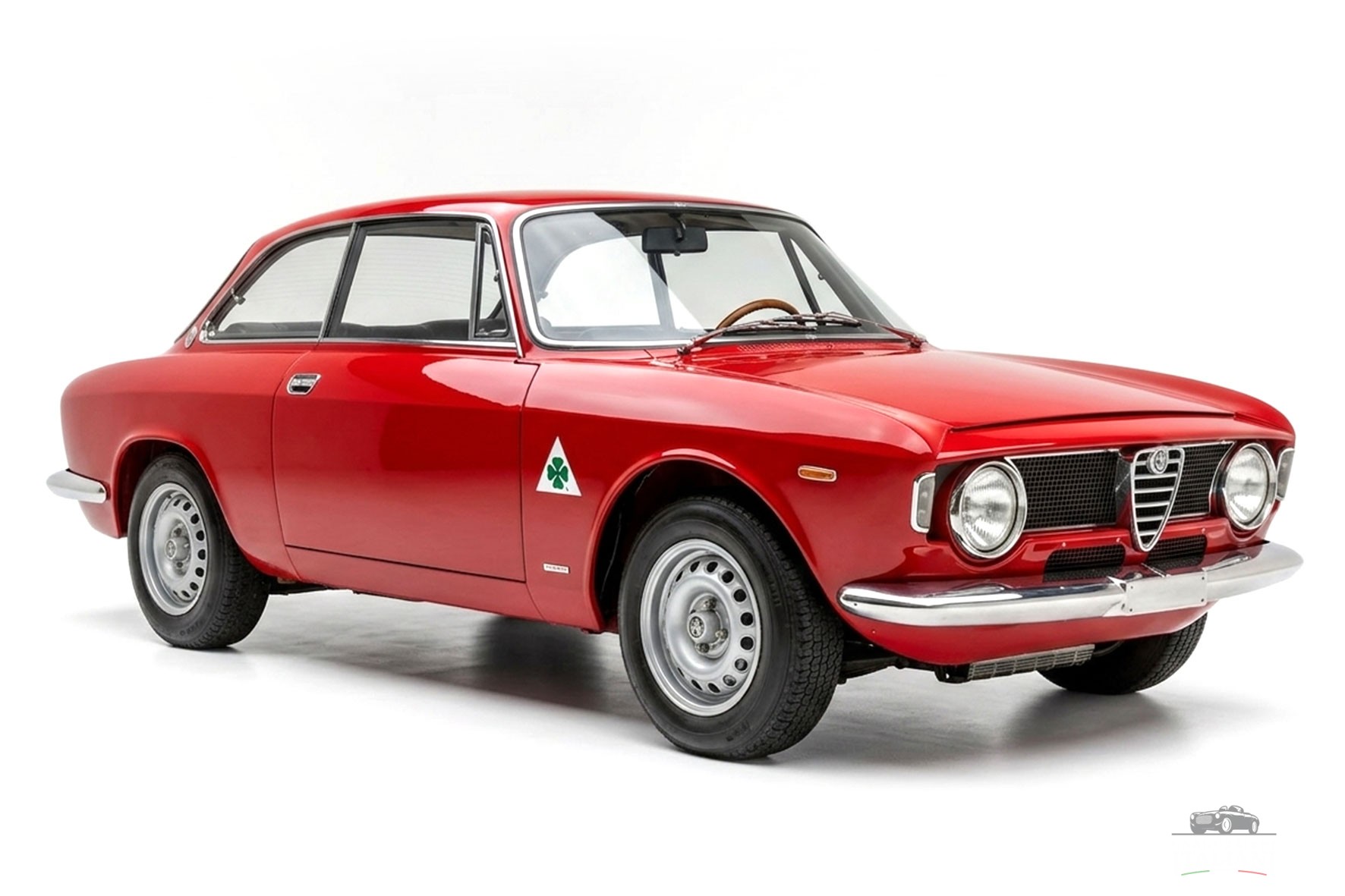
The Alfa Romeo Giulia Sprint GTA 1600 is a lightweight, limited-production derivative of the Giulia Sprint GT coupé, introduced in 1965 for competition homologation. The GTA designation stands for Gran Turismo Alleggerita, referring to the weight reduction achieved through changes to the body and equipment. Its appearance follows the Giulia Sprint GT designed by Giorgetto Giugiaro while working at Bertone. The original coupé’s styling and the GTA’s specialised engineering are distinct aspects of the programme: Alfa Romeo and its competition organisation Autodelta developed the competition derivative, while the Bertone design lineage remained visible in its body.
Lightweight construction
The GTA retained a load-bearing steel structure, but replaced major exterior steel panels with lighter aluminium-alloy panels, generally described as Peraluman. The roof, bonnet, doors and other panels contributed to the reduction in mass. Acrylic glazing was adopted for the side and rear windows, and the interior received simplified trim. Magnesium-alloy components also formed part of the weight-saving measures, although the exact equipment of surviving cars varies. Alfa Romeo’s museum gives an empty weight of 745 kg for the road-going configuration, which should not be treated as the weight of every race-prepared car. The wider use of lightweight transparent materials is discussed in Italy’s Plexiglas Revolution in Postwar Car Design.
Engine and road-going specification
The GTA 1600 used a front-mounted, longitudinal 1,570 cc four-cylinder engine derived from Alfa Romeo’s twin-cam unit. It had twin overhead camshafts, two valves per cylinder, two spark plugs per cylinder and two twin-choke carburettors. The Museo Storico Alfa Romeo specifies 115 metric horsepower (CV) at 6,000 rpm for its road version, transmitted to the rear wheels through a five-speed manual gearbox. Factory museum measurements for the road car include a 2,350 mm wheelbase, 4,080 mm overall length, 1,580 mm width and 1,315 mm height. Hydraulic disc brakes and independent front suspension accompanied a rigid rear axle. Reported competition outputs and running weights were different, depending on the period, regulations and preparation; they cannot be applied to an unidentified GTA as universal specifications.
Homologation and competition
The GTA was intended to make Alfa Romeo competitive in international touring-car racing, and preparation by Autodelta was central to its success. The FIA’s historic register lists homologation no. 199 in Group GT, dated 2 June 1965, and a separate Group T homologation, no. 1395, dated 2 August 1965. The two documents concern different regulatory classifications and should not be conflated. Race-prepared GTAs became prominent in European touring-car competition during the second half of the 1960s. Championships and individual victories belong to identified entrants and race cars, however, rather than automatically to every surviving chassis. Drivers and teams operated cars with changing mechanical specifications over their racing lives.
Production, variants and surviving cars
Alfa Romeo’s museum records 500 examples of the Giulia Sprint GTA 1600, while other historical accounts give slightly different totals, reflecting the need to define precisely which cars are included. The 1600 is generally associated with production from 1965 to 1969. The later GTA 1300 Junior, the experimental supercharged GTA-SA and the subsequent GTAm are separate derivatives, not alternative names for the standard GTA 1600. Individual cars may have been converted for racing, restored to road configuration or modified again during later ownership, so chassis and engine numbers are essential to any provenance claim. The road version forms the technical reference for this model-family entry; documented auction results, exhibition appearances and awards for specific chassis must be recorded individually. Bertone’s broader history and the work of Giorgetto Giugiaro provide context for the underlying Giulia GT design.





THE CONVERSATION
Comments 0