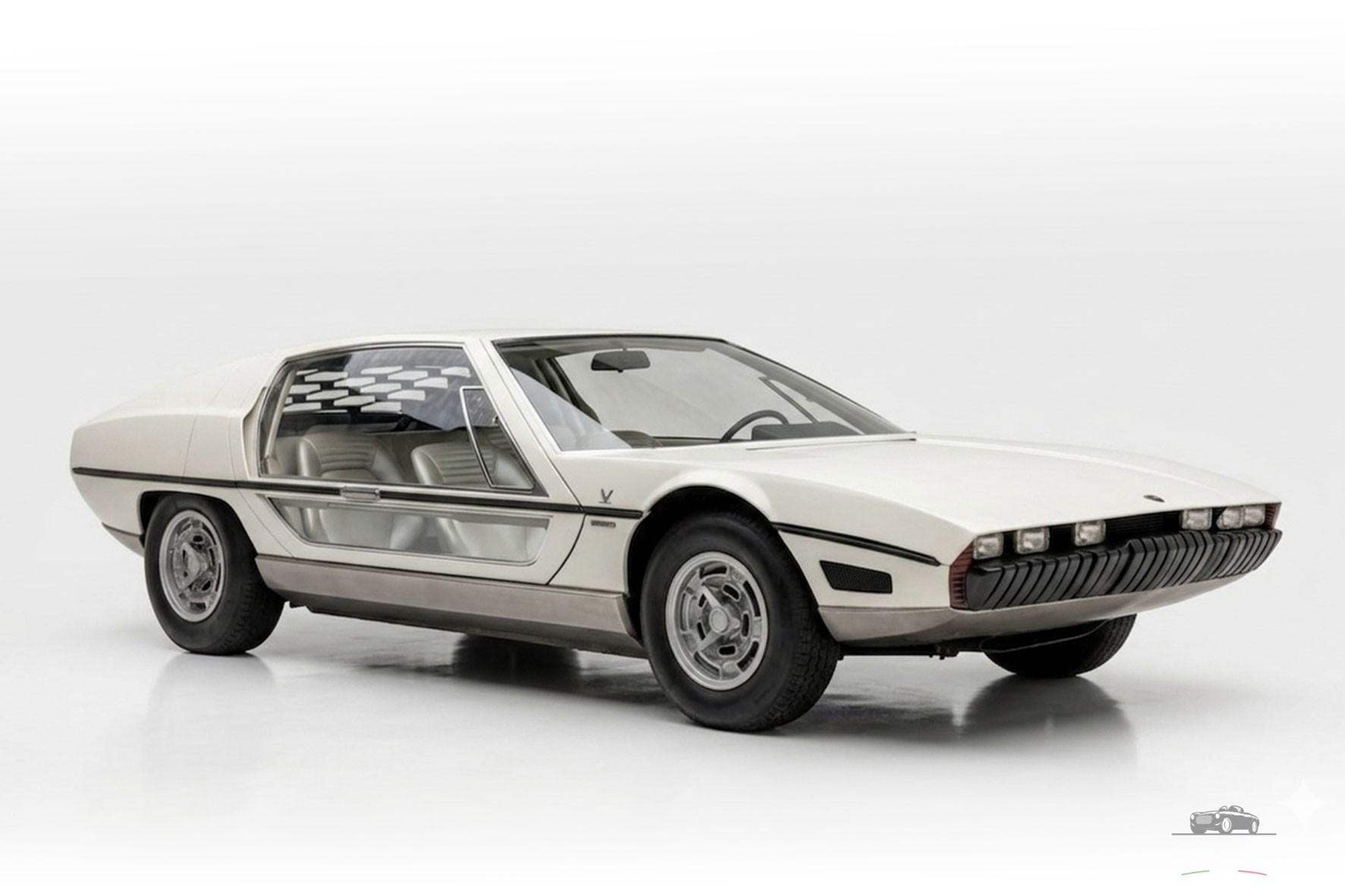
The Lamborghini Marzal was introduced at the 1967 Geneva Motor Show as a fully operational concept designed by Marcello Gandini for Carrozzeria Bertone. Commissioned by Ferruccio Lamborghini, it was conceived to study a four-seat grand tourer layout that could expand the company’s range beyond two-seat sports cars. The Marzal’s design was characterized by extensive glass surfaces. The large gullwing doors, developed in cooperation with the Belgian glass manufacturer Glaverbel, incorporated wide transparent panels that, together with the panoramic roof, maximized outward visibility and cabin light. The interior was finished entirely in silver leather, and a repeated hexagonal motif—visible in the dashboard, seats, and rear glazing—gave the vehicle a consistent and geometric design identity. Power came from a 2.0-liter inline six-cylinder engine derived from half of the Miura’s V12, paired with a five-speed transmission. The chassis was based on a Miura frame extended by twelve centimeters, allowing room for four occupants while preserving a rear-mid-engine configuration. Although a prototype, the Marzal was fully driveable. It appeared publicly at the 1967 Monaco Grand Prix, where it was used by Prince Rainier III and Princess Grace as the parade car before the race. The design directly influenced the production Lamborghini Espada, which translated many of its proportions and ideas into series form. According to Gandini, final assembly before the Geneva debut was completed under tight time constraints, with mechanical issues resolved only hours before the show—an episode that later became part of the Marzal’s development history. The single surviving Marzal is today part of the Albert Spiess Collection. It remains a key reference in the evolution of Lamborghini design, illustrating Bertone’s technical expertise, Gandini’s geometric design language, and Lamborghini’s willingness in the 1960s to experiment with materials and configurations beyond conventional grand tourer standards.



THE CONVERSATION
Comments 0