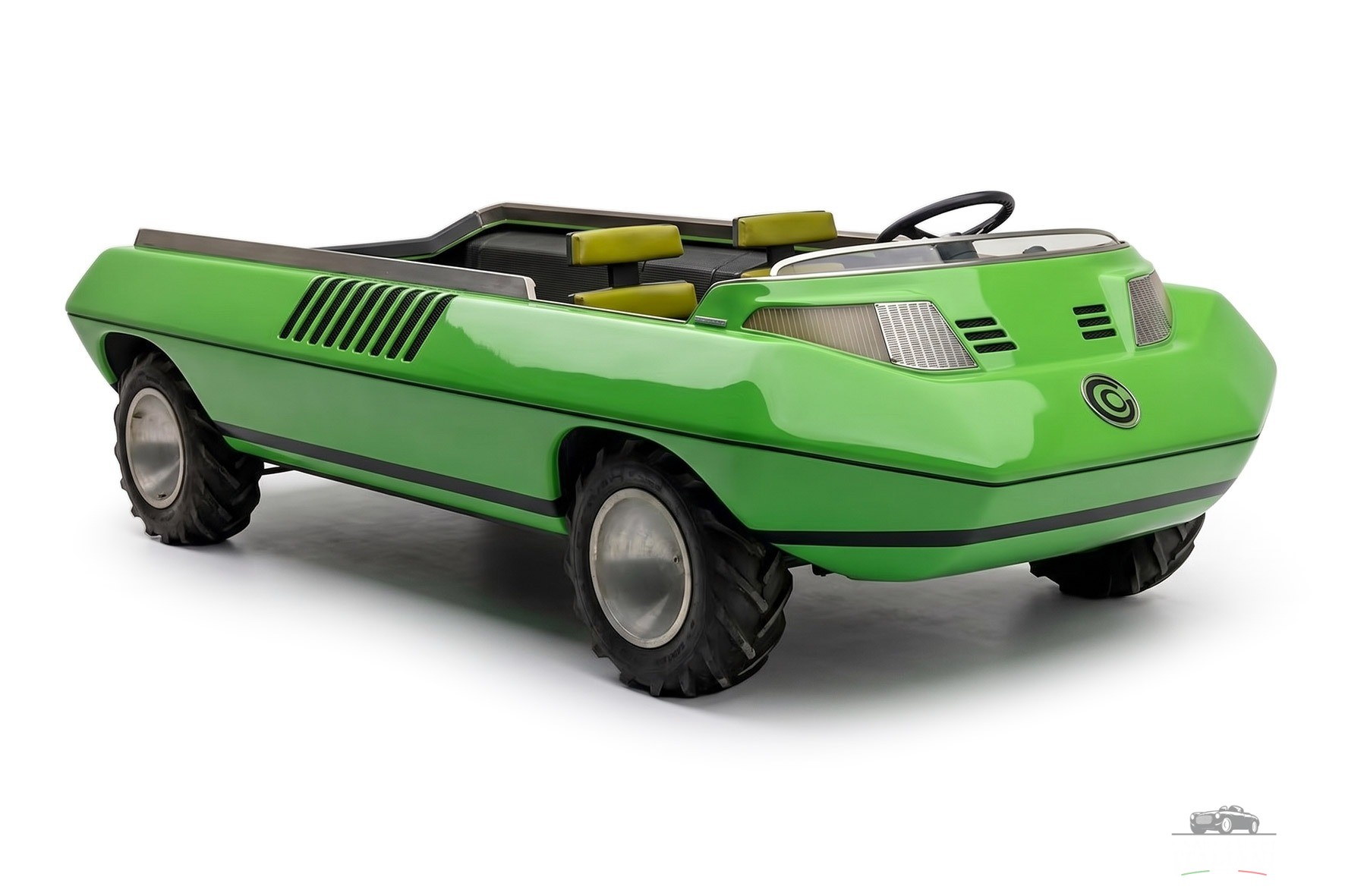
Presented by Bertone at the Brussels Motor Show in January 1972, the Suzuki Go was an experimental two-seat utility vehicle conceived at the intersection of a beach buggy, a compact pick-up and a recreational boat. Its unconventional proportions placed a small, open passenger compartment ahead of a long, flat loading platform intended to carry a motorcycle or other outdoor equipment. Rather than adapting the body of an existing Suzuki car, Bertone explored a purpose-built vehicle around Suzuki motorcycle components. The design is generally attributed to Marcello Gandini, then working at Bertone, although the surviving sources consulted do not establish the authorship of every technical feature.
The Go’s body was made of plastic and dispensed with conventional doors. The low, barchetta-like sides, utilitarian seating and bright finish emphasised its outdoor purpose. A hinged tailgate became a loading ramp, operated through a pulley mechanism from the driving position. The shape also evoked an inflatable dinghy, and contemporary descriptions envisaged attaching an outboard motor at the rear for movement on water. That proposal should not be confused with evidence that the prototype was successfully tested as an amphibious vehicle.
The surviving ASI Bertone Collection identification panel records a water-cooled, two-stroke Suzuki GT750 three-cylinder engine of 738 cm³ and 67 metric horsepower. The engine occupied the left side of the rear mechanical compartment, leaving the right side for the radiator. An unusual Bertone-developed chain-drive differential and reversing arrangement allowed five forward and five reverse ratios, a configuration suited to a vehicle intended to manoeuvre with a load in confined spaces. Published secondary specifications also quote dimensions of 3,350 mm in length and 1,720 mm in width, but these figures require confirmation against a period factory drawing. No verified chassis or engine serial number has been identified.
The Go remained part of the Bertone collection, subsequently safeguarded by the Automotoclub Storico Italiano and brought back to Turin’s Heritage Hub in 2026. Its combination of leisure-vehicle practicality and expressive styling anticipated themes later explored by Bertone. The Bertone Pickster of 1998 is a documented stylistic reinterpretation, not a mechanically related successor. Although a 2026 Stellantis collection press release dates the Go to 1970, the ASI museum identification and the documented Brussels presentation support 1972 as its public debut year; the discrepancy remains open for archival reconciliation.



THE CONVERSATION
Comments 0