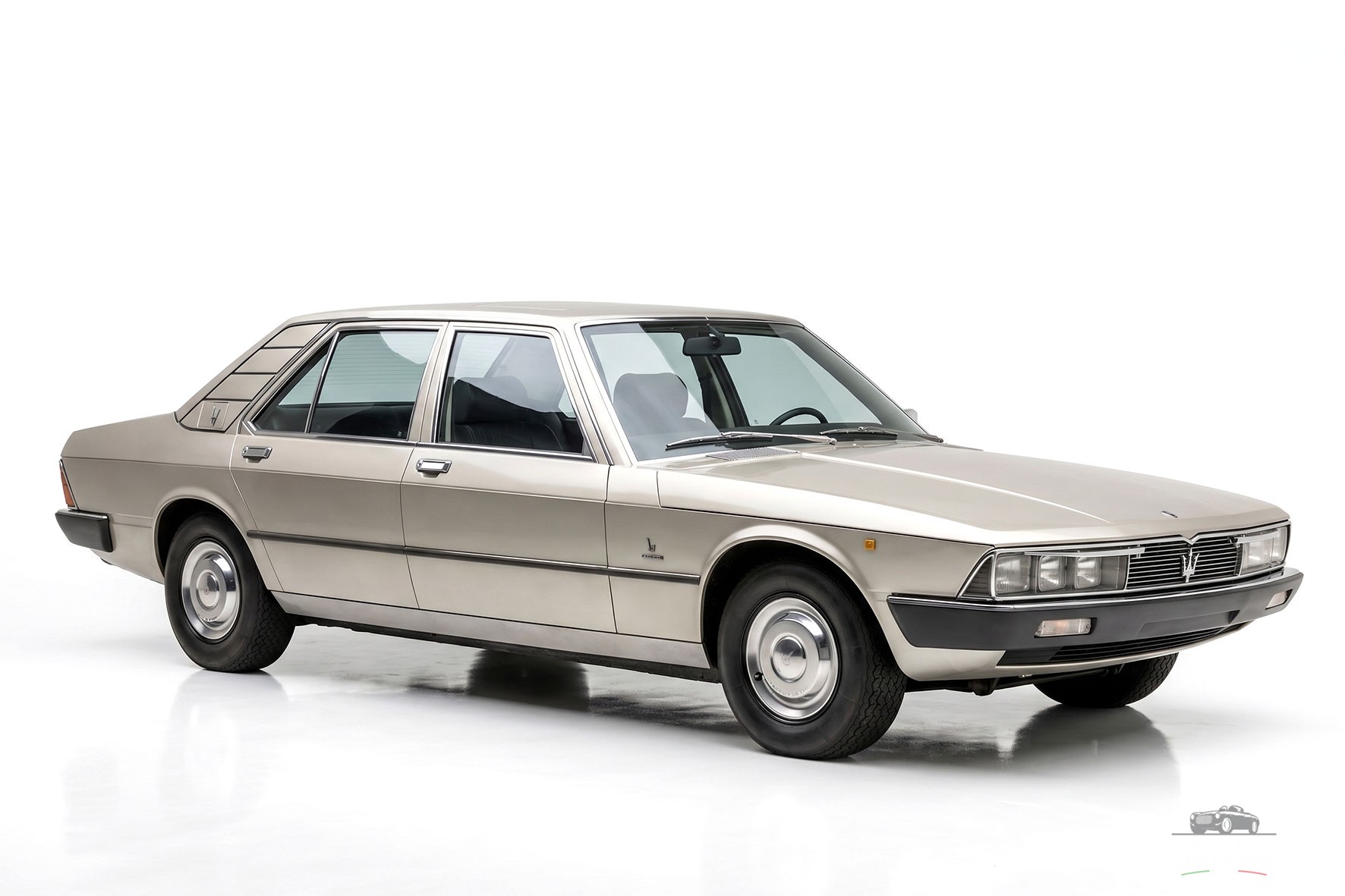
The second-generation Maserati Quattroporte, designated Tipo AM123, emerged in 1974 during the final phase of Citroën’s control of the Modenese manufacturer. Rather than developing a conventional rear-wheel-drive successor to the original V8 saloon, Maserati adopted a lengthened and widened interpretation of the Citroën SM’s engineering architecture. Front-wheel drive, hydropneumatic suspension and sophisticated power-assisted controls gave the new four-door car a markedly different character from the earlier Quattroporte. It made its public debut at the Paris Motor Show in October 1974, but financial upheaval and the subsequent change of ownership prevented the intended regular introduction.
Gandini’s Bertone body and the Citroën connection
The body was entrusted to Bertone, with Marcello Gandini responsible for its crisp, restrained styling. A low waistline and generous glazing contrasted with the six-lamp frontal arrangement, including directional headlamps derived from Citroën practice. The spacious cabin and nearly level floor reflected the advantages of the front-drive layout. Maserati’s published specification describes a 2,965 cc, 90-degree double-overhead-camshaft V6 rated at 210 hp at 6,500 rpm, with a steel platform chassis and a dry weight of approximately 1,700 kg. A five-speed manual gearbox and hydropneumatic suspension are also documented in the contemporary prototype’s later auction records. The engine belonged to the same Maserati V6 family associated with the Merak, although individual specifications should not be transferred indiscriminately between the models.
A short-lived programme and surviving cars
Maserati’s current historical specification gives a total of thirteen Quattroporte II cars for the 1974–1978 programme, while its accompanying narrative refers to twelve sold. These are not necessarily equivalent counts. The surviving cars also require careful chassis-level documentation: Christie’s identified AM123004 as a Paris 1974 display prototype, whereas a later Artcurial catalogue attributes that appearance to AM123008. Until the underlying factory delivery and exhibition records are reconciled, the identity of the individual show car should not be treated as settled. The AM123 was distinct from the earlier Quattroporte proposal by Frua, which followed a different V8-based engineering and styling direction. Despite its very limited production, the Bertone Quattroporte II remains a revealing example of the ambitious but ultimately interrupted collaboration between Maserati and Citroën.



THE CONVERSATION
Comments 0