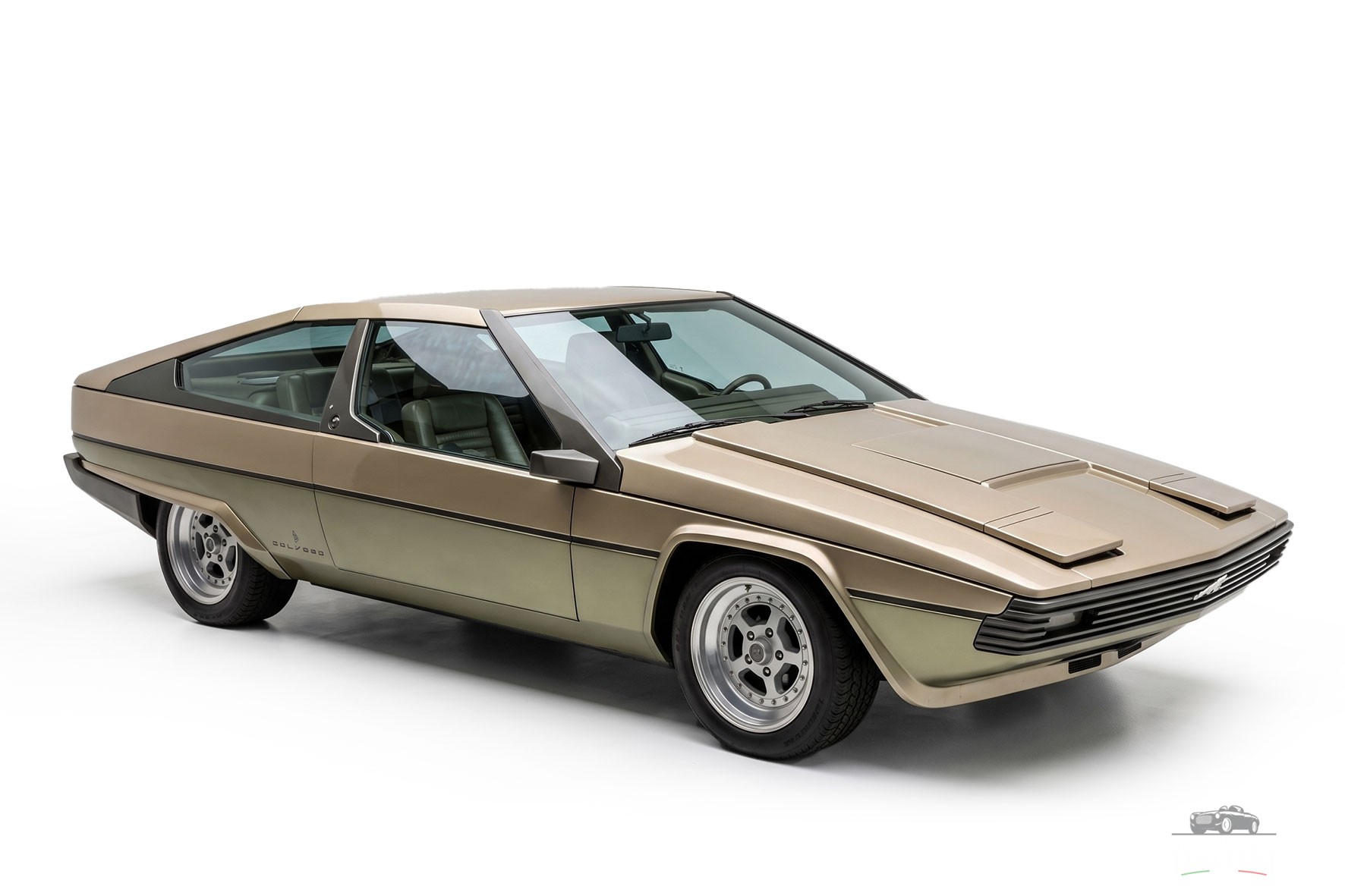
The Jaguar Ascot was a one-off four-seat concept developed by Bertone in 1977, with its design attributed to Marcello Gandini. Conceived around the mechanical architecture of the Jaguar XJ-S, it presented a markedly different interpretation of Jaguar’s grand-touring coupé: a low, sharply folded profile, contrasting pillars, squared wheel openings and a broad, almost architectural front. The Ascot was not a proposed production version of the XJ-S with minor cosmetic changes. It was an independent coachbuilt study intended to explore how the established Jaguar V12 package could be accommodated within the geometric styling language being developed at Bertone during the second half of the 1970s.
The concept retained the XJ-S’s 5.3-litre V12 engine and automatic transmission, according to marque histories, and was built with hand-formed aluminium body panels. Its right-hand-drive cabin combined tan leather and brown suede with instruments and controls taken from the Jaguar donor. A large rectangular dashboard incorporated a telephone, while the rear body was arranged around a lifting hatch rather than the conventional luggage lid of the production XJ-S. Concealed headlights, an unusually wide frontal grille and the shaped bonnet made the exterior immediately recognisable. Published accounts disagree about the extent of the changes to the donor’s wheelbase: some describe a shortening of approximately 200 mm, while another reports the original wheelbase retained with reduced overhangs. Without a factory drawing or measured chassis record, neither dimensional interpretation should be treated as definitive.
The Ascot appeared on the European motor-show circuit in 1977. Archival descriptions of original Bertone press material identify Geneva, whereas several later specialist and Jaguar-club histories cite Turin as its unveiling; the surviving references do not yet establish an unambiguous sequence for the two appearances. A specialist show register also lists Birmingham in 1978. Early photographs document a white exterior, while later accounts record a gold repaint. The individual chassis number and an uninterrupted ownership chronology have not been independently established. The car subsequently formed part of the Bertone collection preserved by the Automotoclub Storico Italiano, which was acquired as a complete collection in 2015 and returned to public exhibition in Turin in 2026.
In design terms, the Ascot followed the Ferrari Rainbow of 1976, another Gandini-led Bertone experiment with geometric surfaces, although the two cars were mechanically unrelated. Its four-seat proportions and treatment of the side glazing also belong to the line of investigations that continued with the Volvo Tundra in 1979. The Ascot remained a singular exercise in combining a British grand-tourer powertrain with Italian experimental body design; its historical significance lies in that tension between familiar mechanical architecture and a deliberately unfamiliar form.



THE CONVERSATION
Comments 0