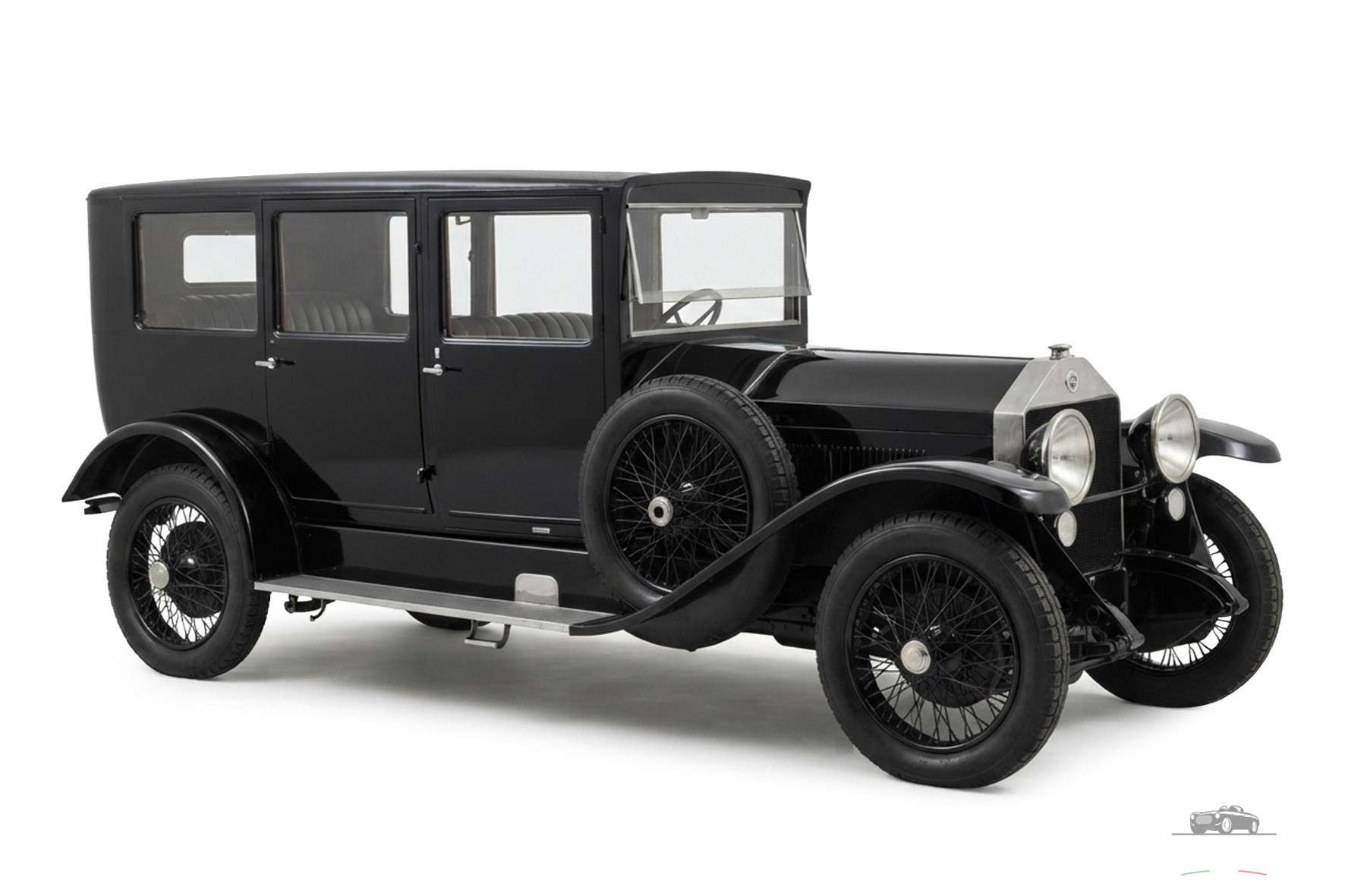
The Carrozzeria Bertone-bodied Lancia Trikappa belongs to the formative years of Giovanni Bertone’s Turin workshop, when the firm was moving from carriage building into the construction of complete automobile bodies. Historical accounts of the coachbuilder illustrate a Trikappa among its early projects, following the SPA 23 S commission of 1921 and the Fiat 501 sporting body. The date 1922, retained in the earlier vehicle record, is consistent with that chronology but has not been established from a dated Bertone construction sheet or Lancia chassis register.
The Trikappa chassis and Bertone coachwork
Introduced in 1922 and produced until 1925, the Lancia Trikappa was one of the marque’s most substantial pre-Lambda luxury automobiles. Its mechanical distinction was a narrow-angle eight-cylinder engine with a displacement of 4,594 cc, for which contemporary-model histories and the Museo Nazionale dell’Automobile report 98 horsepower at 2,500 rpm. The model used a four-speed gearbox, rear-wheel drive and a separate chassis with a wheelbase commonly given as 3,384 mm. The Lancia Club describes the evolution from rear-wheel braking on the earliest cars to four-wheel braking on later examples. These are characteristics of the Trikappa model; without a chassis number they cannot establish the exact specification or series of an individual Bertone-bodied automobile.
Bertone’s early luxury coachwork is often discussed in connection with limousine, landaulet and coupé de ville forms. The older description of this Trikappa refers to such configurations, but the available photograph and secondary accounts do not securely establish which individual body carried which designation. Neither a body number nor a verified production total for Bertone’s Trikappa work has been recovered. The 847 cars reported by the Turin automobile museum represent total Lancia Trikappa production, not 847 Bertone bodies.
Separate bodies and the surviving evidence
The Trikappa chassis also attracted other coachbuilders. The Coupé de Ville attributed to Balbo and the separately catalogued Torpedo Lusso attributed to Solaro belong to the same mechanical family, but neither can be identified as the Bertone automobile. Period Lancia advertising and later photographic archives provide valuable context without supplying a confirmed chassis-to-body match. The Lancia Club has also cited a price of 69,000 lire for a Trikappa with a generic torpedo body; that figure must not be presented as the original price of a Bertone commission.
The historical importance of the Bertone Trikappa lies in the early relationship between the Turin coachbuilder and Lancia, rather than in an independently documented racing record or a known surviving chassis. Its exact completion date, body configuration, first owner, registration and subsequent provenance remain open to verification against original company records and period photographs.


THE CONVERSATION
Comments 0