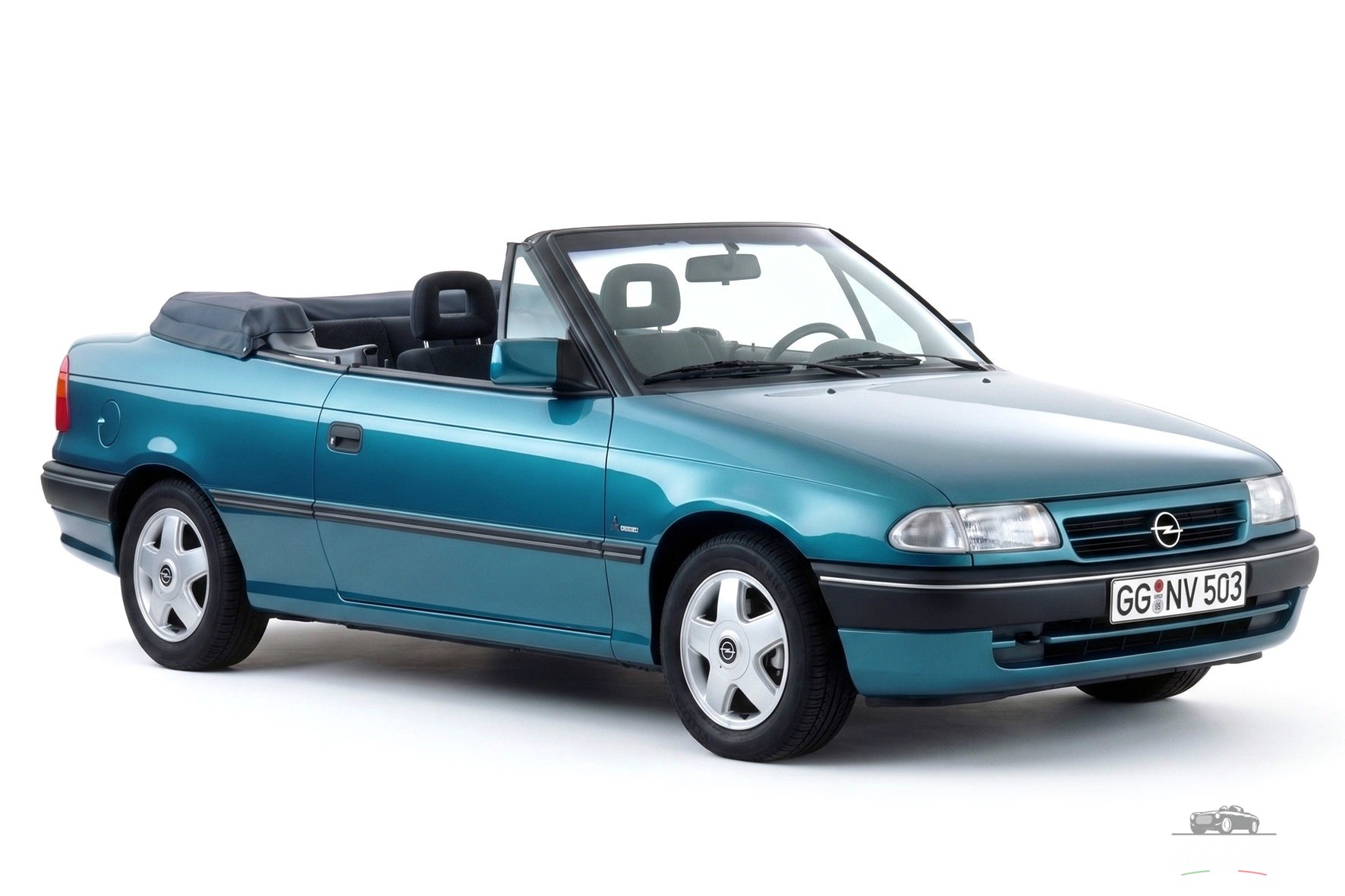
The Opel Astra F Cabriolet made its world debut at the 1993 Geneva Motor Show and reached Italian showrooms at the end of September that year. Developed and manufactured in collaboration with Carrozzeria Bertone in Grugliasco, near Turin, it succeeded the Kadett E Cabriolet, another important product of the Opel–Bertone partnership. Unlike its predecessor, which had a prominent fixed rollover bar, the Astra presented a clean, uninterrupted convertible silhouette. It was a regular production model rather than a one-off show car, although its Geneva unveiling was an important public milestone.
Engineering the open Astra
The conversion was more extensive than removing the roof from a standard hatchback. Opel’s historical account identifies the longer four-door Astra F saloon platform as the starting point, allowing the folded hood to occupy a dedicated space behind the rear seats without substantially compromising the four-seat cabin. Bertone’s Grugliasco operation received mechanical parts and body panels from Opel and its suppliers, then undertook the modifications and assembly within a production system that adopted Opel’s quality-control practices. Additional structural reinforcement compensated for the loss of the fixed roof. Side-impact bars within the doors, front seat-belt pretensioners and a strengthened body shell formed part of the safety package; suspension settings were adapted to the cabriolet’s characteristics.
The three-layer fabric hood could be operated manually or, where specified, electrically. Opel described an electrically operated cycle of approximately fifteen to twenty seconds, with an interlock requiring the handbrake to be engaged. The rear window was made of glass rather than flexible plastic and could therefore be heated. The hood was covered when folded by a removable tonneau, while the four-seat layout and practical luggage compartment reflected the project’s emphasis on everyday usability rather than an uncompromising sports-car character.
Powertrains and production
The initial Italian-market specification described by Opel used a multipoint-injected 1.4-litre four-cylinder engine producing 82 CV (60 kW), with a suggested turnkey retail price of 29,370,000 Italian lire. Other markets and subsequent model years offered different four-cylinder petrol engines, including 1.6-litre and 2.0-litre versions; later 1.8-litre derivatives also appeared. These specifications belong to particular versions and must not be assigned indiscriminately to every Astra F Cabriolet. The model evolved during the 1990s, including the broader Astra F facelift, and remained distinct from the subsequent Astra G Cabriolet produced by Bertone in the following decade.
The Astra F Cabriolet illustrates the industrial scale of the Opel–Bertone relationship, in which a specialist Italian body manufacturer worked as a series-production partner to a major European carmaker. Contemporary model histories and later manufacturer retrospectives do not agree consistently on the precise final production year, and the frequently repeated total of 52,848 cars has not yet been matched to an authenticated factory register. Those points therefore remain open rather than being presented as established figures. The individual authorship of the design also requires stronger documentation: Opel’s published accounts describe the joint work of its own teams and Bertone without establishing a sole stylist.


THE CONVERSATION
Comments 0