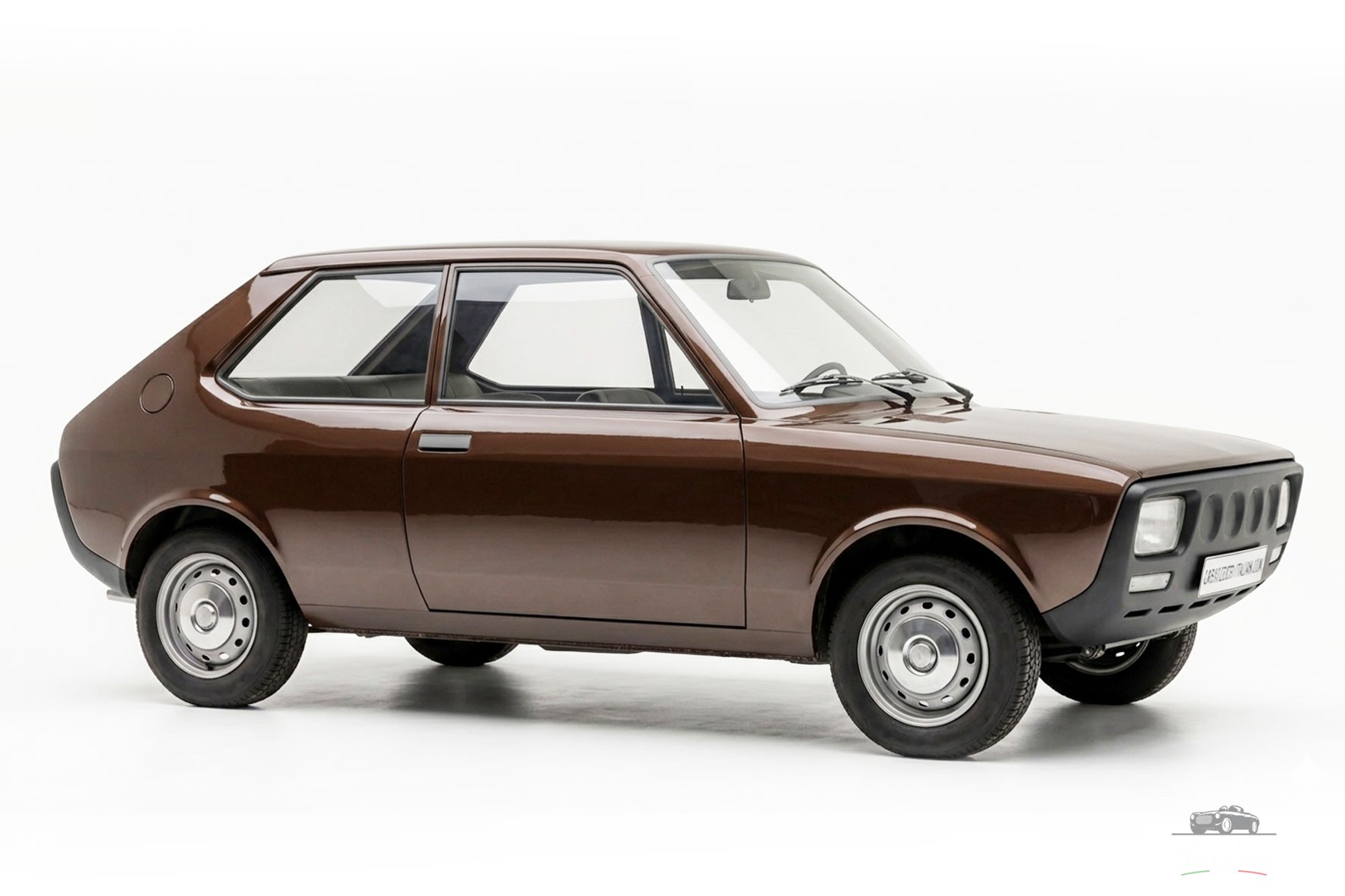
The Bertone proposal for the Audi 50, developed in the early 1970s, represents an early design study for the supermini that Audi introduced in 1974. The prototype was based on the mechanical layout later used for the Volkswagen Polo, employing a front-wheel-drive configuration and a 1.1-liter inline-four engine rated at 50 horsepower at 5,800 rpm. The study was prepared in parallel with Audi’s internal designs during the A0 program, which had been initiated after the NSU–Auto Union merger and the termination of the earlier NSU K50 city-car project. The mockup model produced by Bertone, attributed to Marcello Gandini, employs planar surfaces, sharp edges, and a linear profile consistent with early-1970s geometric styling. The vehicle is a three-door hatchback with a short overhang at the rear and a slightly tapering roofline. The side view shows a continuous beltline and minimal decorative elements. The wheel openings are circular and cleanly integrated, fitted with simple steel rims featuring ventilation holes arranged in two concentric rings. The front design is characterized by a horizontal rectangular grille composed of four recessed modules intended as a graphic interpretation of the Audi rings. The headlamps are housed behind broad plastic shields integrated into the bumper form. The hood is flat and meets the fenders without sculptural transitions, reinforcing the overall rectilinear treatment. The rear design employs a steeply cut tail with a wide hatch opening. A recessed rear window extends deeply into the roof surface. The bumper and lamp panel form a unified graphic element, incorporating four round apertures corresponding to the theme used at the front. The fuel filler is positioned within a circular panel on the right rear flank, treated as an additional graphic device. The underbody is rendered in the same color as the bumpers, visually linking the front and rear. The proposal included the use of polyester bumpers enclosing the lighting units, a solution considered unconventional for Audi’s design vocabulary at the time. Internal evaluation led to the selection of a more conservative configuration, incorporating chromed steel bumpers and a grille aligned with the Audi 80 B1 family identity. Although not adopted for production, the Bertone study illustrates the experimental phase of European small-car design during the early 1970s and provides insight into the design alternatives considered for the Audi 50.


THE CONVERSATION
Comments 0