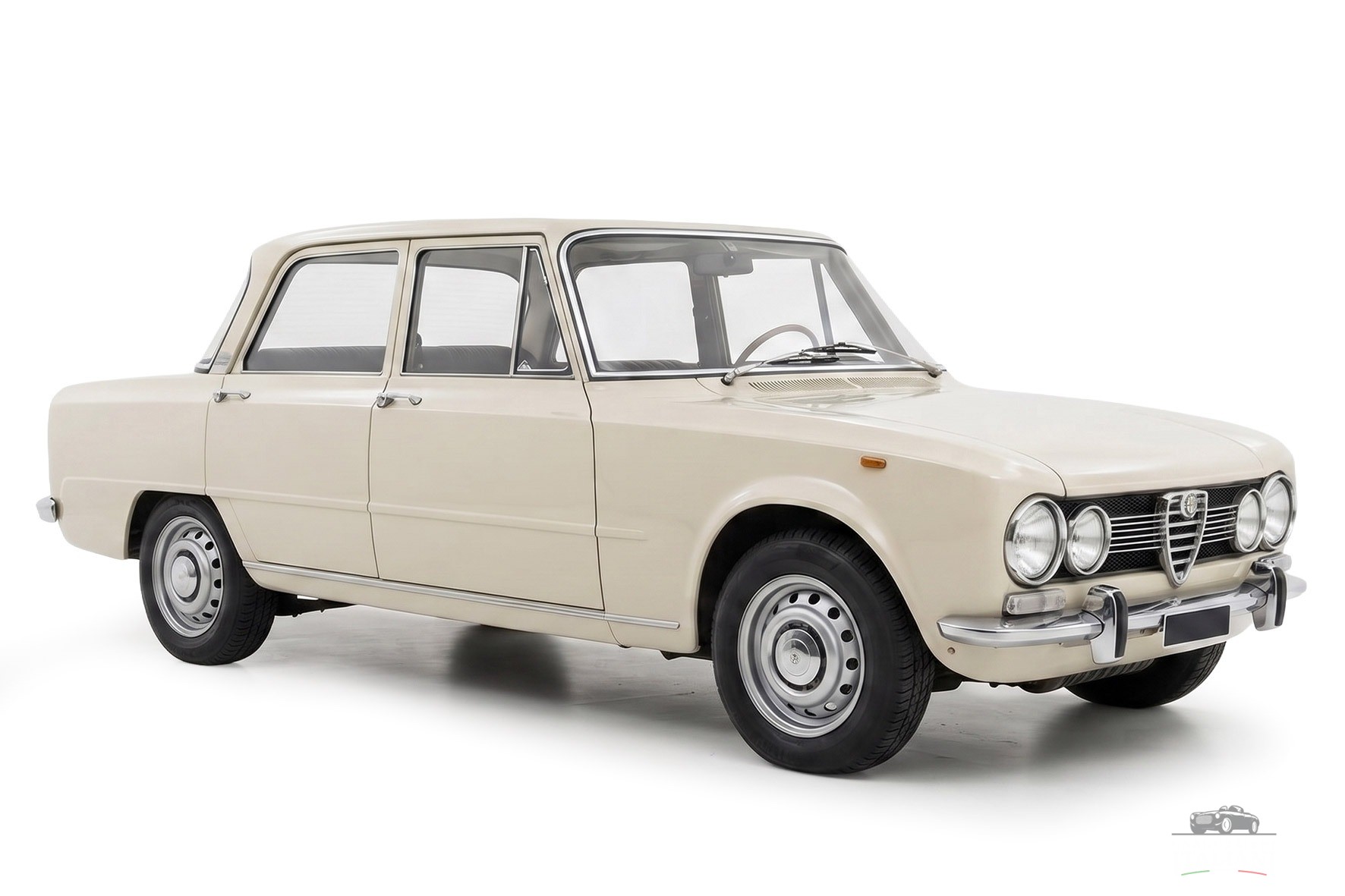
The Alfa Romeo 1750 Berlina was a four-door production saloon introduced in January 1968, with exterior styling developed by Bertone for Alfa Romeo. It was derived from the Giulia family but occupied a larger and more formal position in the manufacturer’s range. The 1750 Berlina was manufactured by Alfa Romeo rather than coachbuilt in Bertone’s workshops; Bertone’s contribution was the design of its series-production body. The model remained in production until its succession by the 2000 Berlina in 1971.
Design and presentation
The 1750 was developed during Alfa Romeo’s expansion of its 105-series range in the 1960s. The styling programme was already underway in 1967, and the new Berlina was presented to the motoring press at Vietri sul Mare, near Salerno, in January 1968, alongside the 1750 GT Coupé. The name revived the numerical designation associated with Alfa Romeo’s pre-war 1750 models, although the new saloon was mechanically and historically distinct from those six-cylinder cars.
Bertone’s four-door design retained the recognisable Alfa Romeo grille and paired circular headlamps while adopting a longer, more rectilinear profile than the Giulia Berlina. The extended passenger compartment and relatively restrained surfaces reflected the intended use as a higher-class family and executive saloon. Marcello Gandini subsequently identified the Alfa Romeo 1750 among his early design work at Bertone; his first-person attribution is distinct from the firm’s formal credit as design studio.
Mechanical specification
The front-mounted Alfa Romeo twin-cam four-cylinder petrol engine displaced 1,779 cm³. A historical Alfa Romeo technical comparison records 118 CV at 5,500 rpm, while a later manufacturer retrospective gives 116 CV. The two published figures should be distinguished rather than treated as proof of different engines fitted to an unidentified individual car. The saloon retained rear-wheel drive and familiar Alfa Romeo mechanical architecture, including independent front suspension, a live rear axle with coil springs and four-wheel disc brakes.
The wheelbase increased to 2,570 mm, compared with the shorter Giulia saloon, contributing to increased passenger space. The manufacturer’s historical specification gives an overall length of 4,390 mm; other published dimensions include 1,565 mm width and approximately 1,430 mm height. Recorded weight figures differ according to the contemporary specification and measuring convention, so they should not be applied indiscriminately to every market version. The model combined a five-seat cabin with the sporting engine and chassis layout characteristic of Alfa Romeo’s contemporary production cars.
Production and related versions
The 1750 Berlina was followed by the larger-engined 2000 Berlina in 1971. Its production history must therefore be distinguished from totals covering both the 1750 and later 2000 series through 1977. The 1750 GT Veloce and 1750 Spider Veloce shared the general period and engine family but had separate bodies and production histories. Specialised derivatives included the 1750 Giardinetta Veloce, a station-wagon conversion associated with the 1750 platform; its builder attribution and individual production details require chassis-specific documentation.
This database entry represents the Bertone-styled production saloon as a model family, not a single numbered chassis. Historic registrations, private ownership records, modified examples and auction transactions for individual cars must remain associated with those specific vehicles, rather than being assigned to an otherwise unidentified example of the model.



THE CONVERSATION
Comments 0