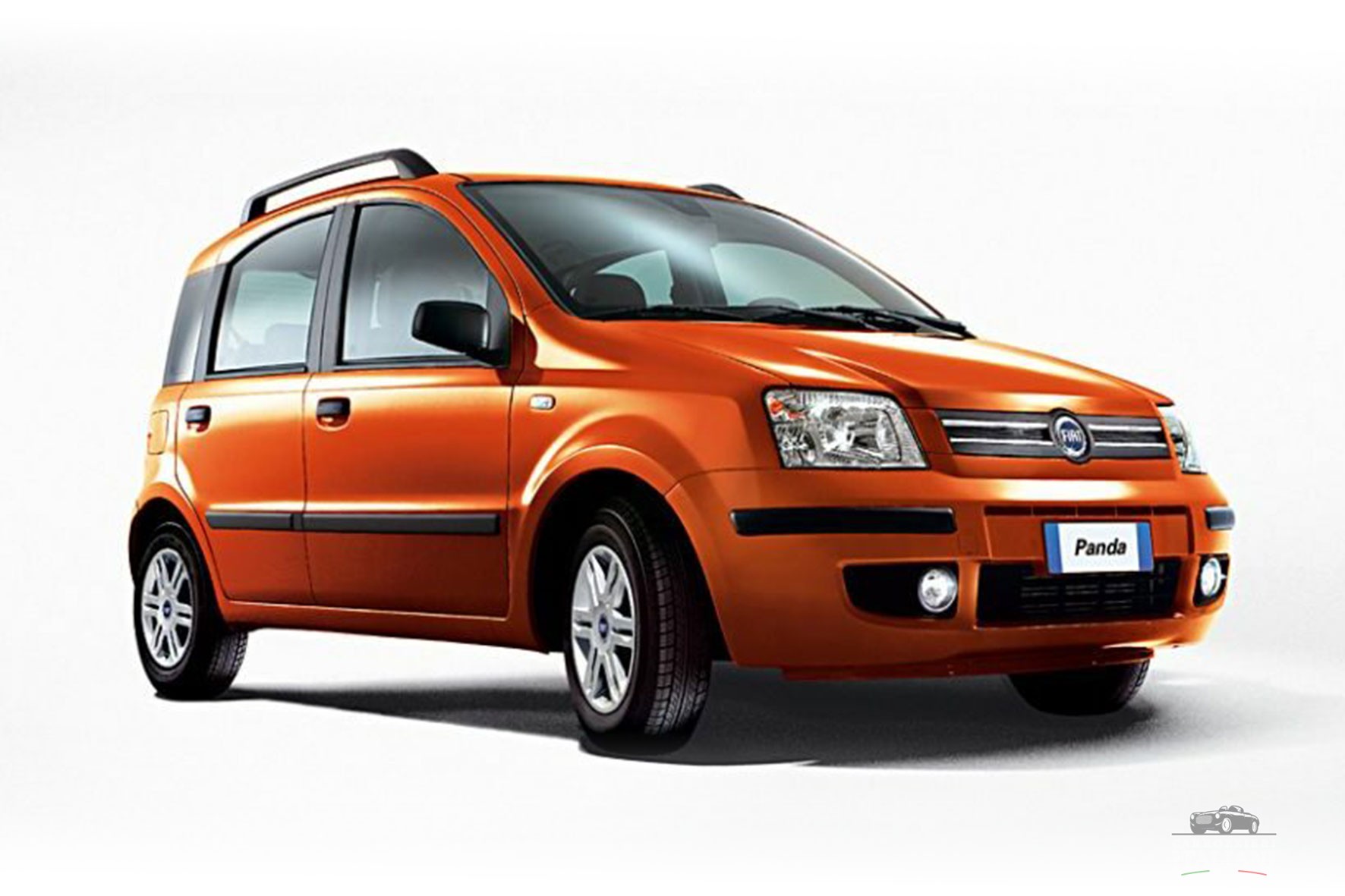
The second-generation Fiat Panda, developed as project 169, marked a fundamental change in the small Fiat’s architecture. The original three-door Panda, introduced in 1980, was succeeded by a taller, five-door car with a more flexible passenger compartment and a dashboard-mounted gear lever. Initially shown under the name Gingo at the Geneva Motor Show in March 2003, the new model was officially renamed Panda on 30 July, before its international press presentation in Lisbon that September. Fiat explained the change partly by the similarity of Gingo to a competitor’s existing name, while emphasising the recognition accumulated by the Panda nameplate. The first generation ended production on 5 September 2003, as the new model entered European showrooms.
Design and manufacture
The Panda’s styling emerged from a collaboration between Centro Stile Fiat and Bertone. Contemporary design histories identify Giuliano Biasio, then working at Bertone, as a central contributor to the exterior design. This is an important distinction for the history of Italian coachbuilding: Bertone contributed design work, but did not manufacture the production bodies. Series production was undertaken by Fiat Auto Poland at Tychy, where assembly began in May 2003. The five-door body combined a compact footprint with an upright cabin. Fiat’s later technical documentation records a 2,299 mm wheelbase, 3,538 mm length and 1,589 mm width, while height, weight and other specifications varied according to version. The range included small petrol engines and the 1.3 Multijet diesel, with front-wheel drive on conventional versions and four-wheel drive on selected derivatives.
Awards and developments
The new Panda received two major design and automotive distinctions: the 2004 European Car of the Year title, with 281 jury points, and the 2004 ADI Compasso d’Oro. Both recognitions belong to the second-generation production model, not to the Giugiaro-designed 1980 Panda or to an individual prototype. The platform subsequently supported a broader family, including the Panda Cross. It also provided the basis for distinct coachbuilding and concept-car interpretations, notably the 2003 Panda Marrakech developed by I.DE.A Institute and the 2006 Panda Jolly by Stola. Fiat recorded the millionth second-generation Panda in 2007 and the two-millionth in 2011. The design remained in the range as Panda Classic as the next generation arrived.


THE CONVERSATION
Comments 0