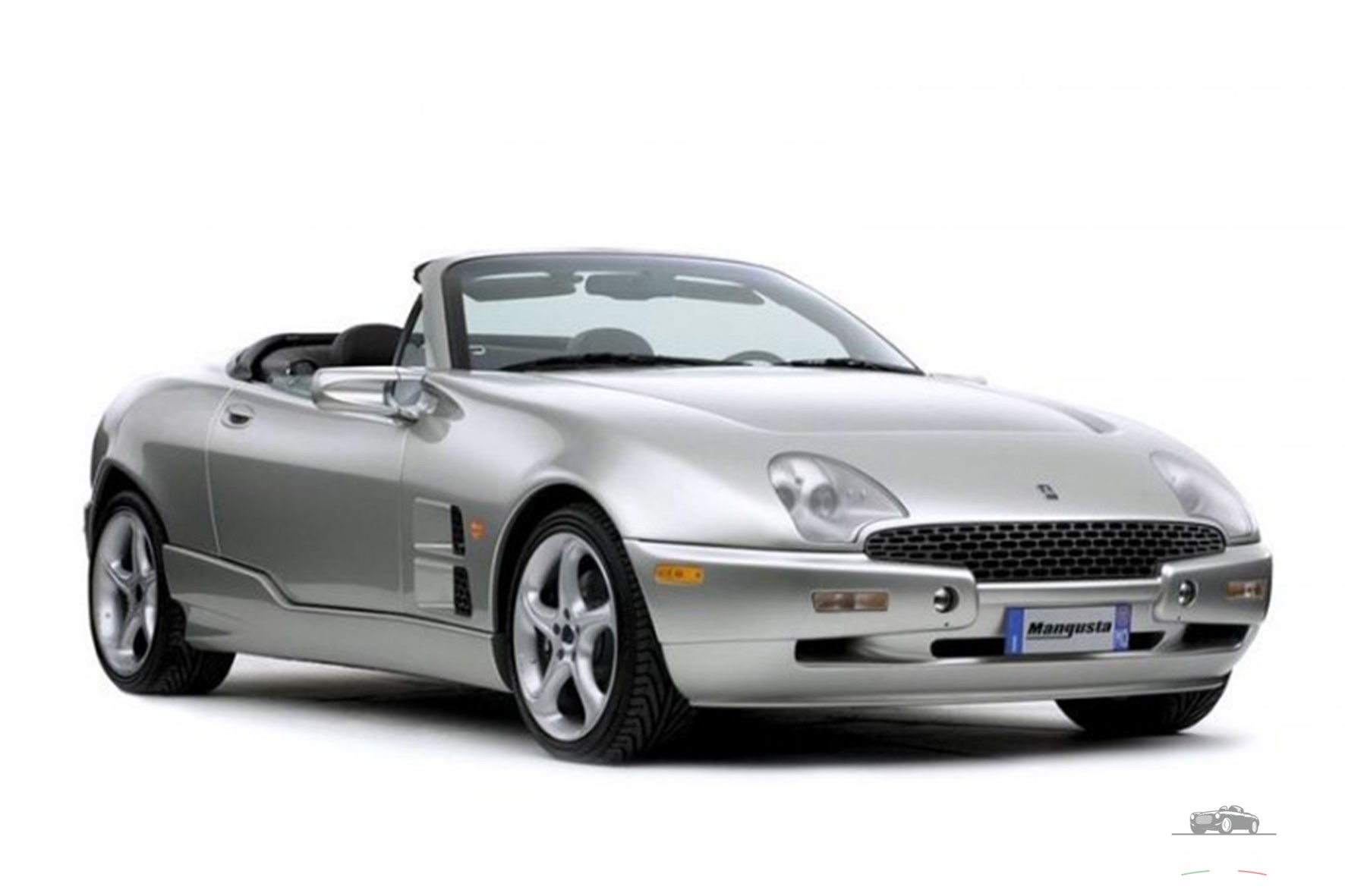
The Qvale Mangusta was developed from the De Tomaso Biguá concept car shown to the general public at the 1999 Geneva Motor Show. When the car started production, it was renamed De Tomaso Mangusta (named after the car originally built between 1967 and 1971) before De Tomaso became disassociated from the project and all subsequent cars received Qvale badging. In 1993 and 1994, Maserati technical director Giordano Casarini made several business trips to the United Kingdom and, while there, saw the TVR Griffith for the first time and was impressed by the style and sales success of such a low-volume car. Meanwhile, Alejandro de Tomaso had suffered a stroke in 1993. After a period of recovery de Tomaso asked Casarini, whom he considered a trusted friend, what to do with the De Tomaso company. Casarini suggested that he produce an “Italian TVR,” emphasizing the positive design elements that made Griffith attractive. Alejandro de Tomaso negotiated with the president of Maserati to let Casarini go to De Tomaso so that work on the project could begin. Casarini intended to use an existing, inexpensive V8 engine that could reduce the car’s purchase and maintenance costs. In keeping with the tradition for De Tomaso’s cars, he wanted to use a Ford V8 and considered using Ford’s new 4.6-liter modular V8, but found that Ford was not yet ready to sell it to manufacturers. Casarini learned that TVR was investigating the possibility of using differentials made by the Australian company BTR Automotive in its cars. While communicating with a supplier for differentials, he was redirected to Holden Special Vehicles, which would be able to offer engines and transmissions. At this stage, the De Tomaso project was given the internal code name “ETX.” Shortly after Casarini’s communications with HSV, Ford Motor Company contacted him with the news that they would indeed be able to supply the modular V8, along with transmissions, accessories and electrical systems. Alejandro de Tomaso had been an admirer of the work done by Marcello Gandini, so the designer was called to Modena to discuss the design work on the new De Tomaso project. To show him the character and feel of the desired product, Gandini was driven around in a TVR Griffith. He was eventually commissioned to style the car and instructed that the folding roof mechanism on the De Tomaso was similar to the multi-position soft top used on the Griffith.A prototype of the car was displayed at the 1996 Geneva motor show and was called the De Tomaso Biguà, although it still needed further development before reaching the production version. The company required the capital to continue with this project, and an initial appeal to the Italian government failed due to Alejandro de Tomaso’s declining health. Eventually, the company approached the Qvale family, which, led by Kjell Qvale, had been a North American importer of the De Tomaso Mangusta in the 1960s and later of the Maserati when it was under De Tomaso ownership. Qvale agreed to finance the development of the Qvale Mangusta, with the agreement that the final product would be sold under the De Tomaso brand, as the De Tomaso Mangusta. The agreement between De Tomaso and Qvale soured over licensing and distribution issues. Bruce Qvale, who ran Qvale at the time, decided to produce the car under the Qvale name after an investment of more than $30 million in developing the car. The Qvale Mangusta uses a front mid-engine, rear-wheel drive layout, and is powered by a 4.6 L DOHC Ford modular V8 engine. It was offered with either a BorgWarner T45 5-speed manual or a 4-speed automatic transmission.


THE CONVERSATION
Comments 0