
Billie Brownlie
AT A GLANCE
- Nationality
- American
- Occupation
- Automotive stylist
- Active from
- 1950s
- Studio
- Chrysler
- Based in
- United States
THE STORY
Overview
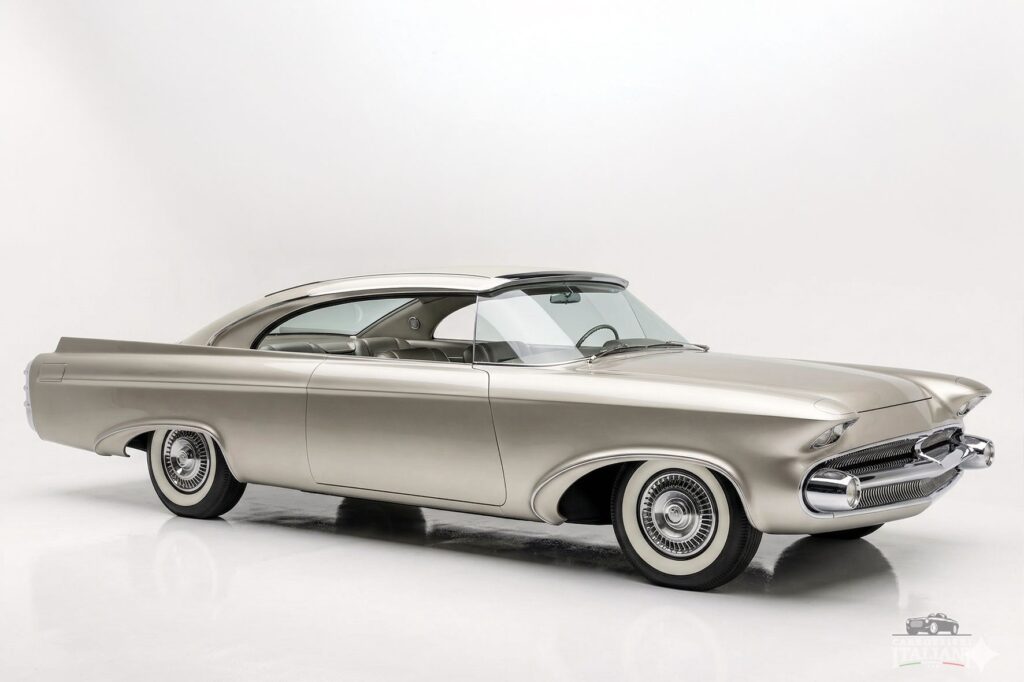
William “Bill” Brownlie, also recorded as Billie Brownlie in accounts of the Chrysler–Ghia collaboration, was an American automotive stylist and design executive. A Detroit native, he worked for Ford and Briggs Manufacturing before joining Chrysler’s styling organisation in the 1950s. He is particularly associated with the 1956 Chrysler Norseman, an experimental four-seat coupé styled within the team led by Virgil Exner and constructed by Carrozzeria Ghia in Turin. His surviving work and documented professional activities also extend to commercial-vehicle interior design, Chrysler’s Imperial studio and the review of advanced transportation concepts.
Training and early design career
Brownlie attended Eastern High School in Detroit and subsequently the Detroit Institute of Technology. He served in the United States Navy during the Second World War aboard a destroyer escort in the Asiatic theatre. His earliest documented civilian design appointment was with the Joseph Buegeleisen Company in 1948–49, followed by employment as an automotive stylist at Ford from 1949 to 1952. By the early 1950s he was developing highly finished vehicle-interior presentation drawings, illustrating the close relationship between industrial design, styling communication and the commercial demands of American car and truck manufacturers.
A truck-cab interior rendering dated 1952 and preserved by the Cooper Hewitt, Smithsonian Design Museum, is an especially useful example of Brownlie’s own graphic work. The drawing uses airbrush and ink to present a passenger-side cutaway, with careful treatment of upholstery, colour, proportions and light. It documents a specific design and presentation exercise, but does not establish that the depicted interior entered series production.
Briggs Manufacturing and Chrysler
Brownlie worked at Briggs Manufacturing before transferring to Chrysler after the latter company acquired the body supplier. In 1954 he entered Chrysler’s Styling Section, part of its engineering organisation. The company was then undergoing a period of major stylistic change associated with Virgil Exner’s Forward Look and a programme of increasingly ambitious experimental vehicles. In 1956 Brownlie became manager of Chrysler’s Imperial Exterior Studio. A contemporary April 1958 announcement by the Detroit Chapter of the American Institute of Architects identified him by his full name and this exact managerial responsibility, making it a particularly strong contemporary record for his career chronology.
In April 1958 Brownlie was scheduled to address Detroit architects on automotive design and styling. The invitation reflected the mid-century connections between architecture, manufacturing and industrial design, and the growing influence of appearance on automobile purchasing decisions. His role was not limited to sketching an individual body: he worked within a large corporate organisation that translated design proposals into models, engineering packages and vehicles intended for production or display.
The Chrysler Norseman and the Ghia collaboration
The most clearly documented Italian coachbuilding connection in Brownlie’s career is the Chrysler Norseman. The concept originated inside Chrysler’s American design organisation under Exner’s overall direction, while Brownlie is identified in specialist accounts of the programme as the stylist responsible for its development. The project sought an unusually open passenger compartment: a cantilevered roof carried by the rear body structure, with conventional front roof pillars eliminated and an electrically operated roof panel integrated into the slender upper structure.
Chrysler commissioned Carrozzeria Ghia in Turin to turn the design into a functioning prototype. The technical and practical difficulties of constructing the roof, glazing and associated mechanisms were addressed by the Italian coachbuilding team, in particular the prototype shop led by Sergio Coggiola. Brownlie’s design responsibility, Exner’s direction and Ghia’s physical execution are distinct roles; the Norseman should not be described as an entirely independent Ghia styling proposal or as the personal creation of any single member of either team.
After completion in 1956, the one-off vehicle was shipped aboard the Italian liner Andrea Doria for its intended American debut. The liner collided with Stockholm on 25 July and sank the following day. The Norseman was lost before it could be publicly exhibited, although contemporary photographs and surviving records document its appearance and construction. The loss also ended any opportunity to examine the prototype in a normal exhibition context. The vehicle was never a production model, and the loss of the prototype must not be confused with the production history of other Chrysler or Imperial cars.
Imperial design and later work
Brownlie’s Imperial studio position connected him with the wider Chrysler luxury-car programme. Historical accounts of the Chrysler–Ghia relationship include Brownlie among the American styling personnel contributing to early design work for the Ghia-built Crown Imperial limousines, together with Virgil Exner and Cliff Voss. The Italian firm’s own designers and craftsmen undertook further design development and construction, and particular models or individual limousines require more precise evidence before receiving a personal Brownlie attribution.
His later activity is independently documented in May 1973, when he and fellow Chrysler design executive Art Blakeslee reviewed transportation-design students’ work at ArtCenter College of Design in California. The Chrysler-sponsored exercise concerned a versatile family travel and recreation vehicle intended to combine the usefulness of a station wagon with some of the packaging benefits of a van. Brownlie’s participation demonstrates his continuing involvement with transportation design and professional education nearly two decades after the Norseman programme. It does not, by itself, prove authorship of a later production minivan or any specific Chrysler model.
Attribution and historical record
Brownlie represents a generation of designers whose achievements were often recorded under the names of corporate design chiefs or the specialist coachbuilders that executed their projects. The Norseman provides a comparatively clear example of his role, while the Imperial programmes require careful treatment of joint authorship. The available contemporary evidence establishes his Detroit background, appointments and work for Chrysler, but does not support exact birth and death dates. Historical portrait material and surviving studio images must be assessed individually for provenance and reproduction rights before being added to his public record.
THE NETWORK
Shared vehicle credits

CONTINUE EXPLORING

THE CONVERSATION
Comments 0