
Maggiora
Founded in 1925 by Arturo Maggiora, Carrozzeria Maggiora developed from bespoke bodywork into industrial production, manufacturing bodies and vehicles for Italian automotive brands.
Explore record ↗
1994Coachwork by Maggiora
THE VEHICLE AT A GLANCE
THE PEOPLE BEHIND THE CAR
Founded in 1925 by Arturo Maggiora, Carrozzeria Maggiora developed from bespoke bodywork into industrial production, manufacturing bodies and vehicles for Italian automotive brands.
Explore record ↗Andreas Zapatinas is a Greek automotive designer whose career spans Fiat, BMW and Subaru. At Fiat, he played a leading exterior-design role in the Barchetta project.
Explore record ↗01 / THE STORY
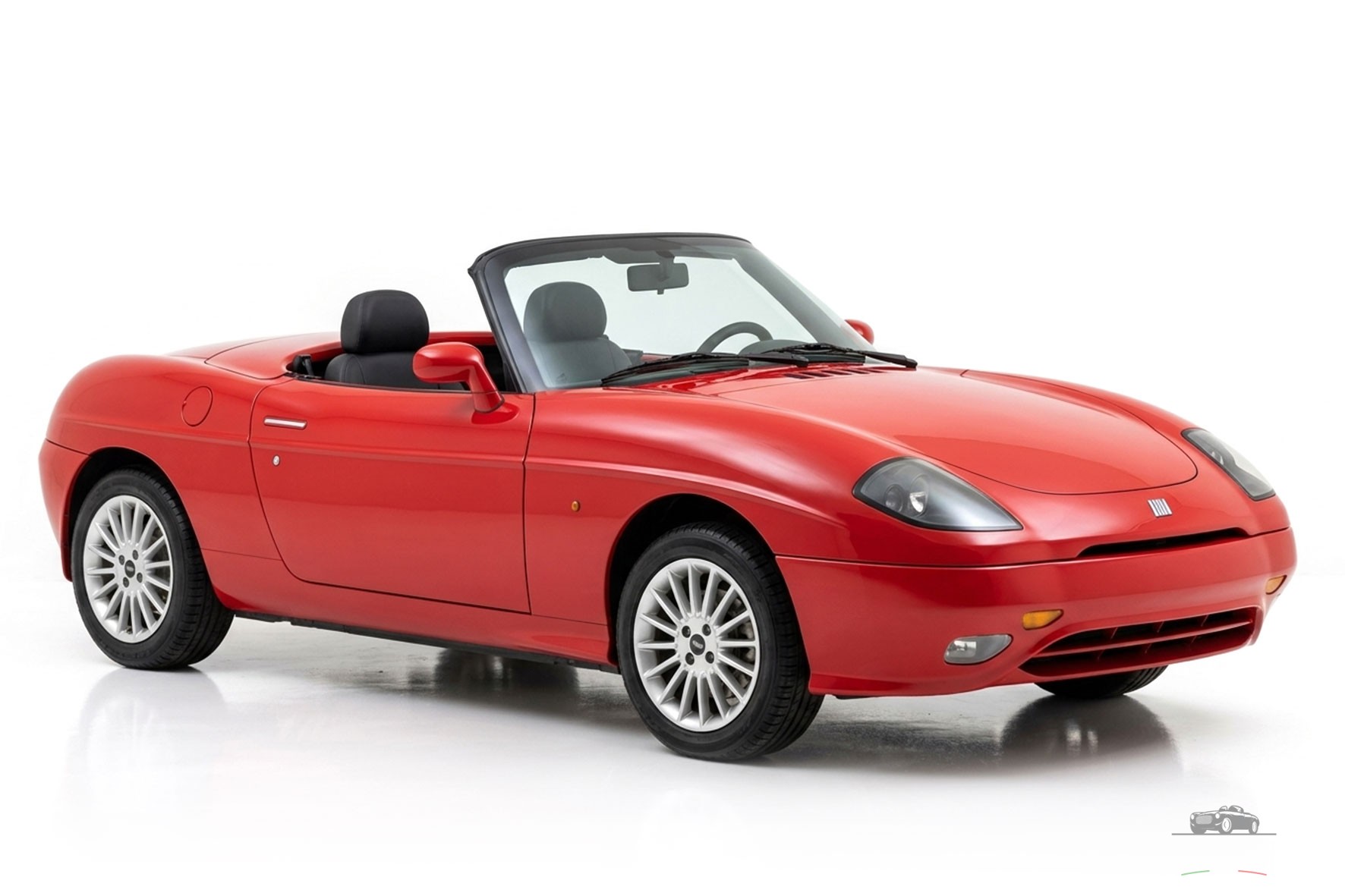
The Fiat Barchetta is a roadster produced by the Italian automaker Fiat from 1994 to 2005, marking Fiat’s return to the sports car segment after a long absence. The design of the Barchetta, often written in lowercase by enthusiasts, was created by Greek designer Andreas Zapatinas. He drew inspiration from the Ferrari 166 MM in his initial sketches, made in 1990, and led the project until 1993, when he was replaced by Alessandro Cavazza, who guided the car into production. The Barchetta was built on the shortened platform of the Fiat Punto and was equipped with a 1.747 cm³ 16V engine from the Pratola Serra modular family, producing 130 horsepower at 6,300 RPM. This engine, shared with the Fiat Coupé and the Punto HGT, featured a variable valve timing system (VFD) on the intake camshaft, optimizing torque and performance at different engine speeds. This allowed the Barchetta to accelerate from 0 to 100 km/h in under 9 seconds and reach a top speed of over 200 km/h. In 1999, the engine underwent a technical update without much public announcement. The new “Step 2” version featured a Hitachi micro-hybrid ECU and a variable intake system (V.I.S.), which improved response without increasing emissions. In 2001, the Barchetta was further updated to comply with Euro 3 emissions standards, adding a pre-catalytic converter and electronic throttle control. A unique aspect of the Fiat Barchetta is that prototyping was carried out by Stola and its final assembly was handled by Maggiora at the former Lancia factory in Chivasso. Maggiora was responsible for assembling components that were produced at various locations: the chassis was made by ILCAS, the painting was done by Carrozzeria Bertone, and the engines were built at Fiat’s Pratola Serra plant before being sent to Chivasso for final assembly. When Maggiora went bankrupt in 2002, production was halted, but it resumed in 2003 at Fiat’s Mirafiori plant. The Barchetta featured advanced safety systems, including airbags, side impact bars in the doors, and a reinforced body with a deformation-controlled structure. Its braking system had a dual-circuit setup with a short-stroke brake booster, making it highly efficient for sporty driving. ABS was available on some versions. Approximately 57,791 units of the Fiat Barchetta were produced, with the car debuting at the Geneva Motor Show in 1995. Production ended definitively in June 2005. In 1996 Maggiora made a Coupé Prototype and a prototype for a second generation was created by Carrozzeria Bertone in 2007, but it never reached production.
02 / TECHNICAL IDENTITY
03 / DESIGN, BODY & SUPPLIERS
Coachbuilder / Design studio
Founded in 1925 by Arturo Maggiora, Carrozzeria Maggiora developed from bespoke bodywork into industrial production, manufacturing bodies and vehicles for Italian automotive brands.
Explore record ↗Attributed designer
Andreas Zapatinas is a Greek automotive designer whose career spans Fiat, BMW and Subaru. At Fiat, he played a leading exterior-design role in the Barchetta project.
Explore record ↗Become a Pro member to see the full details in this section.
Membership is not available yet.
View membership options04 / CHRONOLOGY
07 / GALLERY

THE CONVERSATION
Comments 0