
Motto
Founded in Turin in 1932 by Rocco Motto, Carrozzeria Motto became known for lightweight hand-formed aluminium bodies and specialist sporting cars.
Explore record ↗
1955Coachwork by Motto
THE VEHICLE AT A GLANCE
THE PEOPLE BEHIND THE CAR
Founded in Turin in 1932 by Rocco Motto, Carrozzeria Motto became known for lightweight hand-formed aluminium bodies and specialist sporting cars.
Explore record ↗01 / THE STORY
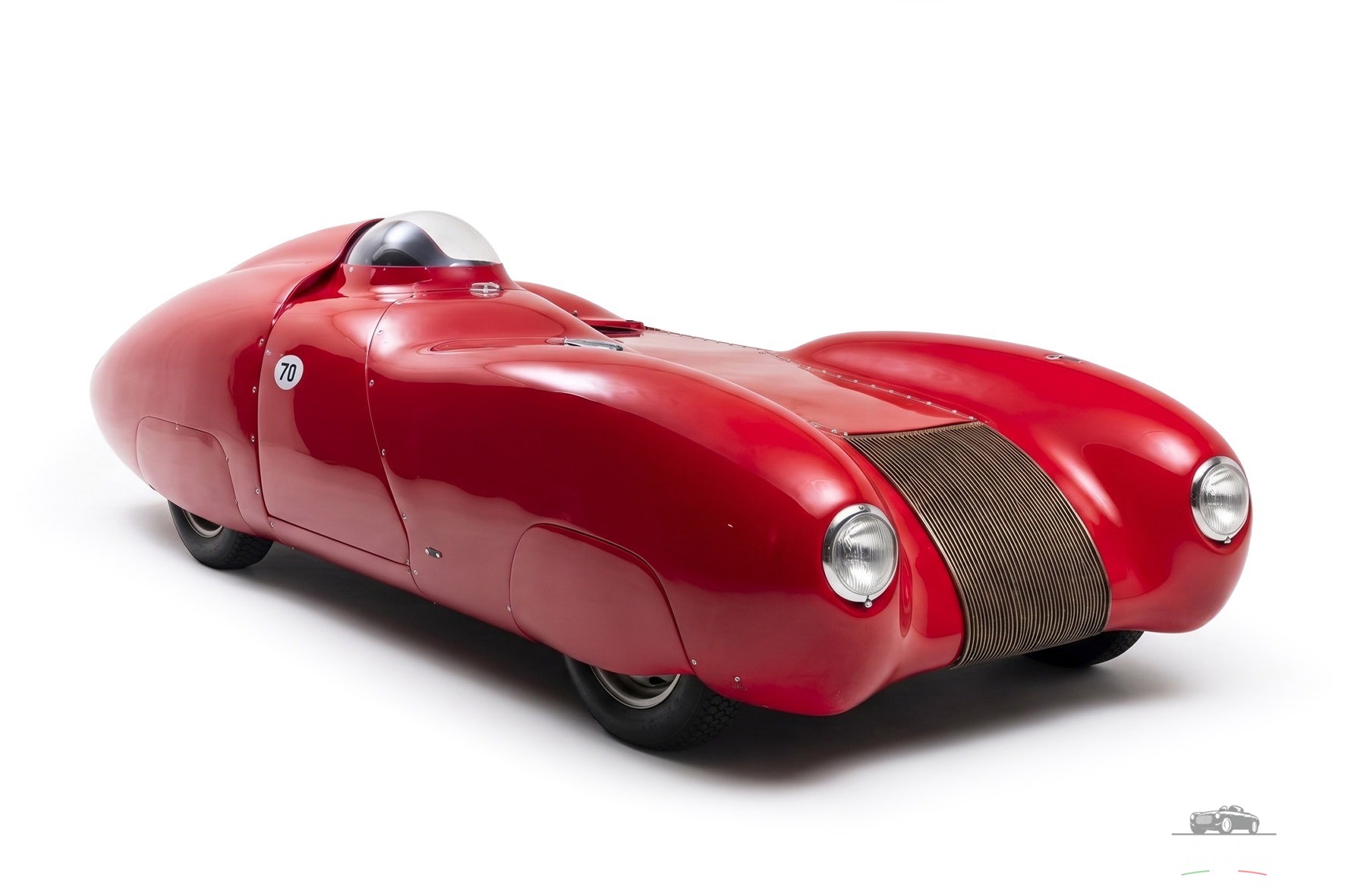
The Nardi Bisiluro, also known as the Nardi Le Mans, represents a fascinating yet ultimately short-lived experiment in automotive design and racing innovation during the 1950s. Conceived by Enrico Nardi’s Automobili Nardi in 1955, the Bisiluro was intended to push the boundaries of aerodynamics and performance at the prestigious Le Mans 24-hour race. The defining feature of the Nardi Bisiluro was its unique trimaran-like design, crafted by Carrozzeria Motto. The car was split into two distinct sections: the smaller, left-hand side housed the 735 cm³ Giannini engine, positioned horizontally. Meanwhile, the larger right-hand side accommodated the cockpit and fuel tank. This asymmetrical layout was aimed at optimizing aerodynamic efficiency and weight distribution, inspired by principles seen in marine trimarans. In practice, however, the Bisiluro faced significant challenges on the racetrack. Its unconventional design made it exceptionally unstable, particularly vulnerable to crosswinds. This instability was evident during the Le Mans race where, after just five laps, driver Mario Damonte encountered lapping traffic from much faster 3-liter cars. The turbulence created by these larger vehicles caused the Bisiluro to lift off the ground and ultimately overturn, leading to an accident. Despite the crash, the relatively slow speed of the Bisiluro meant the damage was minor, and fortunately, Damonte escaped unscathed. However, the incident underscored the fundamental flaws in the Bisiluro’s design, particularly its susceptibility to external forces and lack of stability at high speeds. Following this setback, Nardi chose not to pursue further development of the Bisiluro concept. The car’s brief foray into racing highlighted the ambitious yet precarious nature of its design. While innovative in theory, the practical challenges it faced on the track outweighed its potential benefits. As a result, the Nardi Bisiluro remains a curious footnote in automotive historya testament to bold experimentation and the quest for performance through unconventional means during a pioneering era of motorsport.
02 / TECHNICAL IDENTITY
03 / DESIGN, BODY & SUPPLIERS
Coachbuilder / Design studio
Founded in Turin in 1932 by Rocco Motto, Carrozzeria Motto became known for lightweight hand-formed aluminium bodies and specialist sporting cars.
Explore record ↗04 / CHRONOLOGY
05 / PEOPLE, COLLECTIONS & MUSEUMS
08 / GALLERY
THE CONVERSATION
Comments 0