
Riva
Carrozzeria Riva evolved from nineteenth-century carriage construction to commercial vehicles, advertising bodies and sporting automobiles during the twentieth century.
Explore record ↗
1935Coachwork by Riva
THE VEHICLE AT A GLANCE
THE PEOPLE BEHIND THE CAR
Carrozzeria Riva evolved from nineteenth-century carriage construction to commercial vehicles, advertising bodies and sporting automobiles during the twentieth century.
Explore record ↗01 / THE STORY
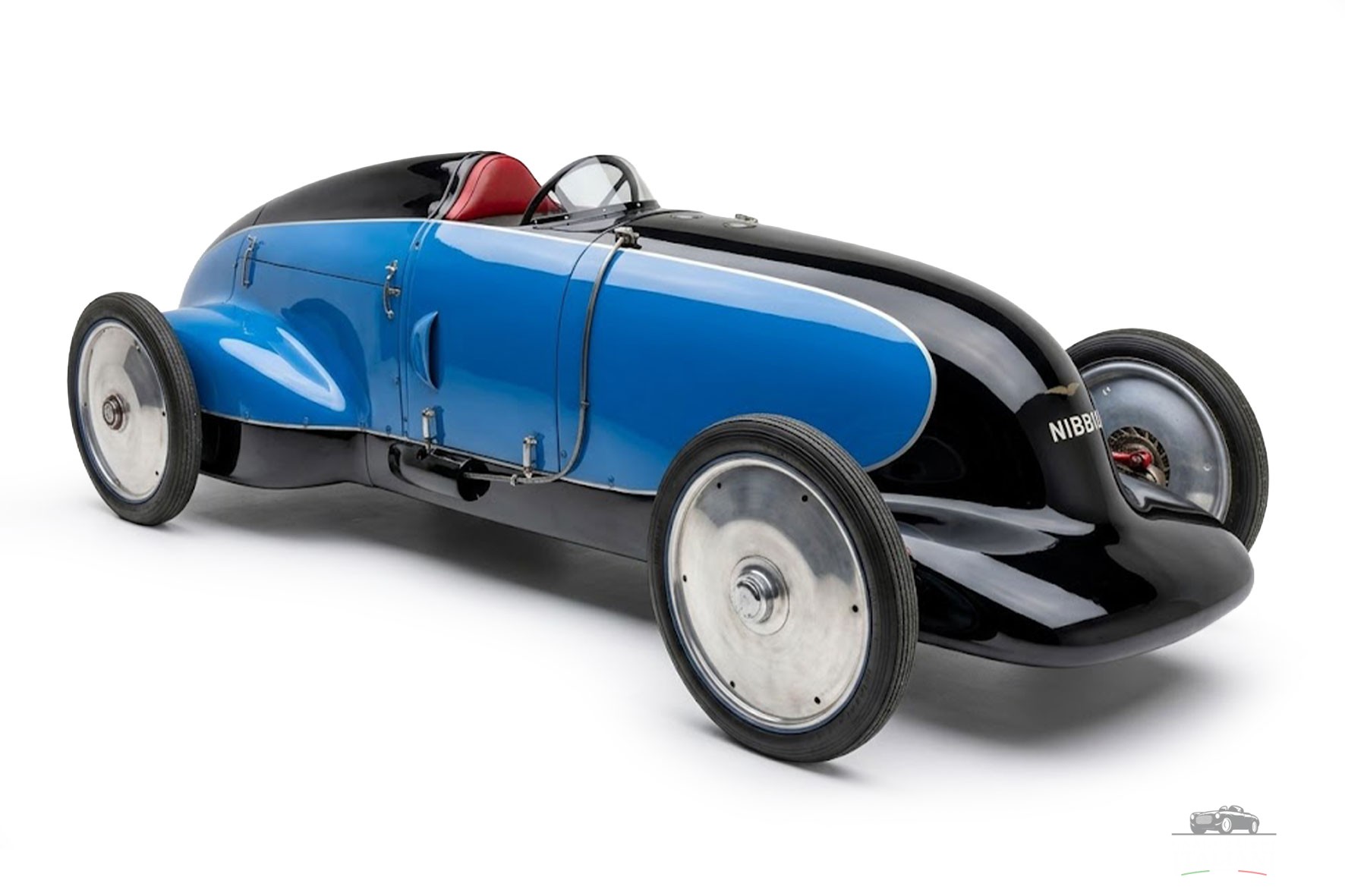
The Lurani Nibbio is a fascinating and pioneering automobile that represents the innovative spirit and engineering excellence of Giovanni Lurani. Born in Lombardy, Northern Italy, Lurani began his professional career as an automobile designer and quickly made a name for himself in the racing world. By the late 1920s, Lurani was already competing in motor racing, and he participated in the Mille Miglia a total of nine times, achieving three class victories, including in 1938 while driving a BMW 328. However, it was in the realm of record-breaking that Lurani truly showcased his talent, particularly with the creation of the Lurani Nibbio. The Nibbio, designed by Lurani as a lightweight and aerodynamically styled vehicle, was built with the purpose of setting speed records. In fact, it was the first automobile in its class with an engine capacity of just 0.5 liters to surpass 100 mph (160.9 km/h). The car was powered by a 500 cc two-cylinder motorcycle engine from Moto Guzzi, which produced 46 hp. Driven by Lurani himself, the Nibbio broke four World Speed Records, cementing its place in automotive history. This success was a testament to Lurani’s engineering skill and his ability to create vehicles that combined lightweight construction with impressive performance. In 1939, Carrozzeria Riva further optimized the Nibbio’s body, contributing to even greater success, as the car went on to break an additional eight records. The Nibbio continued to evolve, with further speed records being set up until 1947. During this period, the Nibbio’s engine was upgraded to a 250 cc supercharged single-cylinder unit from Moto Guzzi, pushing the limits of speed even further. Later, the supercharged engine was replaced by a naturally aspirated engine that generated 43 hp, which continues to power the Nibbio to this day. The Lurani Nibbio’s legacy extended beyond its mechanical achievements. In 2017, it was awarded the prestigious Coppa d’Oro Villa d’Este, a recognition of its historical importance and enduring influence on automotive design and performance. The development of the Nibbio marked the beginning of a new chapter in small-engine record-breaking cars, and Lurani’s success was a defining moment in the early history of high-performance, lightweight vehicles. The Nibbio II, developed in 1955 with a body made by Ghia, continued Lurani’s pursuit of excellence in design and speed, further elevating his reputation in the world of automotive engineering.
02 / TECHNICAL IDENTITY
03 / DESIGN, BODY & SUPPLIERS
Coachbuilder / Design studio
Carrozzeria Riva evolved from nineteenth-century carriage construction to commercial vehicles, advertising bodies and sporting automobiles during the twentieth century.
Explore record ↗04 / CHRONOLOGY
05 / PEOPLE, COLLECTIONS & MUSEUMS
08 / GALLERY
THE CONVERSATION
Comments 0