
Savio
Carrozzeria Savio was a Turin coachbuilder founded by Antonio and Giuseppe Savio, known for bespoke bodies and later specialist vehicles on Fiat and other Italian chassis.
Explore record ↗
1975Coachwork by Savio
THE VEHICLE AT A GLANCE
THE PEOPLE BEHIND THE CAR
Carrozzeria Savio was a Turin coachbuilder founded by Antonio and Giuseppe Savio, known for bespoke bodies and later specialist vehicles on Fiat and other Italian chassis.
Explore record ↗01 / THE STORY
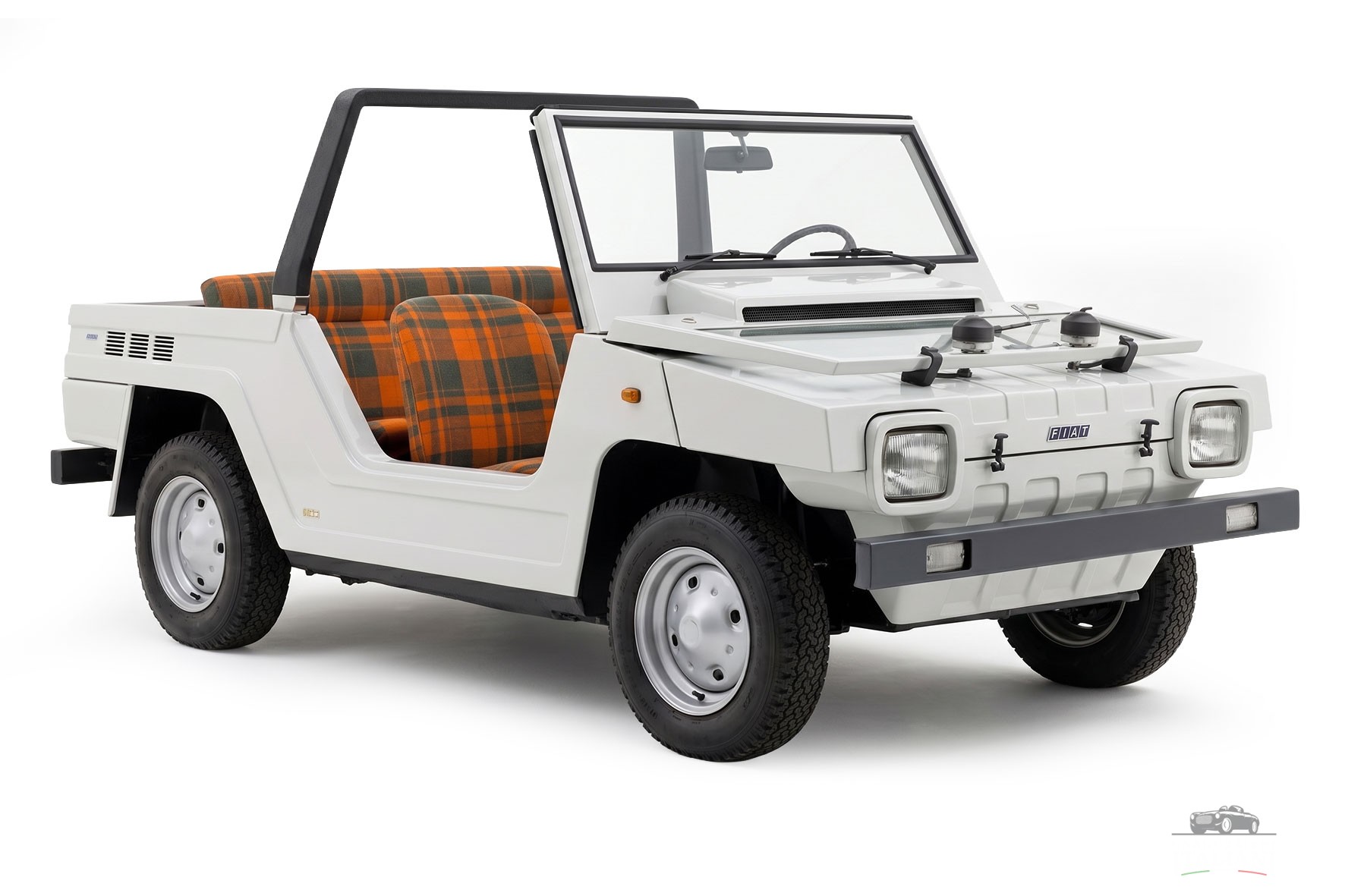
The Fiat 126 Jungla was a low-production leisure vehicle developed by Carrozzeria Savio during the 1970s, based on the mechanical platform of the Fiat 126. It adhered to the spiaggina typology, a class of simplified, open-bodied vehicles adapted from standard models for recreational and resort environments. The Jungla was conceived as a utilitarian transport solution for short-distance, low-speed applications, frequently within coastal or insular contexts. The base Fiat 126, introduced in 1972 as a successor to the Fiat 500, featured a rear-mounted, air-cooled two-cylinder engine displacing 594 cubic centimeters in its early iterations. Power output was modest, ranging from 23 to 26 horsepower, transmitted through a four-speed manual gearbox to the rear axle. The mechanical layout of the Jungla remained unchanged from the production 126, offering basic mobility rather than performance. Savio’s intervention was limited to the bodywork, which was entirely replaced with a lightweight, open-air structure composed of pressed steel or aluminum panels, depending on the version. The roof was replaced by a removable canvas top, and the doors were either entirely omitted or reduced to tubular or panel inserts. The design prioritized ease of access, visibility, and low-cost manufacturing. Seating was rudimentary, and weather protection minimal, reflecting the vehicle’s intended use in fair weather and controlled environments. The Jungla was particularly suited for deployment in tourist zones, private estates, or as auxiliary transport in rural and insular settings. It served a similar role to other European leisure vehicles such as the Citroën Méhari or the Renault Rodeo. Unlike those examples, however, the Jungla remained relatively obscure and was produced in smaller numbers. The distribution was primarily confined to the Italian domestic market, with limited export activity. The Fiat 126 Jungla occupies a marginal position within the broader narrative of Italian automotive history. It represents a continuation of localized coachbuilding traditions adapted to standardized, postwar production platforms. Its historical value resides in its alignment with a specific mode of seasonal transportation, illustrating a form of vehicular minimalism defined not by austerity but by environmental specificity and utilitarian design logic.
02 / TECHNICAL IDENTITY
03 / DESIGN, BODY & SUPPLIERS
Coachbuilder / Design studio
Carrozzeria Savio was a Turin coachbuilder founded by Antonio and Giuseppe Savio, known for bespoke bodies and later specialist vehicles on Fiat and other Italian chassis.
Explore record ↗07 / GALLERY
THE CONVERSATION
Comments 0