
THE VEHICLE AT A GLANCE
Model dossier
- Manufacturer
- Ferrari
- Base model
- 330 P4
- Coachbuilt version
- factory P4; Berlinetta converted to Spyder
- Coachbuilder
- Sports Cars
- Production period
- 1967
- Body style
- Berlinetta / Spider
- Chassis
- 0856
- Designer
- Mauro Forghieri
THE PEOPLE BEHIND THE CAR
Coachbuilding, design & conversions
01 / THE STORY
History & context
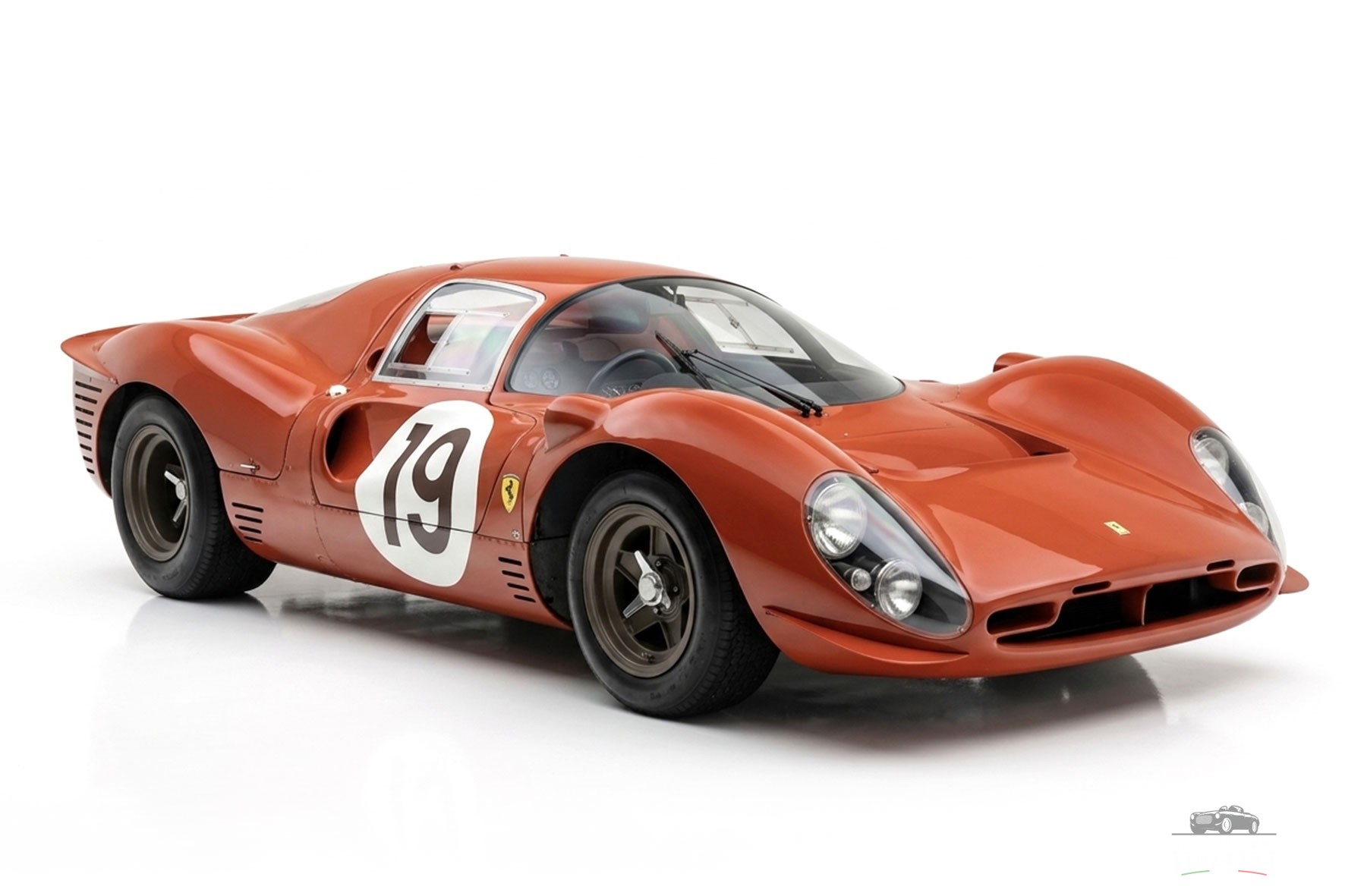
The Ferrari 330 P4, introduced in 1967, represents one of the final and most refined expressions of Ferrari’s mid-century endurance racing ambitions. Developed in direct response to the competitive threat posed by Ford’s GT40 programme, the 330 P4 was engineered with the objective of regaining superiority in international sports car racing, particularly within the World Sportscar Championship. The vehicle was constructed around a tubular steel chassis, clothed in a curvilinear fiberglass body by Carrozzeria Sports Cars that had been honed through aerodynamic testing. The overall form emphasized reduced drag and improved high-speed stability, with pronounced wheel arches, a low frontal profile, and an enclosed cockpit contributing to a coherent aerodynamic silhouette. The total weight of the machine remained under 800 kilograms, supporting the balance between velocity and endurance. At the mechanical core of the 330 P4 was a naturally aspirated V12 engine, displacing 3,967 cubic centimetres. This unit, developed under the guidance of Franco Rocchi, featured a three-valve-per-cylinder layout—two intake and one exhaust—paired with a Lucas fuel injection system. The engine was capable of producing approximately 450 horsepower at 8,000 revolutions per minute, enabling a top speed in excess of 320 kilometres per hour. The gearbox was a five-speed manual, driving the rear wheels, consistent with the mid-engine, rear-wheel-drive configuration adopted by Ferrari’s prototype race cars during this era. Suspension was fully independent, employing unequal-length wishbones and coil springs over dampers, with ventilated disc brakes fitted to each wheel to ensure consistent deceleration over extended periods of competition. The vehicle’s dynamics were calibrated to sustain both high-speed stability and cornering efficiency over endurance distances. The 330 P4’s most notable achievement occurred at the 24 Hours of Daytona in 1967, where Ferrari secured a dominant 1-2-3 finish. It also claimed a second-place result at the 24 Hours of Le Mans the same year. Only four chassis were constructed, rendering the P4 a rare artifact of competition history. It remains emblematic of Ferrari’s late 1960s rivalry with Ford and serves as a culminating example of front-line European endurance racing design prior to the regulatory transformations of the 1970s.
02 / TECHNICAL IDENTITY
Specifications & construction
Production & construction
- Production
- 1
- Production type
- One-off
Engine & performance
- Engine configuration
- V12
Individual vehicle details
Become a Pro member to see the full details in this section.
Membership is not available yet.
View membership options03 / DESIGN, BODY & SUPPLIERS
Design, body & suppliers
Coachbuilder / Design studio

Sports Cars
Founded in Modena by former racing driver Piero Drogo, Carrozzeria Sports Cars built specialist bodies for Ferrari and other Italian competition-car manufacturers during the 1960s.
Explore record ↗Designer
Body form & construction
- Body style
- Berlinetta / Spider
04 / CHRONOLOGY
Chronology
Le Mans 0856
- Date
- 1967
- Chassis
- 0856
06 / CHASSIS REGISTER
Chassis register
Chassis 0856
Identity & build
- Model year
- 1967
07 / GALLERY
THE CONVERSATION
Comments 0