Trevisan
Trevisan is recorded as a specialist coachbuilding concern associated with Treviso. Individual bodywork commissions and the precise history of the workshop remain under review.
Explore record ↗
1950Coachwork by Trevisan
THE VEHICLE AT A GLANCE
THE PEOPLE BEHIND THE CAR
Trevisan is recorded as a specialist coachbuilding concern associated with Treviso. Individual bodywork commissions and the precise history of the workshop remain under review.
Explore record ↗01 / THE STORY
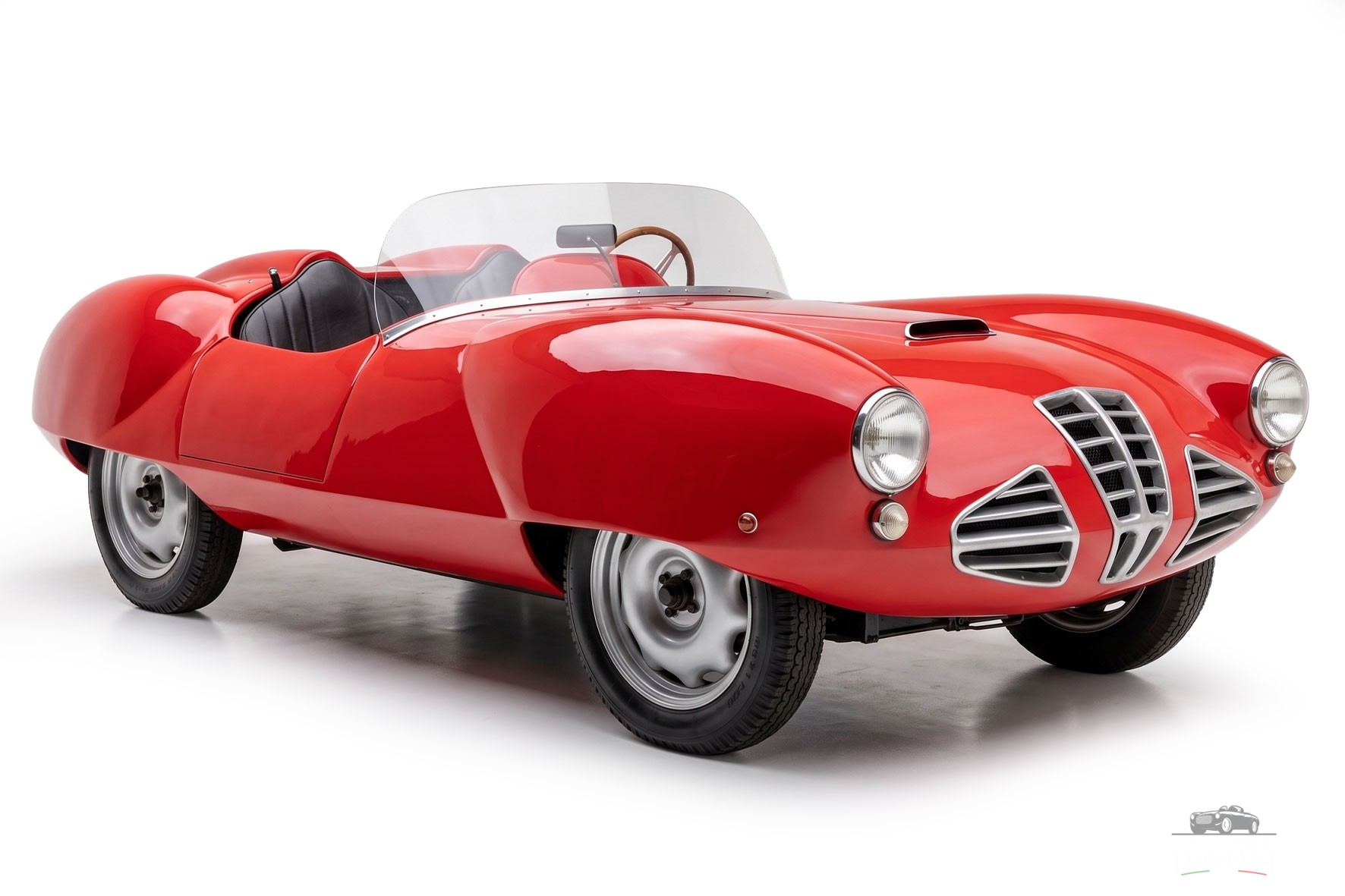
The Fiat 500C Disco Volante by Trevisan was a limited-production sports barchetta developed in the early 1950s, based on the Fiat 500C Topolino platform. Constructed by the small Italian carrozzeria Trevisan, the model adopted a distinct streamlined form influenced by contemporary aerodynamic experimentation and tailored for lightweight competition use. The chassis employed was that of the standard Fiat 500 C, a model introduced in 1949 as an evolution of the pre-war Fiat 500 Topolino. The mechanical configuration consisted of a front-mounted, water-cooled inline four-cylinder engine with a displacement of 569 cubic centimetres. Output was rated at approximately 16 horsepower in its original specification. Modifications to the Disco Volante variant included adjustments for reduced weight and altered weight distribution, though the drivetrain remained largely consistent with the production vehicle. Power was transmitted to the rear wheels through a four-speed manual gearbox. Coachwork was executed in hand-formed aluminium over a lightweight frame. The body adopted a barchetta configuration with enclosed wheels, faired-in headrests, and a low-slung profile. The design bore a notable resemblance to the Alfa Romeo Disco Volante concept developed by Touring, though the Trevisan interpretation predated it in certain respects. Stylistic elements included integrated cycle fenders, minimal brightwork, and a tapered rear section. The frontal aspect featured a recessed grille and compact lighting arrangement. The number of units produced remains undetermined. Period sources and later documentation suggest that between two and five specimens were completed. These were built for private entrants and intended primarily for local competition, including potential eligibility for events such as the Mille Miglia. Trevisan, as a small-scale coachbuilder, did not issue promotional literature or maintain systematic records for these vehicles. No definitive chassis or engine numbers have been publicly disclosed. Surviving examples are rare and not formally catalogued. At least one specimen was known to exist in Germany in the 21st century, restored for historic racing eligibility.
02 / TECHNICAL IDENTITY
03 / DESIGN, BODY & SUPPLIERS
Coachbuilder / Design studio
Trevisan is recorded as a specialist coachbuilding concern associated with Treviso. Individual bodywork commissions and the precise history of the workshop remain under review.
Explore record ↗07 / GALLERY
THE CONVERSATION
Comments 0