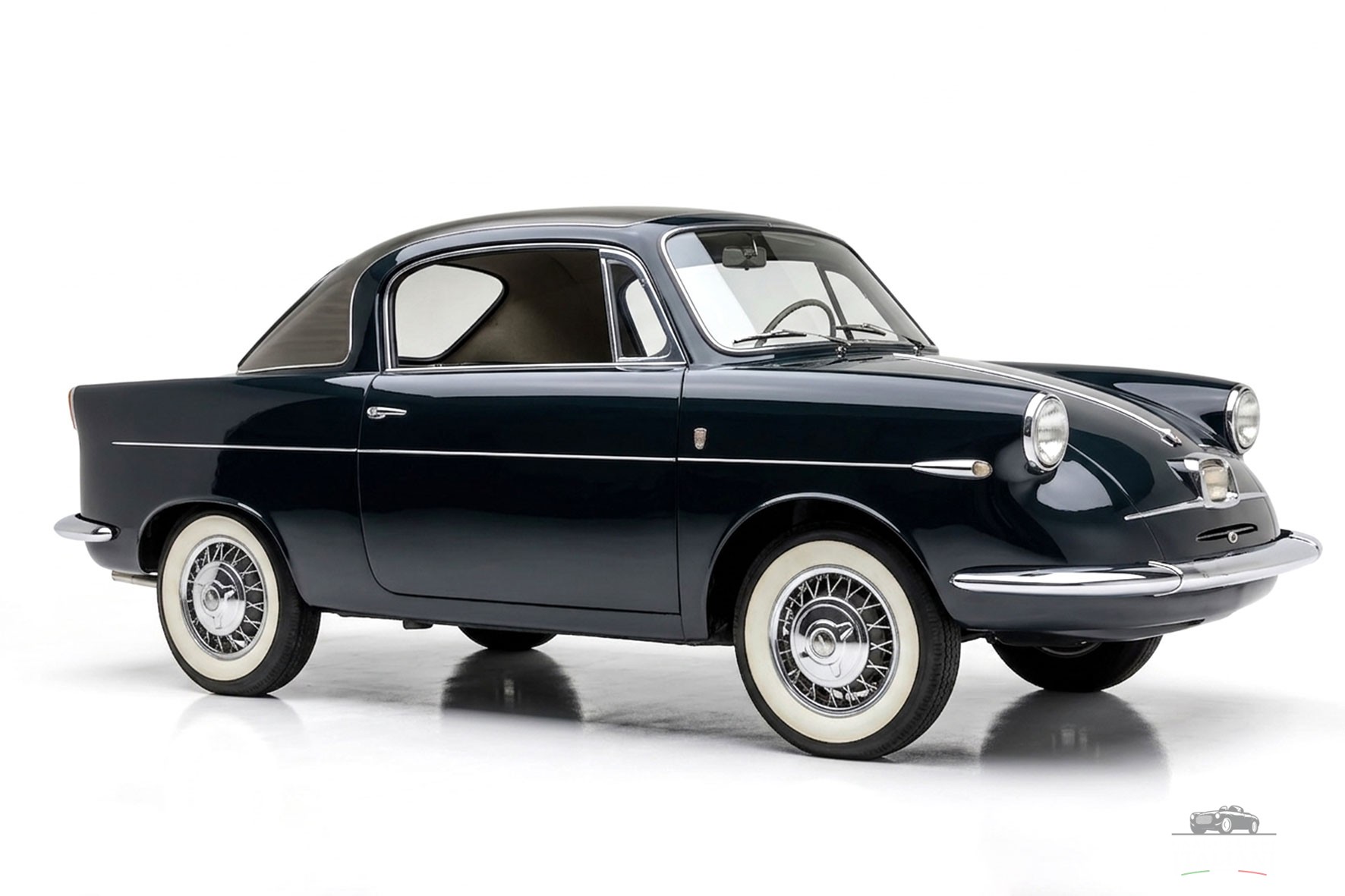
The Fiat 600 Coupé by Carrozzeria Bertone was a limited-production coachbuilt variant of the Fiat 600, developed in the late 1950s. It was constructed using the standard Fiat 600 mechanical platform and adapted into a closed two-door coupé body configuration. The model was intended as a stylistic exercise to elevate the visual presentation of a mass-produced city car while retaining its essential mechanical simplicity. The coachwork was designed by Franco Scaglione, who was at the time working under contract with Bertone. Scaglione’s approach to compact proportions, flowing lines, and balanced volumes was evident in the final form, which combined aerodynamic sensitivity with restrained ornamentation. The resulting design contributed to Bertone’s emerging identity as a modern design house in postwar Italy. The base platform was derived from the Fiat 600, introduced in 1955. The 600 utilized a rear-mounted, water-cooled inline four-cylinder engine. Early examples were fitted with a 633 cc engine designated as the Tipo 100, delivering approximately 21 horsepower. Later examples, built after the introduction of the 600 D in 1960, were equipped with a 767 cc version producing up to 29 horsepower. Both variants were coupled to a four-speed manual gearbox. The car employed independent front suspension with transverse leaf spring and swing axle rear suspension. Braking was via hydraulically operated drum brakes at each wheel. Bertone’s design featured a low roofline, a sloping fastback tail, and modifications to the front and rear panels. The overall proportions were adapted to the compact wheelbase and layout of the standard Fiat 600 chassis. The Coupé format provided a more enclosed, aerodynamically refined body with seating for two adults and minimal rear accommodation. The cabin layout varied based on commission, as the vehicle was produced in very small numbers without standardization of interior features. Production totals for the Fiat 600 Coupé by Bertone are not definitively recorded. Contemporary coachbuilding practice suggests the number did not exceed a few dozen units. No comprehensive registry of chassis numbers or ownership history exists. The model remains significant as an early design by Scaglione and as a representative of Bertone’s pre-industrial coachbuilding phase.


THE CONVERSATION
Comments 0