
Belloni
AT A GLANCE
- Historical city
- Milan
- Country
- Italy
THE STORY
Overview
The origins of the Belloni coachworks
Carrozzeria Belloni belonged to the first generation of Milanese carriage builders to enter the automobile trade. Its roots go back to 1811, when Giovanni Belloni established a workshop for the construction of horse-drawn carriages. This is the date of the family carriage-making enterprise, not the beginning of its work on automobiles. The historic works near the Conca dell’Incoronata formed part of a much older Milanese tradition of luxury transport, in which craftsmanship, upholstery, woodworking and the construction of bespoke coach bodies were essential disciplines.
After the founder’s death in 1836, the business passed to his son Francesco, initially working with his brother Luigi. This partnership ended in 1859. Francesco subsequently enlarged the enterprise through a connection with the carriage works of his father-in-law, Giovanni Boschetti. The workshop served a demanding clientele and was associated with high-quality carriage production. At the 1881 Milan Industrial Exhibition, the Francesco Belloni enterprise presented six horse-drawn carriages, an important reminder that its reputation was established well before the automobile became commercially significant.
A further family division followed Francesco’s death in 1883. His son Giovanni continued the original family concern, while another son, Luigi, established a separate coachbuilding company, later known as Fabbrica Milanese di Carrozzeria Luigi Belloni & C. This distinction is fundamental: surviving references to Belloni in period exhibition lists cannot automatically be assigned to the same legal business. The separate Luigi Belloni workshop operated at Via Giuseppe Sirtori and is generally dated from 1883 to 1906.
From carriages to motor cars
In the closing years of the nineteenth century, Belloni began adapting its traditional bodymaking expertise to motor vehicles. Alessandro Sannia’s research for AISA connects the Milan works with the earliest imported Benz cars handled by the Ricordi automobile business. At a time when manufacturers commonly supplied a mechanical chassis while specialist craftsmen built the passenger compartment, Belloni’s experience with luxury carriages provided useful skills for the emerging automotive industry.
Period and institutional records document the company in the Via Solferino area of Milan. The historical reference produced by the Biblioteca Sormani records the family carriage concern at Via Solferino 56 by 1882, while an advertisement in the official guide to the 1906 Milan Exhibition gives Via Solferino 58 for Francesco Belloni and explicitly advertises both horse-drawn carriages and automobile coachwork. The two civic numbers should be preserved as documentary variants rather than silently reduced to a single address.
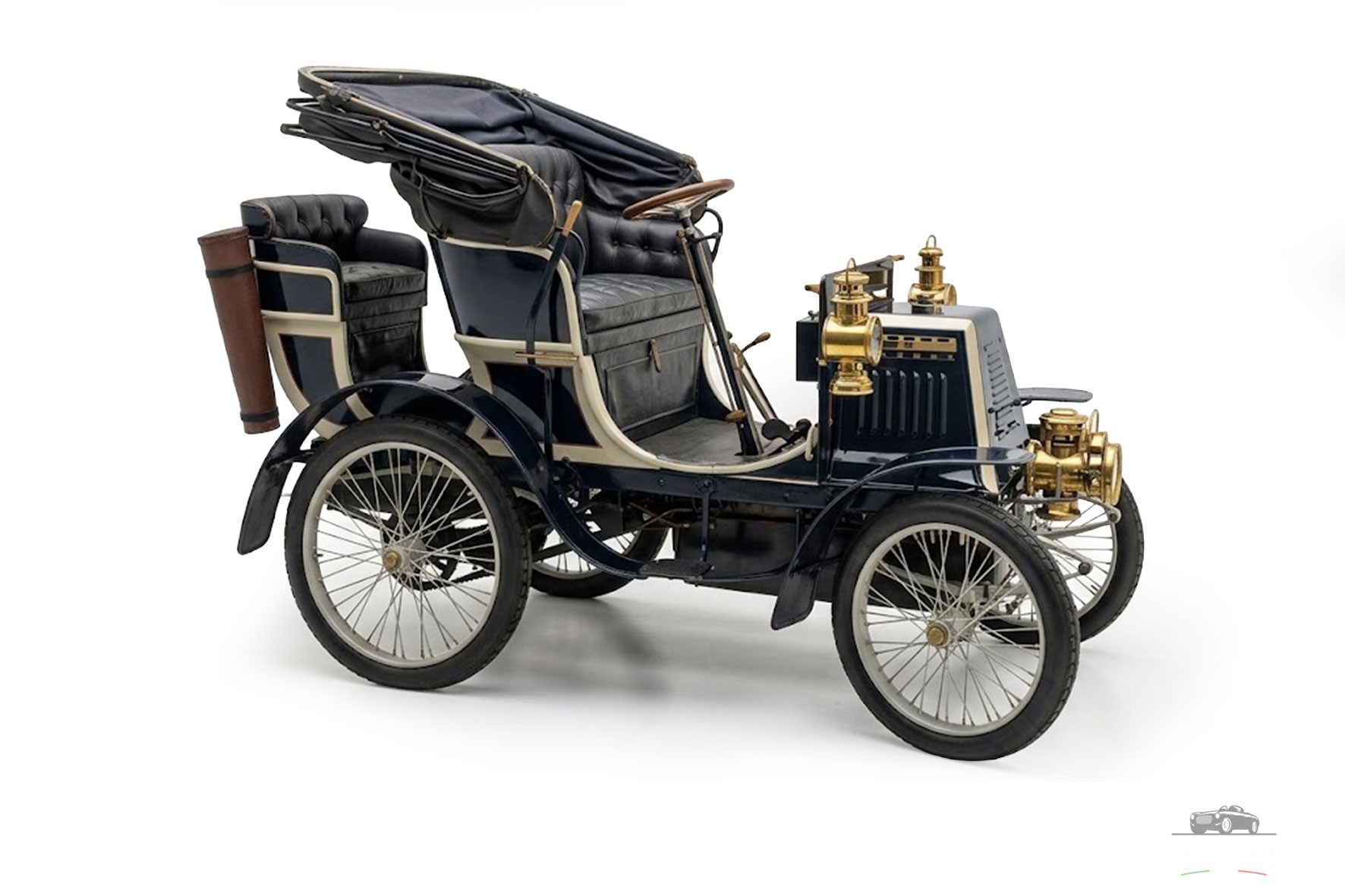
Belloni also became a body supplier to the young Isotta-Fraschini enterprise during the opening years of the twentieth century. This company-level relationship is documented by AISA, but it does not establish the coachbuilder or year of every early Isotta-Fraschini automobile. In particular, the catalogue attribution of an Isotta Fraschini Model D to Belloni in 1901 lacks an independently verified chassis, original order or exact model identity. It must remain separate from the later 1905 Isotta-Fraschini competition Tipo D.
Industrial reorganisation and exhibitions
In 1906 the principal Belloni concern was reorganised under the name Società Anonima Carrozzeria Lombarda Automobili Vetture Belloni, often abbreviated C.L.A.V.B. It subsequently operated in Via Ponte Seveso. Historical references differ over whether the address was number 37 or 39; the latter is recorded by AISA for the successor works, while the municipal industrial history gives number 37. The legal transition from the older carriage business to the motor-car enterprise should be understood as a development in stages rather than as an entirely new foundation.
AISA records Belloni’s participation in the 1907 Turin automobile exhibition, including a triple phaeton and a coupé limousine associated with a Renault chassis. The documented exhibit illustrates how traditional coachbuilding formats were adapted to the motor car. A separate contemporary exhibitor list for Turin in 1906 names L. Belloni & C.; because this was the distinct Luigi Belloni concern, that registration should not be confused with the principal Carrozzeria Lombarda enterprise.
Recognition at the Milan exhibition of 1906 also requires careful attribution. A contemporary award report lists Carrozzeria Francesco Belloni among silver-medal recipients, whereas AISA describes a silver medal awarded to Luigi Belloni’s independent workshop. These references may concern different exhibition sections, commercial names or an unresolved historical attribution. Until the original lists are reconciled, the award should not be treated as an unequivocal prize of the main Belloni company.
The end of the independent enterprise
The financial difficulties that followed the rapid early expansion of the automobile industry affected many specialist bodymakers. AISA records a takeover of Belloni by the Varese-based Macchi concern in 1909, followed in 1911 by a further transfer into the newly established Carrozzeria Italo-Argentina. The latter continued the workshop tradition and developed its own corporate and commercial identity. The municipal historical record instead refers to a liquidation of C.L.A.V. by 1907; the precise legal sequence remains a subject for archival confirmation. The 1811 origin and the early twentieth-century reorganisations should therefore be kept as distinct milestones.
Belloni occupies an important position in Italian coachbuilding history because it connects the culture of nineteenth-century Milanese carriage making with the technical and commercial demands of the earliest automobiles. Its historical importance does not depend on a large catalogue of surviving vehicles: the documented family enterprise, industrial premises, bodymaking experience and early relations with imported chassis and Isotta-Fraschini show the significance of this transition.
KEY MOMENTS
Timeline
-
Origin of the Giovanni Belloni coachbuilding enterprise
Milan, Italy
-
Belloni’s motor-car business is documented as C.L.A.V. by 1906
Milan, Italy
-
Carrozzeria Belloni is acquired by Macchi
Milan / Varese, Italy
-
Foundation of Società Anonima Carrozzeria Italo-Argentina
Milan, Italy
-
Carrozzeria Belloni is sold and merged into Carrozzeria Italo-Argentina
Milan, Italy
Vehicles at a glance
- Related vehicles
- 1
- Limited series
- 1
CONTINUE EXPLORING

THE CONVERSATION
Comments 0