
Christopher Rhoades
AT A GLANCE
- Occupation
- Automotive designer
- Active from
- 1990s
- Studio
- Mercedes-Benz Advanced Design
- Based in
- Sindelfingen, Germany
THE STORY
Overview
Christopher Rhoades is an American automotive and industrial designer whose career has encompassed passenger-car concept studies, commercial-vehicle design and the management of advanced-design studios at Mercedes-Benz. He trained in industrial and transportation design in the United States, joined Mercedes-Benz Advanced Design in Germany in 1987, worked for Daimler Trucks of North America from 1998 to 2004, and subsequently held senior design and studio-management responsibilities at Mercedes-Benz Research & Development North America. His best-documented connection with Italian coachbuilding is the Mercedes-Benz F200 Imagination, built by Stola for the 1996 Paris Motor Show.
Education and early design work
Rhoades studied industrial design at the University of Washington in Seattle, earning a Bachelor of Fine Arts, before completing transportation-design studies at ArtCenter College of Design in Pasadena, California. The University of Southern California’s German Studies programme records his graduation with honours in 1987. His training combined product and transport design, following an early interest in aircraft and mechanical design. His professional accounts also describe a short internship at General Motors Design in Warren, Michigan, before he entered the European automotive industry.
This educational background preceded an international career that combined vehicle styling with the modelling, engineering and organisational processes required to bring design studies to physical form. Rhoades subsequently worked on both exterior and interior assignments, including vehicles intended for exhibition, further research and eventual series-production development.
Mercedes-Benz Advanced Design, Sindelfingen
In 1987, Rhoades joined Mercedes-Benz’s newly established Advanced Design studio in Sindelfingen, Germany. A biographical account published by the University of Southern California identifies him as one of the two founding automotive designers of the studio. His own professional portfolio describes him as the first American creative designer recruited to Mercedes-Benz Advanced Design in Germany. The period from 1987 to 1998 placed him within an organisation responsible for investigating future vehicle forms and interior concepts rather than only styling current production models.
Rhoades’s account of this work includes nine show-car assignments over eleven years, together with exterior and interior design responsibilities. The number describes his reported project involvement; it does not by itself establish individual authorship of every car developed by the studio. The Mercedes-Benz programme operated within a broader design structure headed by senior executives and developed in cooperation with the company’s research and engineering departments.
Mercedes-Benz F200 Imagination and Stola
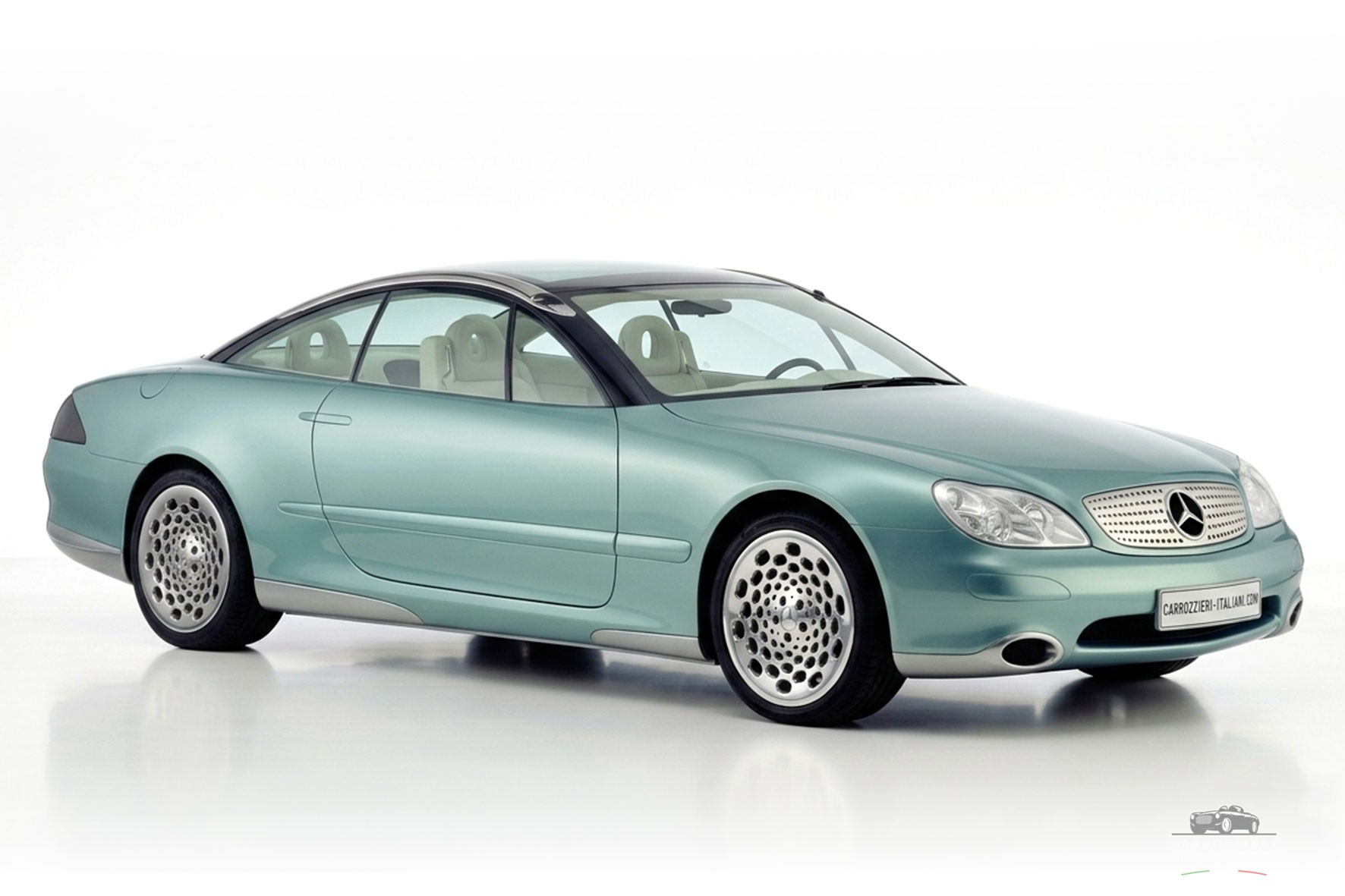
The 1996 Mercedes-Benz F200 Imagination provides an unusually well-documented example of Rhoades’s individual design work. The historical archive maintained by StudioTorino and the Stola family identifies his selected 1995 drawing for the F200, developed within the Sindelfingen Advanced Design studio directed by Harald Leschke. This distinction is important: Rhoades is credited with the selected styling proposal, Leschke directed the Advanced Design activity, and the Mercedes-Benz research teams were responsible for the experimental control and electronic systems. Stola constructed and developed the functioning prototype in Rivoli, Italy; the execution of its aluminium coachwork was a separate industrial contribution from the authorship of the design proposal.
The F200 was presented at the Paris Motor Show in October 1996 as a two-door research coupé. Its principal experiment was a drive-by-wire control system operated through side-mounted joysticks instead of a conventional steering wheel and pedals. The prototype also incorporated an unusually extensive digital display arrangement, cameras in place of conventional mirrors, active-suspension research and other electronic functions. Mercedes-Benz later identified the F200 as an important demonstration of systems and design ideas explored in subsequent vehicles. These technical innovations belonged to a multidisciplinary development programme, and should not be assigned personally to the exterior designer.
Stola’s account records that the body panels were hand-formed in aluminium and that Coggiola supplied aluminium sheet material for the programme. These distinctions establish three different kinds of participation: the Mercedes-Benz advanced-design authorship, Stola’s prototype construction and the specialised supply of material. They do not make Stola or Coggiola the originators of the original styling proposal, nor do they make Rhoades the car’s sole mechanical engineer. The F200 remains the principal directly attributed vehicle in his Carrozzieri Italiani designer record.
Daimler Trucks of North America
In 1998, Rhoades moved to Daimler Trucks of North America in Portland, Oregon, where he worked as a senior designer and programme manager for approximately six years. His responsibilities extended to commercial-vehicle exterior and interior design, including the development of the first-generation Freightliner Cascadia. The University of Southern California biography and his professional portfolio specifically associate him with the Cascadia’s exterior and dashboard design. This assignment marked an extension of his passenger-car design experience to a different vehicle category, with distinct requirements for visibility, driver accommodation, aerodynamic efficiency and long-distance operation.
Mercedes-Benz Advanced Design in California
In 2004, Rhoades took a senior position at Mercedes-Benz Advanced Design of North America, initially based in Irvine, California. The studio relocated to Carlsbad in 2008. Institutional and professional biographies describe his responsibilities as Chief Designer and Assistant General Manager, incorporating supervision of clay and digital modelling, engineering coordination, information-technology operations, personnel and project management. His work in these roles involved the development and assessment of advanced vehicle proposals as well as the organisation of the teams producing them.
His published professional profile also lists experience in computer-aided design and architectural design, reflecting the wider technical scope of an advanced automotive studio. The dates attached to some overlapping positions in professional online profiles differ; the 1987–1998 Sindelfingen, 1998–2004 Daimler Trucks and post-2004 California sequence is supported by the University of Southern California’s account. No reliable public birth date has been established for this record, and none is inferred from his education or employment history.
Design attribution and Italian coachbuilding
Rhoades’s association with Italian coachbuilding is specific rather than general. In the F200 project, Mercedes-Benz commissioned an operational prototype from Stola, while the design proposal originated within the manufacturer’s Advanced Design organisation. Subsequent vehicle projects associated with Rhoades’s managerial career should be recorded individually only where their authorship and his precise role are documented. A studio-management position, participation in a concept programme or a manufacturer’s design credit does not establish sole authorship of a complete vehicle or a coachbuilt body.
THE NETWORK
Shared vehicle credits

CONTINUE EXPLORING

THE CONVERSATION
Comments 0