
Dick Teague
AT A GLANCE
- Born
- 1923-12-26
- Birthplace
- Los Angeles
- Died
- 1991-05-05
- Nationality
- American
- Occupation
- Automotive designer and design executive
- Active from
- 1948
- Studio
- General Motors / Packard / Chrysler / American Motors
- Based in
- USA
THE STORY
Overview
Richard Arthur “Dick” Teague (26 December 1923 – 5 May 1991) was an American automotive designer and design executive whose career included General Motors, Packard, Chrysler and American Motors Corporation (AMC). As AMC’s director of styling and later vice president of design, he oversaw the development of production automobiles and experimental vehicles, including programmes executed by Italian coachbuilders. His work is associated with the Packard Predictor, AMC Javelin, AMX, Gremlin, Hornet, Pacer and Jeep Cherokee XJ, although individual styling and engineering contributions within these teams must be distinguished from his managerial responsibility.
Training and early automotive work
Teague was born in Los Angeles, California, and developed an early interest in model-making, automobiles and mechanical drawing. After completing his secondary education in 1942, he worked as a technical illustrator at Northrop, where he prepared aircraft-related drawings during the Second World War. The designer Paul Browne encouraged him to study at the Art Center School in Los Angeles. He subsequently entered General Motors styling in the late 1940s, working within the established studio system rather than as an independent coachbuilder.
Accounts differ slightly on the precise dates of his earliest appointments, but agree that his early GM work preceded his move to Packard in the first part of the 1950s. His experience there combined the practical constraints of production styling with the design of experimental vehicles. These years established a career that would alternate between work on regular passenger cars, concept programmes and the direction of design teams.
Packard and the Ghia-built Predictor
At Packard, Teague contributed to the visual identity of the company’s final Detroit-built automobiles, including the characteristic rear lamps and surface treatment introduced for the 1955 model year. His work also encompassed experimental Packard projects such as the Balboa, Panther and Request. These designs belong to distinct programmes and should not be treated as variants of a single concept.
The 1956 Packard Predictor was an especially important collaboration between American styling and Italian body construction. Teague and chief stylist Dick MacAdam developed the concept within the Packard design organisation, operating under the company’s senior styling management. After the preparation of drawings and a model in Detroit, the vehicle was commissioned from Carrozzeria Ghia in Turin. Ghia constructed the show car in approximately ninety days and returned it to the United States at the end of 1955. Technical preparation and remedial work continued in Detroit before its appearance at the 1956 Chicago Auto Show.
The Predictor combined concealed headlights, an unusually broad and low body, large rear fins and electrically operated roof sections. Its design was intended to investigate the appearance and equipment of future Packard models. Teague’s design responsibility must be distinguished from the work of MacAdam and the wider Packard team, from Ghia’s role as body constructor and from the subsequent work of American specialist contractors. The surviving concept is associated with the Studebaker National Museum in South Bend, Indiana.
Chrysler and the American Motors design department
Following the collapse of Packard’s Detroit operations, Teague worked at Chrysler before joining American Motors in September 1959. He became AMC’s director of automotive styling in 1962 and vice president of design in 1964. The company’s smaller size and restricted development budgets encouraged the reuse of structural components and the exploration of model families that could share tooling while retaining distinctive appearances.
During this period AMC introduced a succession of production models and studies, including the Rambler American, Marlin, Ambassador, Javelin, AMX, Hornet, Gremlin and Pacer. Teague’s role was both creative and organisational. The cars did not originate exclusively from his individual drawings: AMC employed stylists, clay modellers and engineers whose specific contributions were central to the development of each design. The Pacer programme, in particular, involved a distinctive glass-intensive passenger compartment and an unconventional wide-body approach within the compact-car market.
Project IV and the Vignale AMX
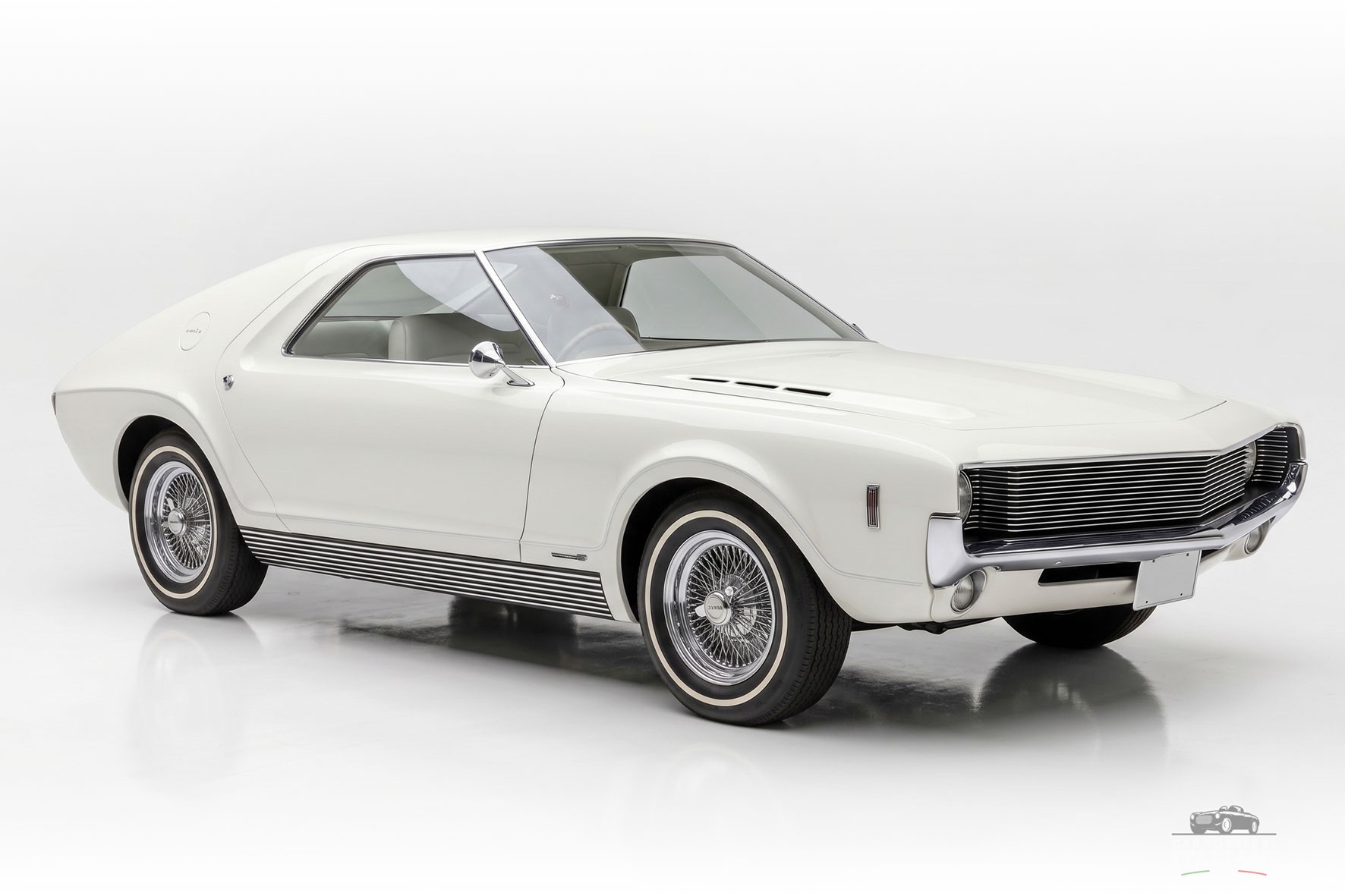
AMC’s Project IV was a group of experimental vehicles used to examine styling ideas during 1966. The AMX Vignale Project IV was an operational show car assembled in metal at Carrozzeria Vignale in Turin, using a modified 1966 Rambler American. Its construction followed AMC’s earlier non-running AMX study; the Vignale car retained the unusual roof treatment and the rear folding seat arrangement known as the Ramble Seat. Period and specialist historical accounts report an accelerated construction schedule of seventy-eight days.
Teague directed the AMC styling organisation responsible for the programme, but the original AMX concept shape is specifically attributed in detailed retrospective research to AMC designer Eric Kugler. The contribution of Vignale was the physical execution of the metal-bodied running prototype, not an independently established new exterior design by the Italian firm. The Project IV Vignale vehicle is separate from the later mid-engined AMX/3 and should not inherit that programme’s chassis, builder or production figures.
AMX/3 and the Italian development network
The AMC AMX/3 was developed as a mid-engined sports-car programme in the late 1960s and unveiled in 1970. Teague supervised the AMC design effort, working with an in-house team associated with Bob Nixon, Eric Kugler, Jack Kenitz and other staff. The programme followed earlier AMX/K and AMX/2 studies, which were related but not identical vehicles. Detailed reconstruction of the design development identifies multiple competing proposals, including a separate study commissioned from Giorgetto Giugiaro’s Italdesign.
European contractors took distinct technical and construction roles. Giotto Bizzarrini participated in engineering development; Italdesign was involved in development work; Autocostruzioni S.D., associated with Salvatore Diomante, was central to prototype construction; and BMW undertook testing and technical evaluation. Reports of an initial Coggiola body commission remain insufficiently documented for an unequivocal builder attribution. These assignments should not be collapsed into a single design or coachbuilder credit, and Teague’s management of the programme does not establish that he personally designed each chassis or body component.
AMC cancelled plans for series production, leaving a small group of prototypes whose histories need to be followed individually. The AMX/3 is therefore distinct in chronology, mechanical layout, contractor relationships and vehicle identity from the earlier Vignale-built Project IV AMX.
Later work and historical importance
Teague continued to direct AMC’s styling during the 1970s and into the early 1980s. The Jeep Cherokee XJ, introduced for the 1984 model year after his retirement, emerged from a longer AMC and Jeep product-development programme in which his design organisation played an important role. As with the earlier cars, the responsibility of a design executive must be distinguished from that of individual project designers and engineers.
Alongside his professional work, Teague collected and restored historic automobiles and developed a substantial archive of automotive material. He retired from AMC in 1983 and died in San Diego on 5 May 1991. His career links post-war American manufacturing with the practice of commissioning specialist European coachbuilders and engineering firms. Within Italian coachbuilding history, the Ghia-built Packard Predictor, Vignale-built AMX and multi-party AMX/3 programme illustrate three different models of transatlantic design collaboration.
THE NETWORK
Shared vehicle credits

KEY MOMENTS
Timeline
-
Birth of Dick Teague
Los Angeles, United States
-
Career begins
-
Career ends
-
Death of Dick Teague
San Diego, United States
CONTINUE EXPLORING


THE CONVERSATION
Comments 0