
Ernesto Cattoni
AT A GLANCE
- Born
- 1936
- Birthplace
- Milan
- Nationality
- Italian
- Occupation
- Automotive designer
- Active from
- 1950s
- Studio
- Alfa Romeo Centro Stile
- Based in
- Milan / Arese, Italy
THE STORY
Overview
Ernesto Cattoni (born in Milan in 1936) is an Italian automotive designer and illustrator whose career included work within Alfa Romeo’s styling organisation and an extensive parallel practice in graphic humour. His contribution to Alfa Romeo is most clearly documented in the surviving Giulia GT Spider prototype, for which he revised the front and rear styling of an earlier Bertone proposal. His work in illustration, published in Italian and international periodicals, developed independently of the company’s automotive programmes. The extent of his individual authorship on other Alfa Romeo models requires distinction from the collective work of the manufacturer’s design department.
Education and early work
Cattoni was born in Milan in 1936 and studied at the School of Art in Lausanne, Switzerland, according to the biographical record maintained by the FFF humour archive. He entered the professional environment of Alfa Romeo’s styling department during the 1950s, when the manufacturer was developing a new generation of cars after the success of the 1900 and Giulietta. The surviving biographical accounts give different impressions of the duration of his Alfa Romeo employment; they do not establish an uninterrupted sequence of appointments or precise dates for all of his responsibilities. His involvement in the firm’s styling work should therefore be described through identifiable projects rather than an assumed complete list of models.
Alfa Romeo’s in-house designers worked alongside engineering teams and outside coachbuilders. The visual development of a new model could include proposals made by an external studio, modifications prepared internally and subsequent construction or production by a third company. This division of work is important when considering Cattoni’s participation in the Giulia programme, which involved both Alfa Romeo Centro Stile and Carrozzeria Bertone.
Alfa Romeo styling and the Giulia programme
The FFF biographical archive associates Cattoni with the Alfa 33, Giulia and Alfetta programmes. These names identify families and projects developed over different periods and do not by themselves demonstrate that he was the sole stylist of their production bodies. The catalogue record establishes his connection with Alfa Romeo design work but does not allocate individual surfaces, drawings or complete vehicles to him. Specific personal credits should be assigned only where supporting design documentation or a reliable historical reconstruction identifies his contribution.
The Giulia family introduced in 1962 was especially significant because the manufacturer examined several body styles on related mechanical architectures. Bertone’s work on the Giulia Sprint GT and Pininfarina’s proposals for an open Alfa Romeo were distinct from the internal explorations carried out by the manufacturer’s styling staff. Cattoni’s documented assignment concerned an experimental open two-seater, not the production Giulia GTC or the later Pininfarina Spider.
The Giulia GT Spider prototype
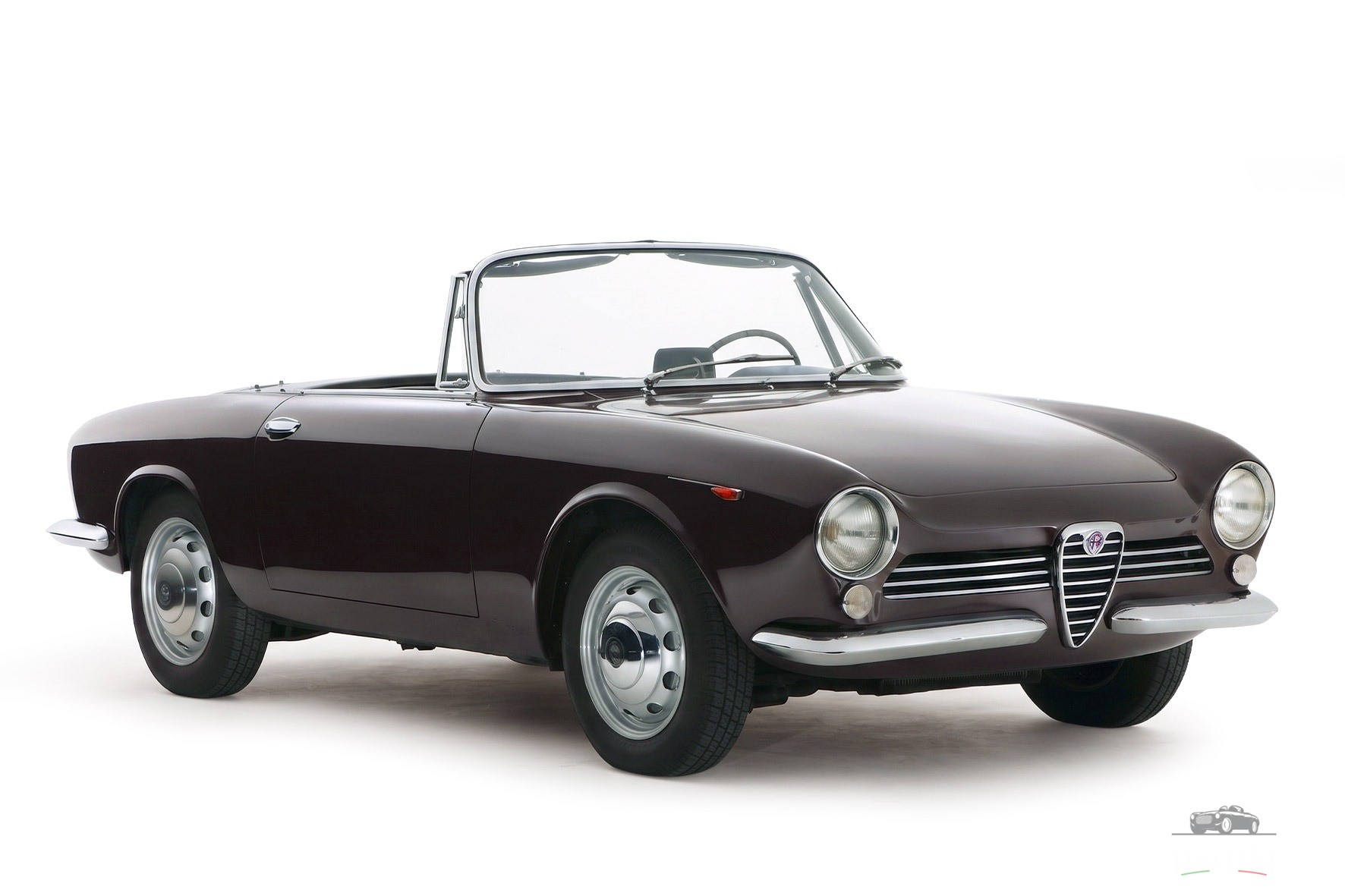
The Alfa Romeo Giulia GT Spider survives as an experimental two-seat vehicle on chassis 10503*00002. The initial proposal was developed by Bertone, using proportions and details associated with the emerging Giulia GT family. Alfa Romeo then explored a different visual treatment of the open car. Specialist historical research attributes its altered nose and rear treatment to Ernesto Cattoni working at Alfa Romeo Centro Stile. The surviving vehicle therefore documents successive stages of authorship rather than a design conceived and completed by a single individual.
Contemporary photographic comparisons described by Alfa Romeo specialists show changes to the grille, the treatment of the central Alfa Romeo shield, the placement of the front lamps and the shape of the rear. One reconstruction dates photographs of the Centro Stile alterations to January 1962, while the surviving car is commonly catalogued as a 1963 prototype. These descriptions should not be compressed into one certain date for every design and construction stage. The precise chronology of the original Bertone study, Cattoni’s revision and the final state of the vehicle remains a subject of historical investigation.
The Giulia GT Spider remained a one-off and was not adopted as Alfa Romeo’s production open car. Its identity must also be separated from the later Giulia GTC, a four-seat convertible assembled by Touring, and from the Pininfarina-designed Spider introduced in 1966. The survival of the prototype in the Lopresto Collection has made it possible to compare its design with period photographs and the other contemporary alternatives for Alfa Romeo’s open-car range.
Survival and attribution of the prototype
Historical investigations of chassis 10503*00002 reconstructed its preservation after the prototype remained within Alfa Romeo’s orbit for many years. It subsequently entered private collecting circles and became part of the Lopresto Collection. Research involving period images, the surviving body and testimony from people familiar with Alfa Romeo’s design office helped identify Cattoni as the designer responsible for important changes to the earlier Bertone design. Specialist accounts describe both his work on the front and rear and the part played by the manufacturer in commissioning alternative treatments.
The car was displayed at historical automobile events after its recovery, including Villa d’Este in 2002 and Rétromobile in 2015. Its appearance in exhibitions is evidence for the continuing study of the prototype; it should not be read as evidence that Cattoni personally designed the whole Giulia GT range or built the vehicle’s Bertone body. Nor does the documented existence of chassis 10503*00002 establish further surviving examples of the same proposal.
Illustration and graphic humour
In parallel with automotive design, Cattoni developed an independent career as a cartoonist and illustrator. His early humorous drawings were accepted by the Italian weekly L’Europeo. Biographical accounts credit him with more than 12,000 cartoons and illustrations, often created without captions or dialogue. The absence of words helped his drawings circulate internationally, while their precisely described settings and characters provided the basis for the comic effect.
His work appeared in publications including Famiglia Cristiana, Epoca, Corriere della Sera, Panorama, Grazia, Paris Match and Le Figaro, as well as other periodicals. From the 1960s his work circulated through the Disegnatori Riuniti agency associated with Cassio Morosetti. In contrast with the industrial teamwork of an automobile styling department, the published drawings constitute a more individually attributable body of work. They were conceived for print and exhibition rather than for the manufacture of a motor vehicle.
The National Humorists Association’s appraisal of Cattoni emphasised the controlled lightness of his humour and the elaborate construction of his images. He was recognised in this field for combining closely observed visual detail with subjects extending beyond everyday jokes. That critical reception belongs to his career as an illustrator and is distinct from the evaluation of his automotive designs.
Books, illustration and exhibitions
Cattoni’s publications include Verde anch’io and Non brontolare amore. He also supplied illustrations for Il Vangelo, primo racconto and La Bibbia, primo racconto, published by Edizioni San Paolo. His graphic work was exhibited in Italy and internationally, including participation associated with the Festivaltravaglia dell’Arte Leggera. These publications and exhibitions document a professional field that continued beyond his initial automotive assignments.
From the 1970s Cattoni lived and worked in Brunate, near Lake Como, and later moved to Bergamo, according to the FFF archive. An exact date of birth, a complete employment chronology and a confirmed date of death have not been established by the sources examined. Those details should not be filled by inference from his age or the historical periods in which his work appeared.
Historical significance and design attribution
Cattoni’s place in automotive design history rests on his participation in Alfa Romeo’s internal styling activity and, more specifically, on his documented alterations to the Bertone Giulia GT Spider proposal. The two-stage development of that prototype illustrates the interaction between an external coachbuilder and a manufacturer’s own design staff. In the database, Cattoni’s designer relationship to the surviving prototype records that documented contribution; it does not replace Bertone’s coachbuilding credit or the earlier external styling work.
His parallel career in graphic humour is substantial in its own right, with an extensive record of periodical illustration, books and exhibitions. Taken together, the two disciplines show a designer working with very different forms of visual communication: the fixed dimensional and industrial requirements of a car body, and the independent visual narratives of the printed cartoon. Where the surviving record does not define his exact role on an Alfa Romeo production car, the credit remains a matter for further documentary research rather than a definitive personal attribution.
THE NETWORK
Shared vehicle credits

CONTINUE EXPLORING

THE CONVERSATION
Comments 0