
Ghia
Founded in Turin in 1916, Carrozzeria Ghia became a major Italian design and coachbuilding house, creating bespoke automobiles, prototypes and international collaborations across the twentieth century.
Explore record ↗
1986Coachwork by Ghia
THE VEHICLE AT A GLANCE
THE PEOPLE BEHIND THE CAR
Founded in Turin in 1916, Carrozzeria Ghia became a major Italian design and coachbuilding house, creating bespoke automobiles, prototypes and international collaborations across the twentieth century.
Explore record ↗01 / THE STORY
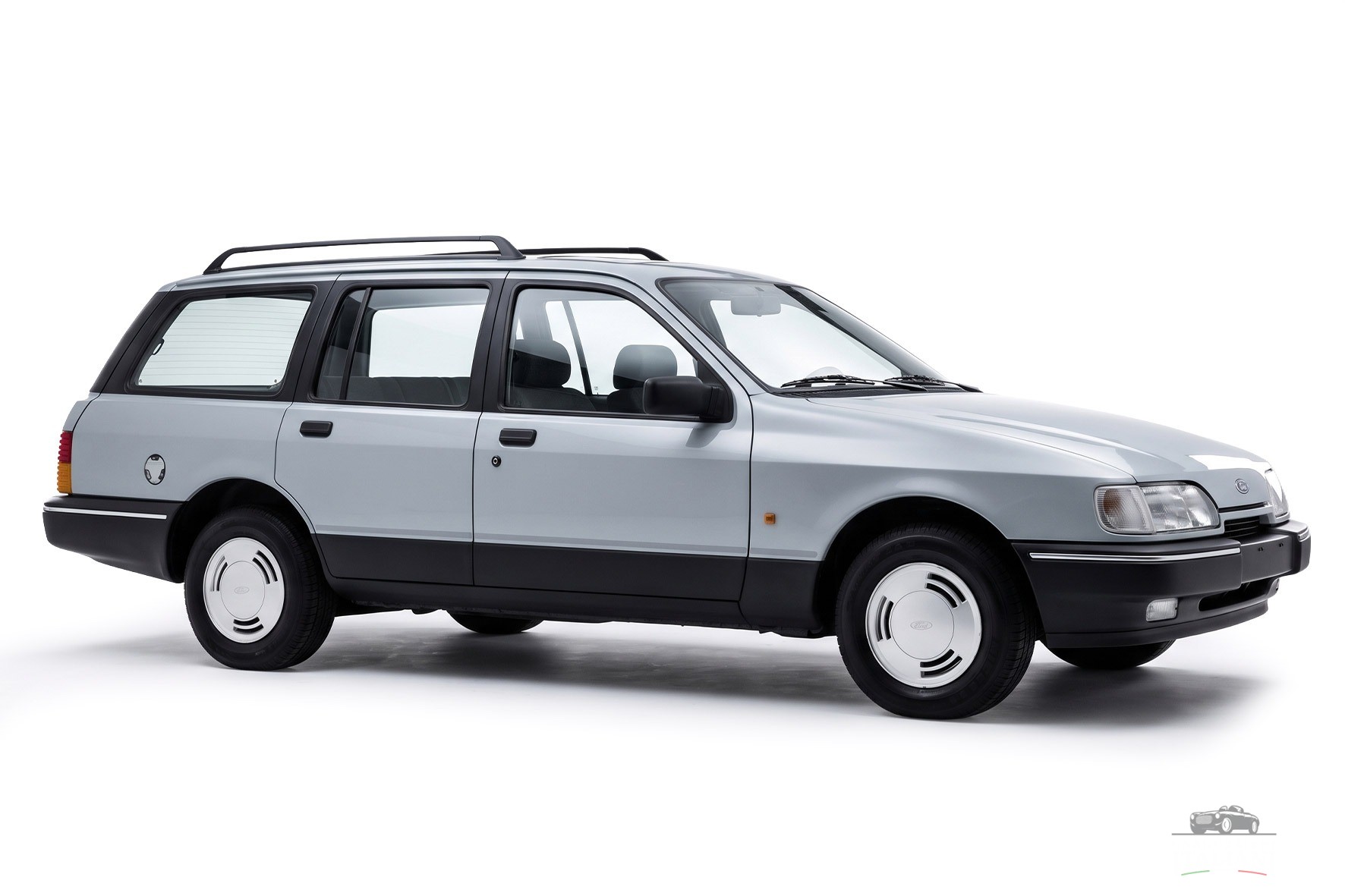
The Ford Sierra SW by Ghia was a station wagon variant of the Ford Sierra range, developed by Ford Europe and introduced in 1982. The model was styled with input from Ghia, the Italian design studio acquired by Ford in 1970, and was positioned as the top-tier trim level within the Sierra lineup. The designation “SW” referred to the station wagon body style, known as the estate in most European markets. Production continued through the early 1990s. The Sierra platform employed a unibody construction with rear-wheel drive as standard, later supplemented by all-wheel-drive configurations in selected markets. The suspension system consisted of independent MacPherson struts at the front and semi-trailing arms at the rear. Braking was provided by discs at the front and drums at the rear, with later versions featuring rear discs on higher-performance models. The Ghia specification included aesthetic and equipment enhancements over the standard models. Exterior features comprised model-specific trim elements, integrated fog lamps, body-colour bumpers, and alloy wheels. Interior appointments included upgraded upholstery, wood veneer detailing, power windows, central locking, and improved sound insulation. Air conditioning and sunroofs were available depending on market and production year. Powertrains offered in the Ghia estate varied across production years and markets but commonly included four- and six-cylinder petrol engines ranging in displacement from 1.6 to 2.9 litres. The 2.8-litre V6 engine, paired with either rear- or four-wheel drive, was among the most powerful configurations, producing approximately 150 PS at 5,700 rpm. Gearboxes included four- and five-speed manual transmissions, as well as a three- or four-speed automatic depending on variant. The station wagon configuration offered extended cargo capacity and was intended to appeal to customers seeking utility without sacrificing comfort. The Sierra SW Ghia formed part of Ford’s strategy to offer premium features within mass-market vehicle categories, competing with similarly positioned models from Opel, Peugeot, and Renault. The vehicle received periodic mechanical and cosmetic updates throughout its production. It was succeeded indirectly by the Ford Mondeo estate following the Sierra’s discontinuation. The Sierra SW by Ghia remains a representative example of European family and executive vehicles of the 1980s, combining practical design with upper-market appointments.
02 / TECHNICAL IDENTITY
03 / DESIGN, BODY & SUPPLIERS
Coachbuilder / Design studio
Founded in Turin in 1916, Carrozzeria Ghia became a major Italian design and coachbuilding house, creating bespoke automobiles, prototypes and international collaborations across the twentieth century.
Explore record ↗07 / GALLERY
THE CONVERSATION
Comments 0