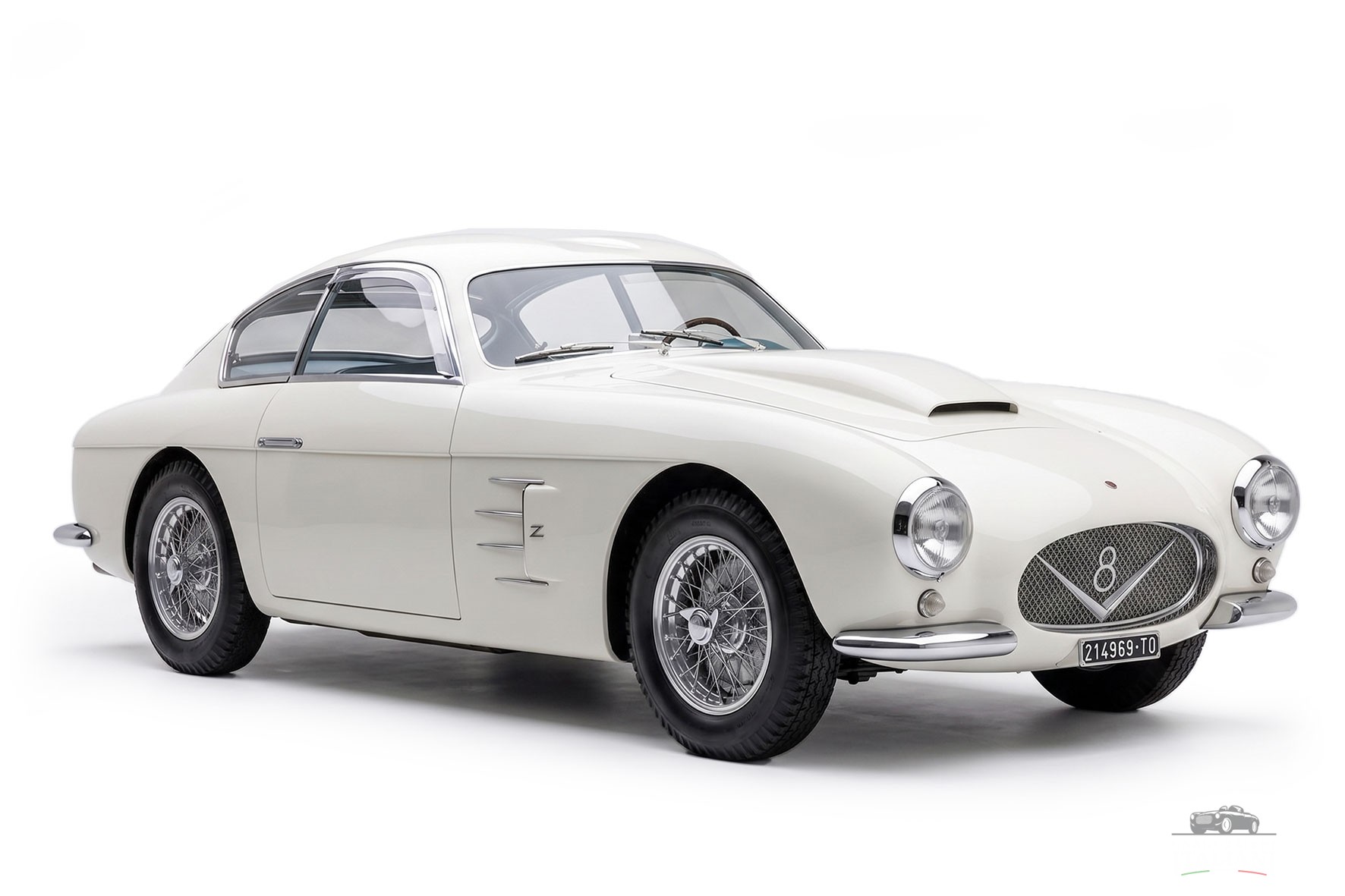

Zagato
Founded in Milan in 1919 by Ugo Zagato, the coachbuilding house developed lightweight aerodynamic bodies inspired by aircraft construction, creating distinctive racing and grand touring automobiles.
Explore record ↗
1952Coachwork by Zagato
THE VEHICLE AT A GLANCE
THE PEOPLE BEHIND THE CAR
Founded in Milan in 1919 by Ugo Zagato, the coachbuilding house developed lightweight aerodynamic bodies inspired by aircraft construction, creating distinctive racing and grand touring automobiles.
Explore record ↗01 / THE STORY
Fiat introduced the 8V, internally designated Tipo 106, in 1952. Its front-mounted 1,996 cc V8 had a 70-degree cylinder-bank angle and drove the rear wheels through a four-speed manual gearbox. The chassis used independent suspension at both axles and a 2,400 mm wheelbase. Fiat completed 114 examples of the 8V programme before ending chassis production in 1954. Fabio Luigi Rapi designed the factory coupé body, while Zagato developed separate lightweight coachwork for the same mechanical platform.
Ovidio Capelli commissioned one of the earliest Zagato-bodied 8Vs on chassis 106.000002 in 1952. Subsequent work included new aluminium berlinettas, conversions of existing Fiat-bodied cars known as Elaborata, and an open-bodied Spider. One documented census records 31 Zagato-bodied cars, comprising 22 new bodies and nine rebodying operations; other accounts report approximately 32. The number depends in part on the classification of conversions and body variants.
Six documented Zagato 8Vs carried the double-bubble roof: chassis 106.000026, 106.000078, 106.000081, 106.000082, 106.000083 and 106.000084. The raised roof sections provided head clearance while allowing a lower central roof profile. Other berlinettas had different roof, bonnet, grille and ventilation treatments.
At the 1955 Targa Florio, Elio Zagato and Ovidio Capelli drove a Fiat 8V Zagato carrying number 6 to eleventh overall and first in the Turismo Speciale category. The precise chassis associated with that entry is not established by the surviving event record. Other Zagato-bodied 8Vs entered the Targa Florio and Giro di Sicilia during the decade.
Chassis 106.000026 was originally delivered in 1953 with Fiat factory coachwork and was registered in Turin in February 1954. After its acquisition by Esteban Sala Soler, it received a Zagato aluminium double-bubble berlinetta body and competition engine modifications. Soler and Ramón Vilaprino drove the car as number 46 in the 1957 Rallye Sestrières, finishing nineteenth overall and third in class. It subsequently won its class in the 1958 Rallye Automovilista Iberico.
Chassis 106.000078 competed in the 1956 Mille Miglia as number 342 with Mario Ferrini and Sergio Rabuffi, finishing forty-seventh overall. It also received a first-in-class result at the 1956 Rimini concours with Sanzio Nicolini. Chassis 106.000076, delivered to Zagato in 1954 and registered in 1955, was originally finished in metallic green and retained engine number 104.000 000162.
Chassis 106.000026 underwent a comprehensive restoration completed in 2009. It won its class at the Concorso d’Eleganza Villa d’Este that year and placed second in the Fiat Custom Coachwork class at Pebble Beach in 2016. At the 2019 Concorso d’Eleganza Kyoto, a Fiat 8V Zagato belonging to Japanese collector Sato received the Best Italian Award; the chassis number of the Kyoto entrant has not been independently established.
02 / TECHNICAL IDENTITY
Become a Pro member to see the full details in this section.
Membership is not available yet.
View membership options03 / DESIGN, BODY & SUPPLIERS
Coachbuilder / Design studio
Founded in Milan in 1919 by Ugo Zagato, the coachbuilding house developed lightweight aerodynamic bodies inspired by aircraft construction, creating distinctive racing and grand touring automobiles.
Explore record ↗04 / CHRONOLOGY
06 / CHASSIS REGISTER
07 / GALLERY
THE CONVERSATION
Comments 0