
Zagato
Founded in Milan in 1919 by Ugo Zagato, the coachbuilding house developed lightweight aerodynamic bodies inspired by aircraft construction, creating distinctive racing and grand touring automobiles.
Explore record ↗
1957Coachwork by Zagato
THE VEHICLE AT A GLANCE
THE PEOPLE BEHIND THE CAR
Founded in Milan in 1919 by Ugo Zagato, the coachbuilding house developed lightweight aerodynamic bodies inspired by aircraft construction, creating distinctive racing and grand touring automobiles.
Explore record ↗01 / THE STORY
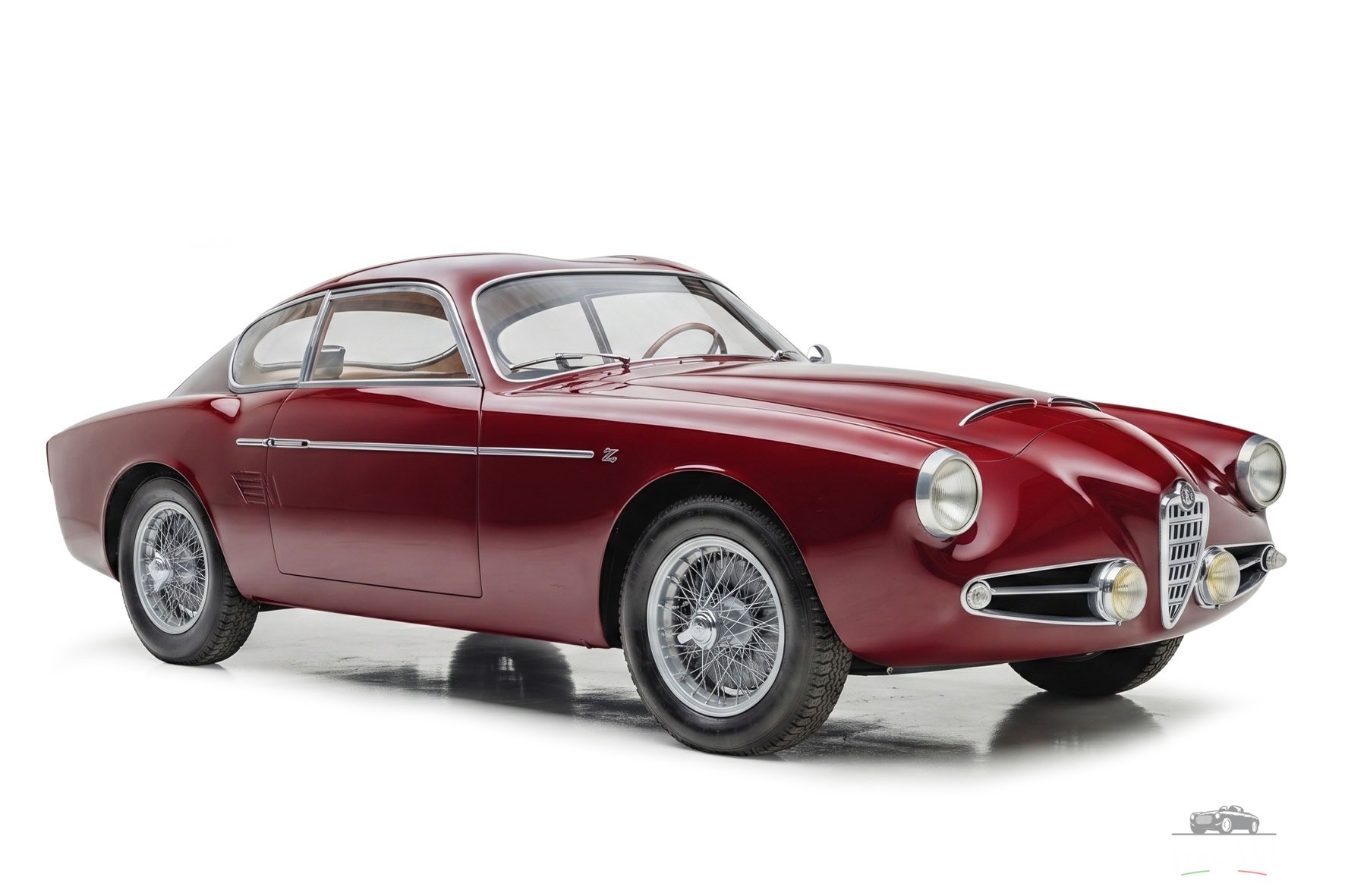
The Alfa Romeo 1900C Super Sprint Zagato Lusso was the final closed-body development of Zagato’s lightweight 1900C programme. The Milanese coachbuilder had produced a small series of aluminium-bodied 1900C Super Sprint coupés from the mid-1950s, using the shortened Alfa Romeo 1900C chassis and its twin-cam four-cylinder mechanical layout. The later Lusso configuration was developed in 1957, alongside the open SSZ Spider shown at the Geneva Motor Show. Three final Lusso coupés are reported, a figure that refers to this late variant rather than the complete production of Zagato-bodied 1900s.
The Lusso retained the characteristic double-bubble roof, with two raised sections above the occupants, but adopted a lower nose, a smaller grille influenced by the Giulietta, smoother sides and revised rear treatment. Its aluminium panels were formed by Zagato. The underlying 1900C Super Sprint platform had a 2,500 mm wheelbase, independent front suspension, a live rear axle and rear-wheel drive. The standard Super Sprint specification used a 1,975 cc twin-cam inline-four engine and a five-speed manual gearbox; these factory figures should be distinguished from the later mechanical condition of individual surviving cars. The bodywork is attributable to Zagato as a studio and coachbuilder, while the identity of an individual stylist for this late variant is not established.
Chassis AR1900C.10593 was completed in May 1957 and is identified as the last of the three Lusso coupés. It is reported to have been fitted with a floor-mounted gear lever in place of the column-mounted arrangement found on other examples. Its later mechanical configuration includes a rebuilt Tipo 1306 engine with a TI-specification cylinder head, while a correct-type Tipo 1308 engine numbered 10508 and a spare gearbox have been retained separately.
The car is reported to have been used briefly by Elio Zagato before passing through later European ownership. It entered the Rosso Bianco Collection assembled by Peter Kaus and was subsequently associated with Paul Schouwenberg, Craig Davis, Dennis Birkheimer and Mark Gessler. During its later historic-event use, it participated in several editions of the retrospective 1000 Miglia, as well as American touring events. Following a change of ownership in 2018, the aluminium body was restored by Beckman Metal Works, with Amaranto paintwork and a two-tone leather interior. In 2019 the restored car appeared in the Zagato Centenary class at the Pebble Beach Concours d’Elegance.
02 / TECHNICAL IDENTITY
03 / DESIGN, BODY & SUPPLIERS
Coachbuilder / Design studio
Founded in Milan in 1919 by Ugo Zagato, the coachbuilding house developed lightweight aerodynamic bodies inspired by aircraft construction, creating distinctive racing and grand touring automobiles.
Explore record ↗04 / CHRONOLOGY
06 / CHASSIS REGISTER
07 / GALLERY
08 / PERIOD ARCHIVE
Become a Pro member to see the full details in this section.
Membership is not available yet.
View membership options
THE CONVERSATION
Comments 0