
Zagato
Founded in Milan in 1919 by Ugo Zagato, the coachbuilding house developed lightweight aerodynamic bodies inspired by aircraft construction, creating distinctive racing and grand touring automobiles.
Explore record ↗
1923Coachwork by Zagato
THE VEHICLE AT A GLANCE
THE PEOPLE BEHIND THE CAR
Founded in Milan in 1919 by Ugo Zagato, the coachbuilding house developed lightweight aerodynamic bodies inspired by aircraft construction, creating distinctive racing and grand touring automobiles.
Explore record ↗01 / THE STORY
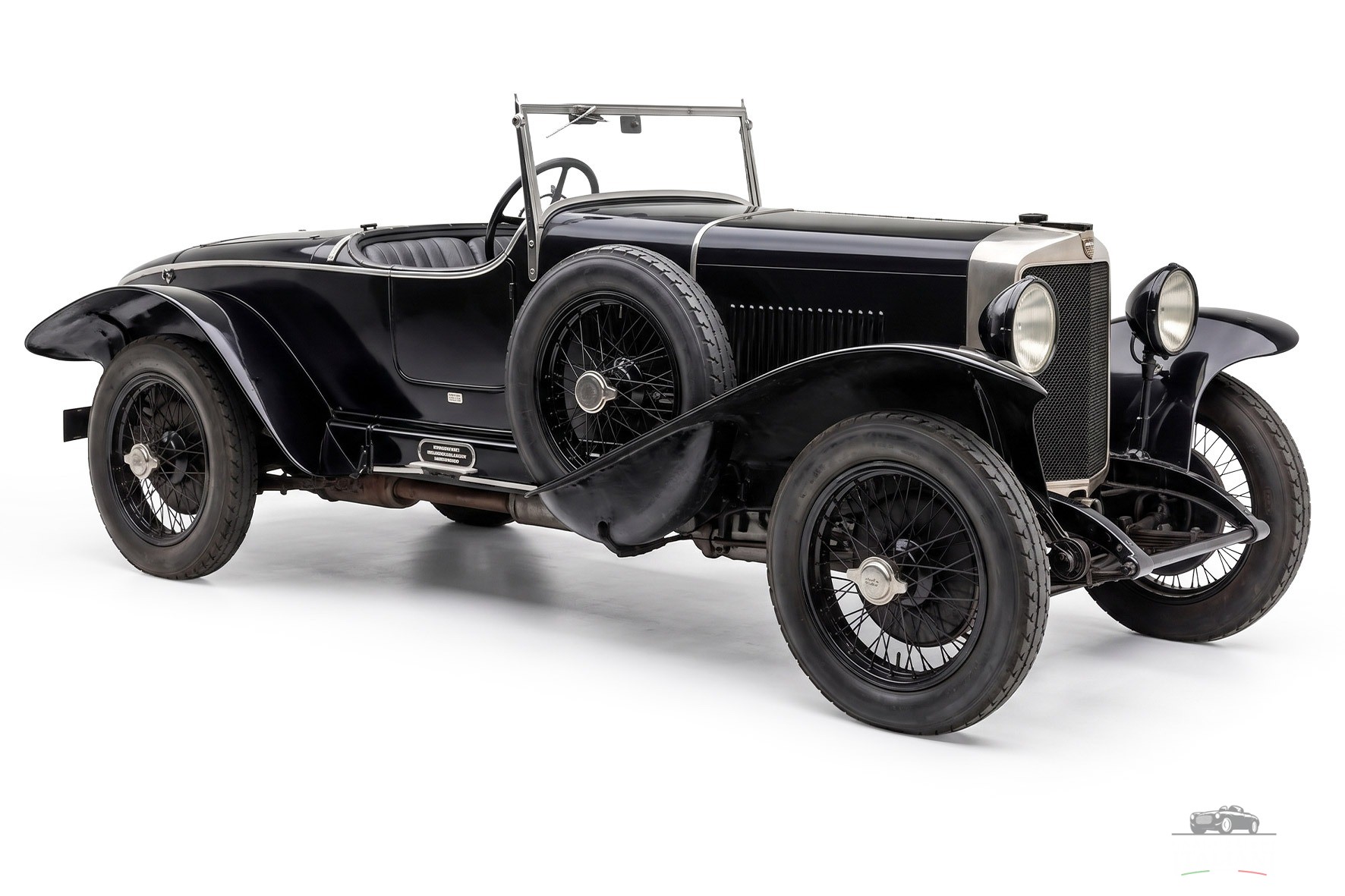
The Alfa Romeo RL Super Sport belongs to the formative years of Zagato, when Milanese coachbuilding was beginning to combine sporting performance with lightweight construction. The official Zagato archive records RLSS projects from 1923 onwards, followed by distinct versions in 1926 and 1927. That chronology matters: the present entry covers the early RLSS Zagato programme and its documented 1926 commission, rather than a securely identified surviving chassis.
A particularly revealing account appears in the March 2016 Zagato special of Ruoteclassiche, written by Luciano Greggio. It records two sporting bodies built on Alfa Romeo RL Super Sport chassis in 1926, with the involvement of financier Gino Finzi. One was destined for General Emilio De Bono, then governor of Tripolitania. The other was commissioned by the German driver Willy Cleer. They must be treated as two separate cars, even though neither individual chassis number has yet been established.
Cleer’s RLSS competed in the German Grand Prix at the AVUS circuit in Berlin on 11 July 1926. The contemporary race is independently documented by the Motor Sport database, which lists Cleer third overall in an Alfa Romeo RLSS, carrying number 7. This result belongs to the Cleer commission, not to the car destined for De Bono. Assigning that podium finish to the latter would confuse two distinct Zagato bodies.
Giuseppe Merosi was responsible for the underlying Alfa Romeo RL project, but that engineering authorship is not proof that he designed Zagato’s coachwork. The RL Super Sport used a 2,994 cc straight-six, with 83 horsepower at 3,600 rpm in the standard specification and a four-speed gearbox driving the rear wheels. These figures are model-family references, not individually verified measurements for De Bono’s car. Likewise, Alfa Romeo’s total of 392 RL Super Sports must not be mistaken for the number bodied by Zagato.
Zagato’s early reputation was closely tied to reduced weight and efficient body structures. A 1924 promotional leaflet reproduced in the same Ruoteclassiche study illustrates the breadth of its contemporary coachwork, while a different RLSS appeared at the Milan Motor Show in 1925. Neither item establishes the exact body form, material specification or public appearances of the De Bono commission.
Much remains to be recovered: chassis and engine numbers, coachwork serial, original registration, delivery documentation, subsequent owners and the present whereabouts of the 1926 car. The later Alfa Romeo 6C 1750 Sport Tourer Zagato offers a separate example of the coachbuilder’s subsequent work, not a continuation of the same chassis history.
02 / TECHNICAL IDENTITY
03 / DESIGN, BODY & SUPPLIERS
Coachbuilder / Design studio
Founded in Milan in 1919 by Ugo Zagato, the coachbuilding house developed lightweight aerodynamic bodies inspired by aircraft construction, creating distinctive racing and grand touring automobiles.
Explore record ↗05 / PEOPLE, COLLECTIONS & MUSEUMS
07 / CHASSIS REGISTER
08 / GALLERY
THE CONVERSATION
Comments 0