
Pininfarina
Founded by Battista Pinin Farina in Turin in 1930, Pininfarina became one of the most influential Italian styling and coachbuilding houses, particularly through its work for Ferrari and other international manufacturers.
Explore record ↗
1987
THE VEHICLE AT A GLANCE
THE PEOPLE BEHIND THE CAR
Founded by Battista Pinin Farina in Turin in 1930, Pininfarina became one of the most influential Italian styling and coachbuilding houses, particularly through its work for Ferrari and other international manufacturers.
Explore record ↗Giuseppe Randazzo was an Italian automotive designer whose career included work at Pininfarina.
Explore record ↗01 / THE STORY
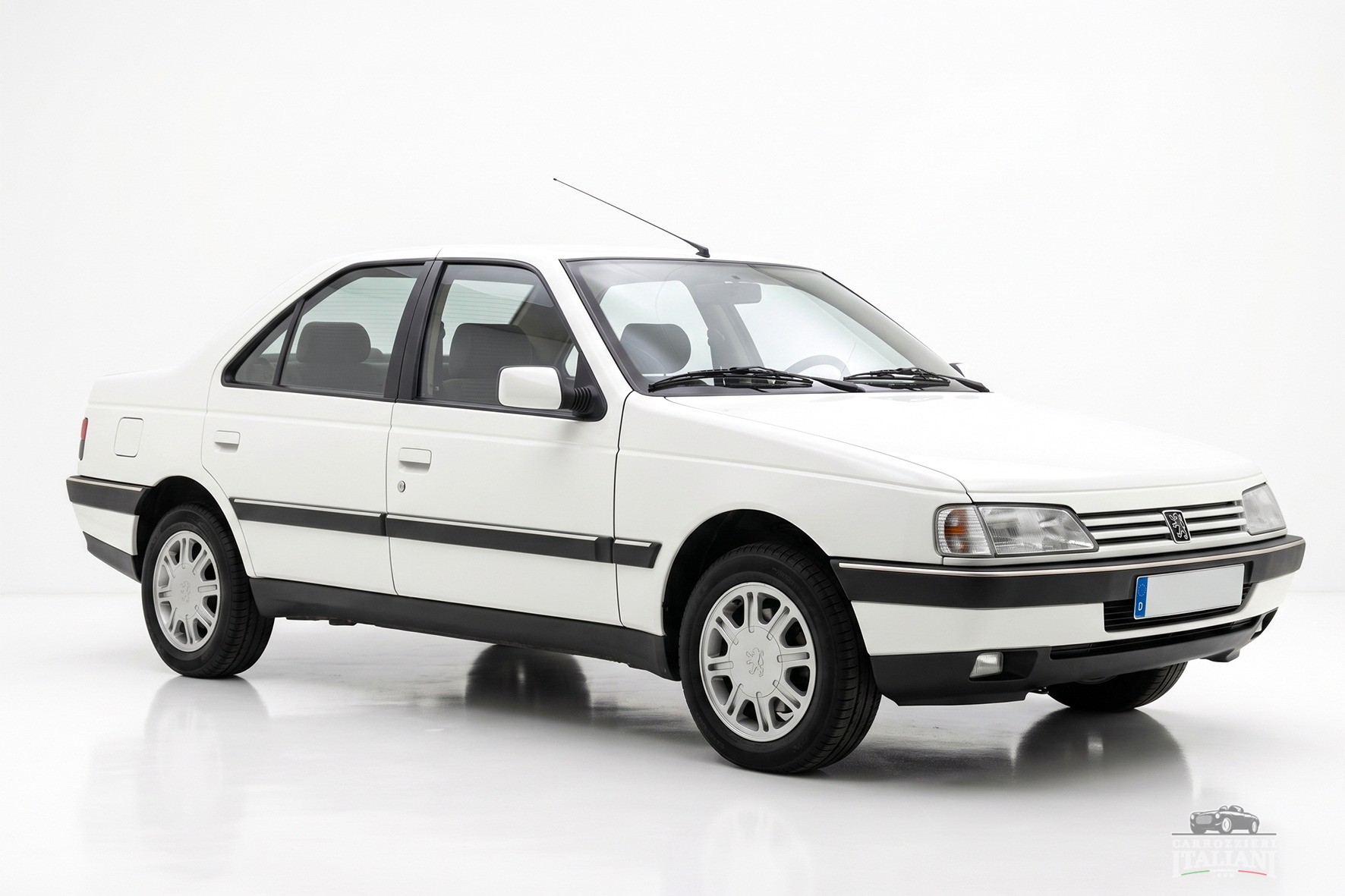
The Peugeot 405 was introduced in 1987 as a midsize saloon positioned in the D-segment. Styled by Pininfarina, the model was first shown to the public at the Frankfurt Motor Show in September of that year. It replaced the Peugeot 305 and adopted a more aerodynamic profile, characterised by flush body panels, integrated bumpers, and a low drag coefficient of 0.31. The design aligned with contemporary European styling trends and reflected Pininfarina’s influence, particularly in its clean proportions and restrained detailing. Built on a front-engine, front-wheel-drive layout, the 405 shared its platform with the Citroën BX but was positioned more conservatively in terms of suspension and styling. The initial range included petrol engines from 1.4 to 1.9 litres, alongside 1.7 and 1.9-litre diesel units. Both naturally aspirated and turbocharged diesels were available, depending on the market. Transmission options included 4- and 5-speed manuals and a 4-speed automatic. Trim levels varied by region, with most European markets offering basic, GL, GR, SR, and higher-spec GTX or Mi16 variants. At the 1988 Geneva Motor Show, Peugeot presented the Mi16 version, fitted with a 1.9-litre 16-valve engine producing 160 PS. This variant featured uprated suspension, four-wheel disc brakes, and subtle exterior modifications. A year later, at the Paris Motor Show, the 405 Break (estate) version was introduced, offering increased luggage capacity and a reinforced rear axle. A four-wheel-drive variant, the 405 T16, was unveiled in 1992 at the Paris Salon, equipped with a 2.0-litre turbocharged engine and electronic torque distribution. The Peugeot 405 was awarded the 1988 European Car of the Year title with a record number of votes. Over 2.5 million units were produced globally, with production continuing in some overseas markets into the early 2000s. The model was manufactured in France, the United Kingdom, Argentina, Iran, and other locations under licence.
02 / TECHNICAL IDENTITY
03 / DESIGN, BODY & SUPPLIERS
Coachbuilder / Design studio
Founded by Battista Pinin Farina in Turin in 1930, Pininfarina became one of the most influential Italian styling and coachbuilding houses, particularly through its work for Ferrari and other international manufacturers.
Explore record ↗Attributed designer
Giuseppe Randazzo was an Italian automotive designer whose career included work at Pininfarina.
Explore record ↗Become a Pro member to see the full details in this section.
Membership is not available yet.
View membership options04 / CHRONOLOGY
07 / GALLERY
THE CONVERSATION
Comments 0