
Castagna
The Castagna coachbuilding tradition dates to nineteenth-century Milan, when Carlo Castagna took over an established carriage business. Carrozzeria Castagna later became renowned for luxury bespoke automotive bodies.
Explore record ↗
2026Coachwork by Castagna
THE VEHICLE AT A GLANCE
THE PEOPLE BEHIND THE CAR
The Castagna coachbuilding tradition dates to nineteenth-century Milan, when Carlo Castagna took over an established carriage business. Carrozzeria Castagna later became renowned for luxury bespoke automotive bodies.
Explore record ↗Gioacchino Acampora was an Italian architect and automotive designer based in Milan.
Explore record ↗01 / THE STORY
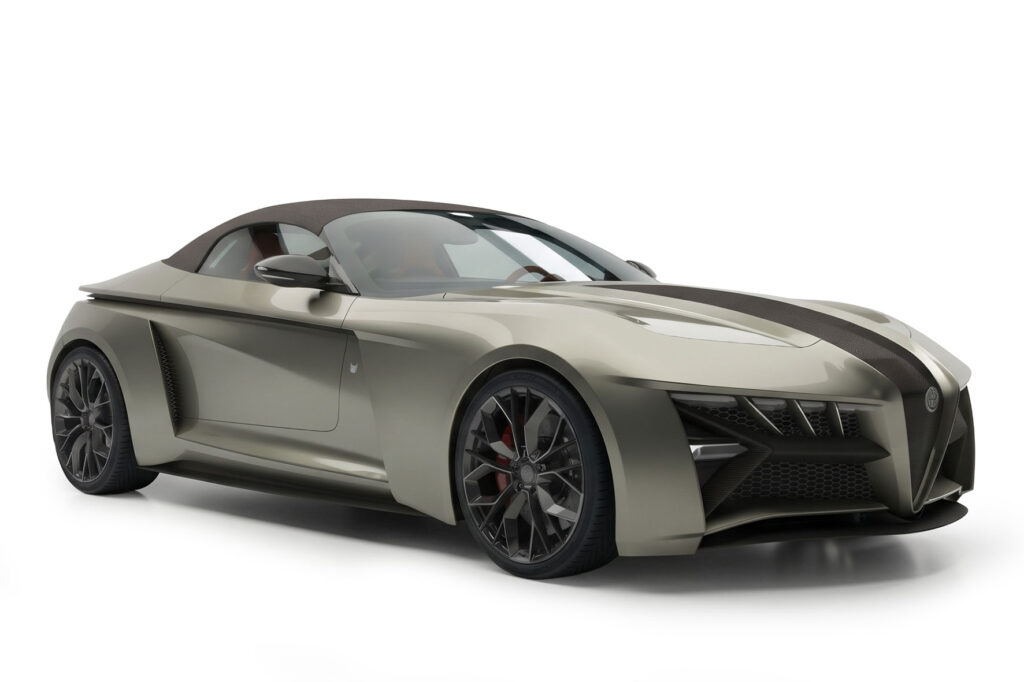
Unveiled in October 2026, Castagna Milano’s Alfa Romeo Giulia cabrio-coupé is a proposed one-off grand tourer based on the most powerful Giulia version then available. Presented ahead of the Paris Motor Show, the two-seat design was described by the coachbuilder as suitable for homologation and construction in the near term, subject to finding a commissioning client. It was not announced as a completed production automobile.
The project fundamentally revises the Giulia’s proportions. Its front seats, steering wheel and dashboard move rearwards by 330 mm, producing an elongated bonnet and a rearward cabin. The proposed dimensions are 4,700 mm in length, 1,936 mm in width, or 2,076 mm including mirrors, and 1,370 mm in height. Front and rear overhangs measure 920 mm each, while the luggage compartment provides 623 litres.
Castagna specifies exposed carbon-fibre bodywork, with flexible, three-dimensionally printed carbon components for vulnerable surfaces. The projected weight is 1,420 kg. The glazing incorporates the coachbuilder’s Vistotal solution: a bonded windscreen supported by slimmer pillars, combined with newly designed side glass and a fabric roof. The folding hood disappears when opened, giving the car a barchetta-like profile; its laminated-glass rear window also acts as a wind deflector.
The three-piece bonnet has a separately opening central section. The front includes four horizontal daytime-running lights, four splitters and a lowered bonnet edge, while the GTAm-style track configuration accommodates broad wheel arches. An underbody extractor and high-downforce rear spoiler complete the aerodynamic treatment. Proposed finishes include two types of leather, illuminated fossil wood and myrtle-green micaceous detailing.
The project accompanies Castagna president Gioacchino Acampora’s MERAKI philosophy, comprising six principles for combining traditional coachbuilding with digital craftsmanship. MERAKI identifies this design methodology, rather than an independently stated model name. The press dossier does not specify a chassis number or confirm construction of the proposed one-off.
02 / TECHNICAL IDENTITY
03 / DESIGN, BODY & SUPPLIERS
Attributed coachbuilder / design studio
The Castagna coachbuilding tradition dates to nineteenth-century Milan, when Carlo Castagna took over an established carriage business. Carrozzeria Castagna later became renowned for luxury bespoke automotive bodies.
Explore record ↗Attributed designer
Gioacchino Acampora was an Italian architect and automotive designer based in Milan.
Explore record ↗07 / GALLERY
THE CONVERSATION
Comments 0