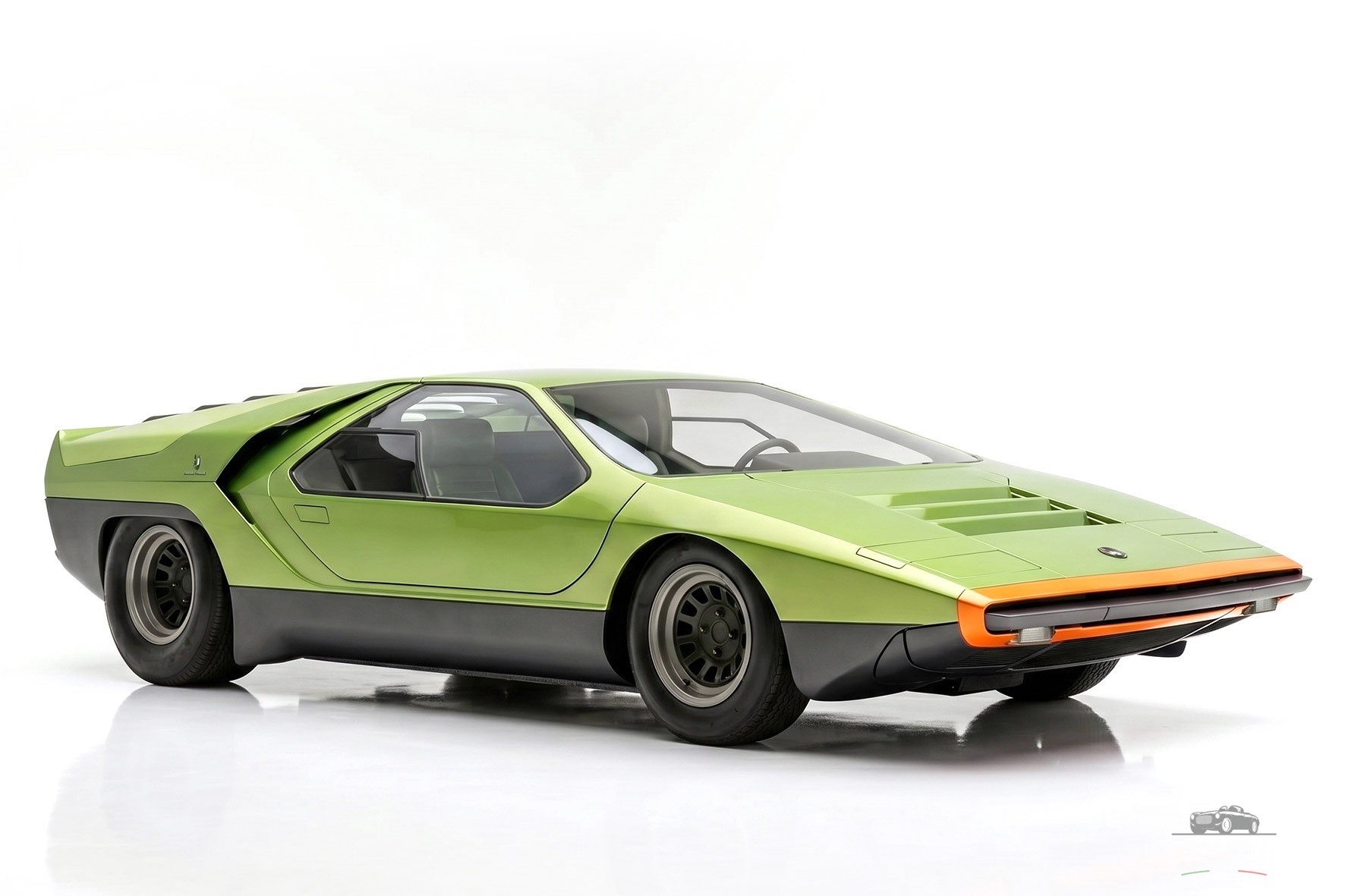
The 1968 Alfa Romeo Carabo is a one-off mid-engined concept coupé designed by Marcello Gandini for Carrozzeria Bertone. Unveiled at the Paris Motor Show in October 1968, it was constructed around the mechanical architecture of the Alfa Romeo 33 Stradale. Specialist chassis records identify the individual Carabo as 75033.109; this identity must not be confused with other Tipo 33-based prototypes. Its angular body marked a deliberate departure from the rounded forms of contemporary Italian sports cars.
Development and mechanical basis
The Carabo was developed during Bertone’s period of experimental mid-engined sports-car design. Alfa Romeo had introduced the road-going 33 Stradale in 1967, using a mid-mounted V8 in a lightweight tubular chassis. Bertone used that engineering foundation to create a body with almost horizontal visual planes, a sharply descending nose and a markedly low roof. Alfa Romeo’s heritage account records a development period of approximately ten weeks and confirms that the Carabo was built as a single example. It was a display and design-development vehicle, not a series-production Alfa Romeo model.
The Carabo retained the 33-derived 90-degree V8 architecture. Stellantis Heritage publishes a capacity of 1,995 cc and an output of 230 CV at 8,800 rpm, together with a historical weight figure of 700 kg and a quoted maximum speed of 250 km/h. These are published period-type specifications, not independently measured results for the surviving exhibit. Alfa Romeo’s 2019 account also identifies a manual gearbox with six forward ratios and reverse. Dimensions commonly reported for the prototype are approximately 4.17 metres long, 1.78 metres wide and 0.99 metres high, with a wheelbase around 2.35 metres; secondary publications differ slightly in their figures and in the vehicle’s quoted weight and speed. Details of its construction materials and any later engine changes require separate documentary confirmation.
Body design and distinctive features
The wedge profile concentrated the body’s visual mass towards the rear, where broad ventilation openings served the mid-mounted engine. Concealed headlights sat behind movable panels at the front. The wheel openings were asymmetrically shaped, while the flat, cut-off tail contrasted with the shallow windscreen. The colour scheme consisted of iridescent green, dark grey and a narrow fluorescent-orange front edge. Gold-toned reflective glazing reinforced the reference to the metallic-green beetle Carabus auratus, from which the Carabo took its name.
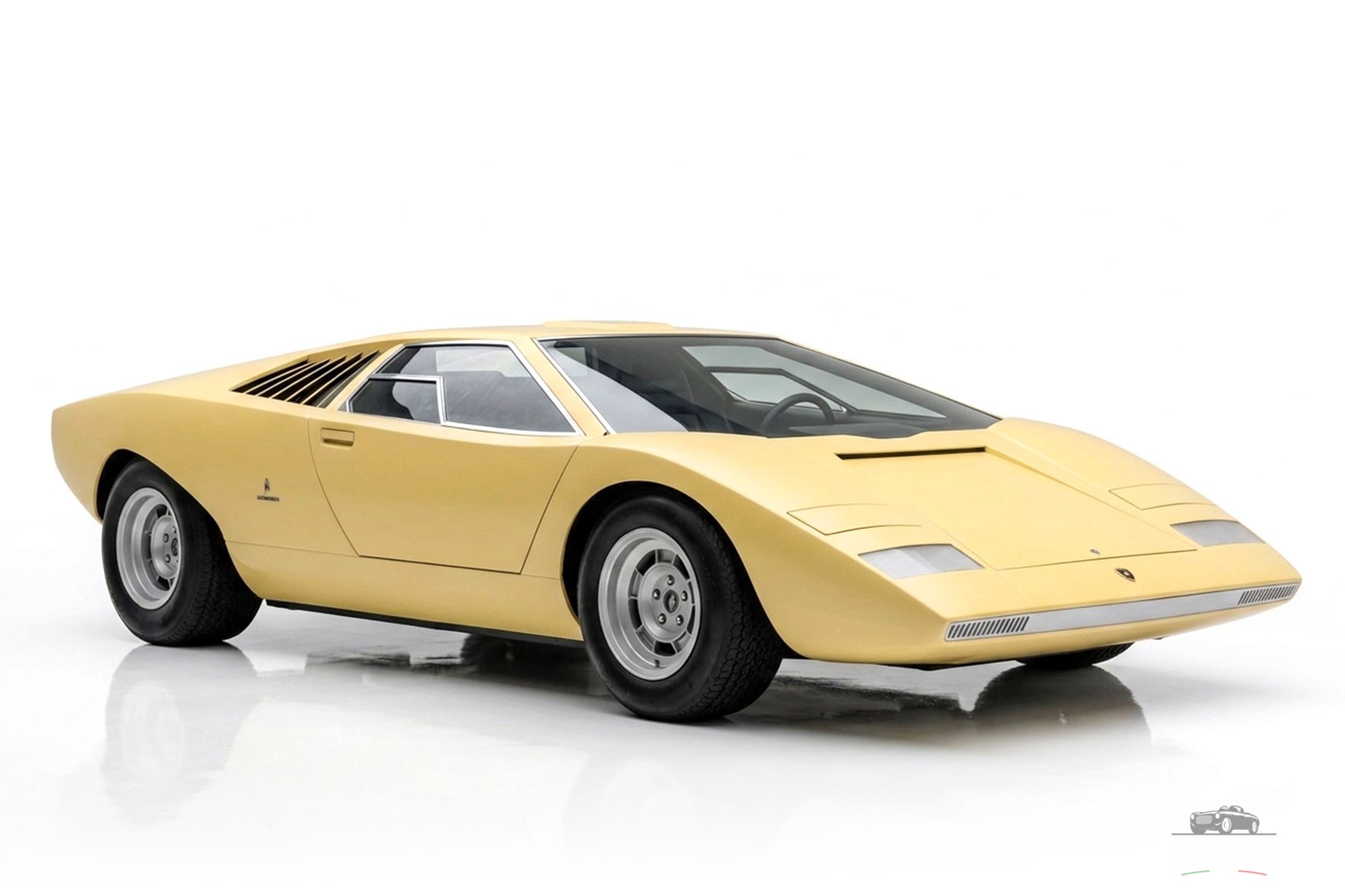
The doors opened upwards in a scissor movement, using a hydro-pneumatic mechanism to make entry possible beneath the unusually low roof. The cockpit used straight-edged instruments and surfaces consistent with the geometric exterior. In a later first-person interview, Gandini described the Carabo as a conscious break with his earlier Miura and Marzal designs, and identified its door arrangement as the starting point for the scissor doors subsequently developed for the Lamborghini Countach. That is a design lineage, not a shared chassis or manufacturing relationship.
Exhibitions and subsequent history
The original Carabo was exhibited in Paris in October 1968. A contemporary photograph of the Bertone display taken on 11 October is preserved in the Revs Institute collection; its archival status does not imply permission to reproduce the image. The car later entered the Alfa Romeo heritage collection and has been displayed at the Museo Storico Alfa Romeo in Arese. On 30 June 2019 it appeared at Chantilly Arts & Elegance Richard Mille, outside the competition, in an exhibition devoted to Gandini’s designs. Alfa Romeo also displayed it during Milan Design Week in April 2023 for the inauguration of the LARUSMIANI Automotive Gallery.
Relationship to other design studies
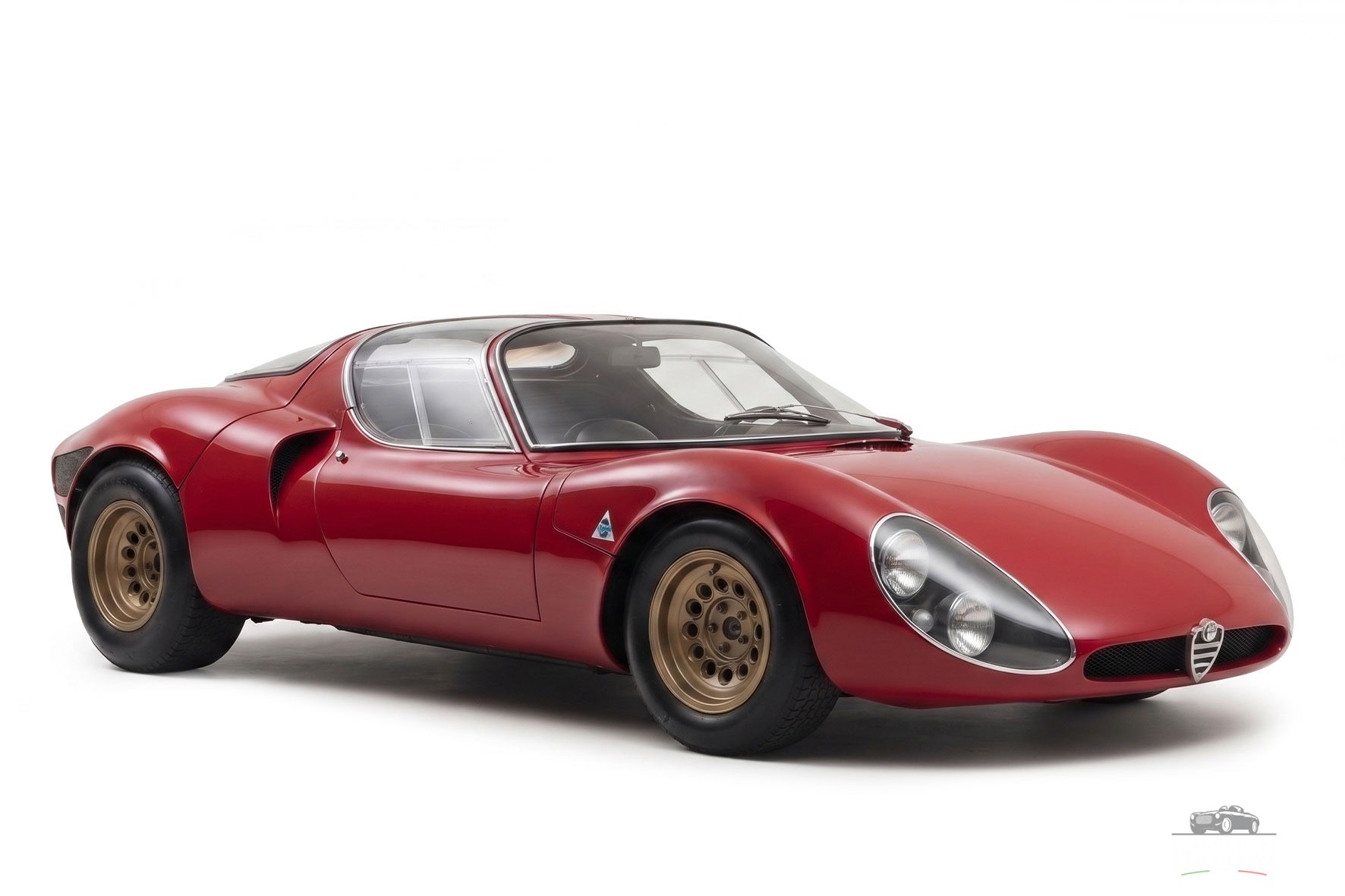
Carabo belongs to the group of experimental coachbuilt bodies that explored the possibilities of the Tipo 33 mechanical platform. The later Alfa Romeo Navajo was another distinct Bertone interpretation, produced on its own chassis rather than as a development of Carabo’s individual body. For the Carabo’s project history and contemporary significance, see the published study The Alfa Romeo Carabo: The Time Machine. Its chassis, technical configuration and individual exhibition history should be maintained separately from those of other Alfa Romeo 33-based concepts.







THE CONVERSATION
Comments 0