Franco Scaglione
Franco Scaglione was an Italian automotive designer celebrated for his aerodynamic bodywork, notably the Alfa Romeo BAT prototypes at Bertone and the Alfa Romeo 33 Stradale.
Explore record ↗
1967Coachwork by Marazzi
THE VEHICLE AT A GLANCE
THE PEOPLE BEHIND THE CAR
Franco Scaglione was an Italian automotive designer celebrated for his aerodynamic bodywork, notably the Alfa Romeo BAT prototypes at Bertone and the Alfa Romeo 33 Stradale.
Explore record ↗Founded by Carlo Marazzi and former Touring employees, Carrozzeria Marazzi assembled Lamborghini grand tourers and produced bodies for specialist Italian sports cars.
Explore record ↗01 / THE STORY
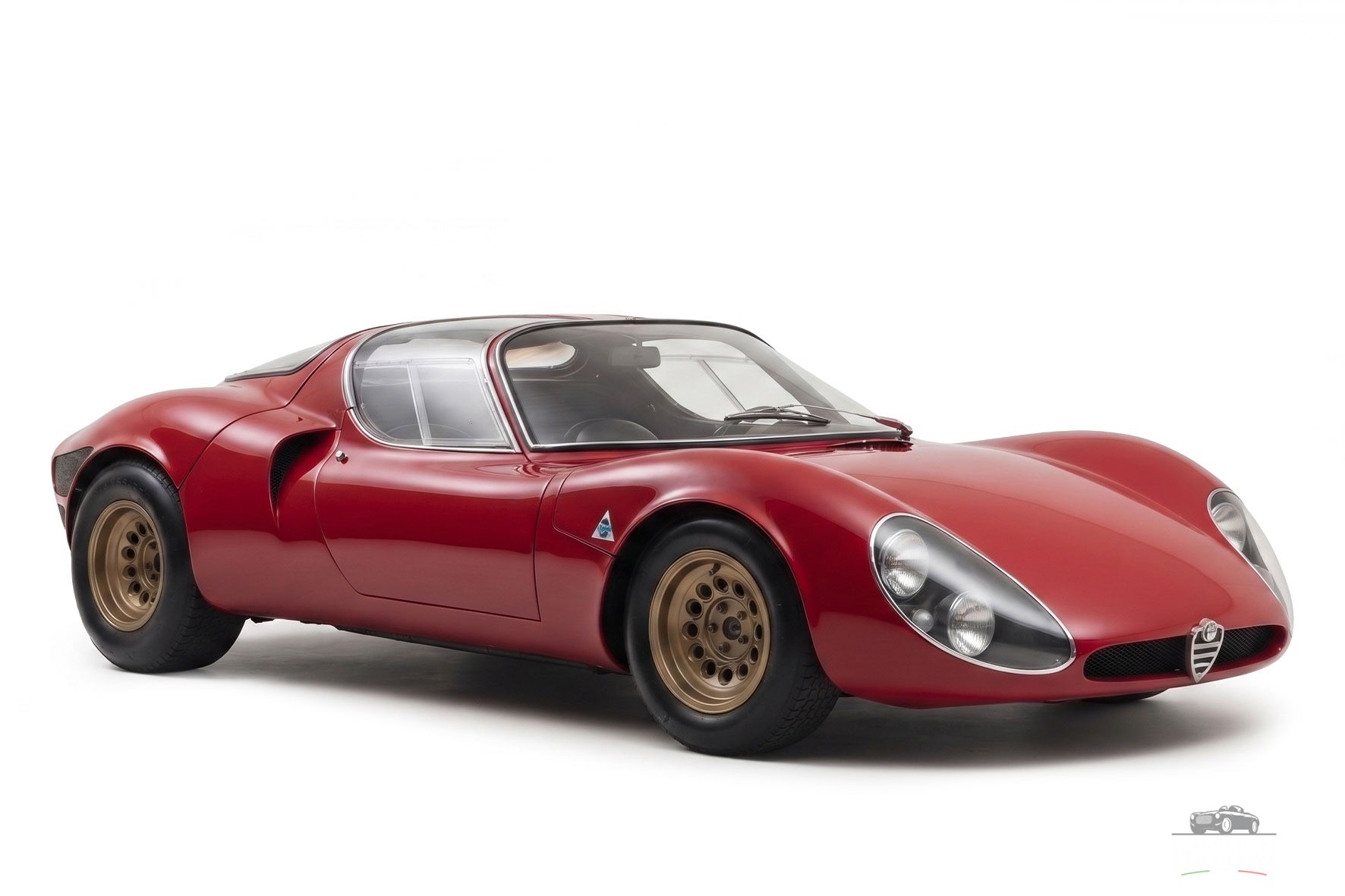
The Alfa Romeo 33 Stradale was introduced in 1967 as a road-going evolution of the Autodelta Tipo 33 racing prototype. Conceived to transfer Alfa Romeo’s competition technology to a production model, it was designed by Franco Scaglione and constructed by Carrozzeria Marazzi. The car debuted at the Paris Salon de l’Automobile on October 5, 1967, representing one of the first supercars to combine advanced race engineering with refined coachbuilt aesthetics. The first prototype, chassis number 10533.01, was assembled at Autodelta’s facilities in Settimo Milanese alongside the Tipo 33 “Periscopica.” It featured an aluminum body and distinctive dual headlamp configuration. A second prototype, chassis 10533.12, was fabricated in magnesium alloy and intended for limited competition use, though completion was delayed until 1968. Both prototypes shared the dual headlight layout, which was later replaced on production models with single headlights due to revised height regulations. The 33 Stradale was powered by a 1,995 cc 90° V8 engine derived directly from the racing unit. Constructed from aluminum with a dry-sump lubrication system and twin overhead camshafts per bank, the engine delivered 230 hp at 8,800 rpm through a six-speed Colotti transaxle. The car weighed approximately 700 kg and achieved a top speed of 260 km/h, with 0–100 km/h acceleration in around 5.5 seconds. The chassis was a tubular steel space frame with aluminum and magnesium body panels. Suspension employed double wishbones with coil springs and telescopic dampers at all four corners, complemented by disc brakes. The design included butterfly doors, flush glazing, and integrated aerodynamic forms. Only 18 examples of the Alfa Romeo 33 Stradale were completed between 1967 and 1969. Manifattura Automobili Torino made a “replica” specimen for a customer and in 2023, Alfa Romeo commissioned Touring Superleggera to reinterpret the model in a limited run of 33 units, following the lineage of Scaglione’s original vision, each custom-built and immediately sold out. Touring Superleggera built the 2023 Alfa Romeo 33 Stradale under direct commission from Alfa Romeo — it wasn’t just an assembly project. Alfa Romeo’s Centro Stile (design center) developed the concept and exterior design, but Touring Superleggera was responsible for the complete construction of all 33 cars. Each was hand-built at Touring’s facility in Milan using a bespoke aluminum and carbon-fiber structure, custom interiors, and individually tailored mechanical specifications (electric or V6 twin-turbo).
02 / TECHNICAL IDENTITY
Become a Pro member to see the full details in this section.
Membership is not available yet.
View membership options03 / DESIGN, BODY & SUPPLIERS
Coachbuilder / Design studio
Founded by Carlo Marazzi and former Touring employees, Carrozzeria Marazzi assembled Lamborghini grand tourers and produced bodies for specialist Italian sports cars.
Explore record ↗Attributed designer
Franco Scaglione was an Italian automotive designer celebrated for his aerodynamic bodywork, notably the Alfa Romeo BAT prototypes at Bertone and the Alfa Romeo 33 Stradale.
Explore record ↗04 / CHRONOLOGY
05 / PEOPLE, COLLECTIONS & MUSEUMS
07 / CHASSIS REGISTER
08 / GALLERY
09 / PERIOD ARCHIVE
Become a Pro member to see the full details in this section.
Membership is not available yet.
View membership optionsTHE CONVERSATION

What I like about the 33 Stradale is that the curves still look purposeful. The relationship between the small cabin and the wheel arches is much more striking than any single detail.