Skip to content
THE ITALIAN COACHBUILDER SITE

Lancia Stratos Zero

1970Coachwork by Bertone

THE VEHICLE AT A GLANCE

Model dossier

Manufacturer
Lancia
Base model
Strato's Zero
Coachbuilt version
one-off fully functional prototype; Turin 1970; mid-mounted Fulvia HF V4
Coachbuilder
Bertone
Production period
1970
Body style
Coupé

AWARDS AT A GLANCE

1 1
View full events & awards ↗

THE PEOPLE BEHIND THE CAR

Coachbuilding, design & conversions

Bertone

Founded in Turin in 1912, Carrozzeria Bertone grew from a small coachbuilding workshop into a leading design and manufacturing house. Its landmark creations include the Lamborghini Miura and Countach, the Alfa Romeo Giulietta Sprint and the Fiat X1/9.

Explore record ↗

Marcello Gandini

Marcello Gandini joined Bertone in 1965 and became its chief designer, succeeding Giorgetto Giugiaro. His designs include the Lamborghini Miura, Countach and Marzal, as well as the Lancia Stratos and Alfa Romeo Montreal, combining sharp forms with inventive proportions.

Explore record ↗

PRICE & SALES RECORD

Vehicle value

Latest recorded sale
EUR 761,600 2011-05-21
Market overview ↗

01 / THE STORY

History & context

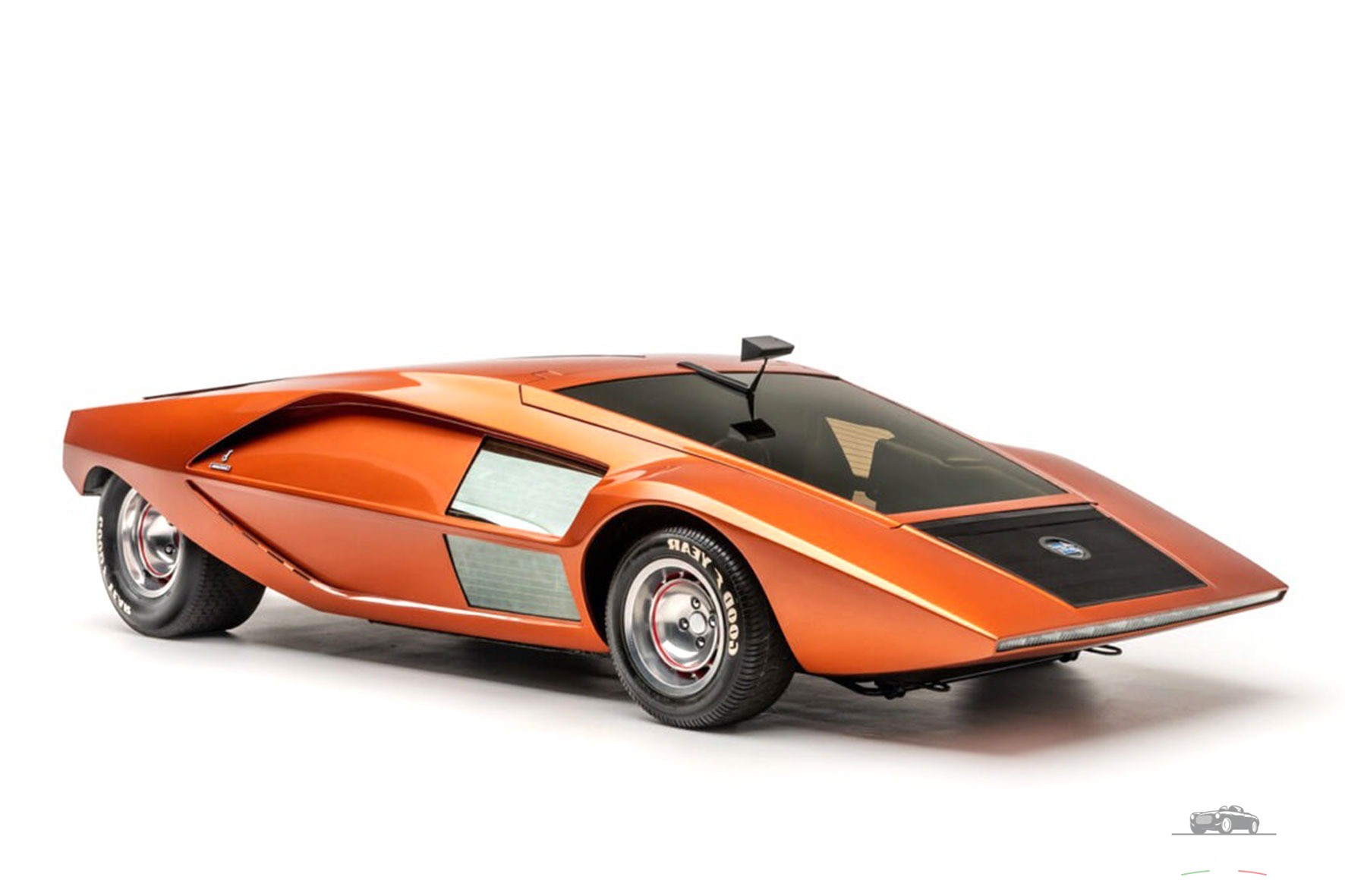
Unveiled on Bertone’s stand at the Turin Motor Show on 28 October 1970, the Lancia Strato’s Zero was a fully operational one-off created to explore how far the proportions of a sports car could be reduced. Marcello Gandini developed the design for Carrozzeria Bertone, which undertook the construction independently of a conventional production-car programme. The exceptionally low, uninterrupted wedge, the narrow bands of lamps and the steeply inclined windscreen made the Zero an uncompromising study in geometry rather than a proposal for a practical series-built coupé. Its body was originally finished in metallic bronze, a colour later reinstated during restoration.

The Zero was not merely a static styling model. The surviving prototype, chassis C/1160 with engine number 818540 2126, combined a purpose-built Bertone chassis with mechanical components from a Lancia Fulvia HF. Its mid-mounted 1,584 cc narrow-angle V4, fed by two twin-choke Solex carburettors, was rated at 115 bhp in the 2011 auction catalogue and drove the rear wheels through a five-speed gearbox. The wheelbase measured 2,220 mm, while the body rose to approximately 84 centimetres. Independent suspension and four-wheel disc brakes were adapted to this unusual layout. The occupants entered through the forward-opening windscreen; the steering column moved to ease access to a cockpit with nearly reclining seats and an instrument display offset towards the driver.

The car’s importance went beyond its radical appearance. By demonstrating Bertone’s engineering and design ambitions to Lancia, the Zero helped establish the collaboration that produced the distinct Lancia Stratos HF prototype of 1971 and, eventually, the rally and road cars. The later Stratos did not use the Zero’s chassis or Fulvia V4 engine. In the wider evolution of Gandini’s work, the Zero can also be considered alongside Bertone’s earlier Autobianchi Runabout, another independent experiment in low, sharply defined forms. Their historical relationship is one of design exploration, not shared identity.

The Zero remained in the Bertone collection for decades. Stile Bertone restored it in 2000, returning the body to its original bronze appearance after an intervening silver finish. On 21 May 2011 it was sold by RM Auctions at Villa d’Este for €761,600; the sale catalogue identifies the actual chassis and engine numbers, making this a documented transaction for the prototype rather than a market estimate for later Stratos models. Entered by collector Phillip Sarofim at the 2024 Pebble Beach Concours d’Elegance, the Zero won its early wedge-concept class and the Gran Turismo Trophy, and was selected among the four finalists for Best of Show. It did not receive the overall Best of Show award.

02 / TECHNICAL IDENTITY

Specifications & construction

Concept Car
Show Car
Wedge
Museum Car

Production & construction

Production
1
Production type
Prototype
Production from
1970
Production to
1970

Engine & performance

Engine configuration
V4
Displacement
1,584 cc
Power (hp)
115 hp
Transmission
5-speed manual
Drive
Mid-mounted engine, rear-wheel drive

Design & manufacture

Design features
Wedge

Dimensions & configuration

Wheelbase
2220 mm
Length
3580 mm
Height
840 mm
Seats
2
Production location
Turin, Italy (Bertone works; exact workshop not documented)
Assembly location
Bertone, Turin

Detailed technical specifications

Pro membership

Become a Pro member to see the full details in this section.

Membership is not available yet.

View membership options

Individual vehicle details

Pro membership

Become a Pro member to see the full details in this section.

Membership is not available yet.

View membership options

03 / DESIGN, BODY & SUPPLIERS

Design, body & suppliers

Coachbuilder / Design studio

Bertone

Founded in Turin in 1912, Carrozzeria Bertone grew from a small coachbuilding workshop into a leading design and manufacturing house. Its landmark creations include the Lamborghini Miura and Countach, the Alfa Romeo Giulietta Sprint and the Fiat X1/9.

Explore record ↗

Designer

Marcello Gandini

Marcello Gandini joined Bertone in 1965 and became its chief designer, succeeding Giorgetto Giugiaro. His designs include the Lamborghini Miura, Countach and Marzal, as well as the Lancia Stratos and Alfa Romeo Montreal, combining sharp forms with inventive proportions.

Explore record ↗

Body form & construction

Body style
Coupé
Construction system
Purpose-built low-profile chassis incorporating Fulvia HF components
Chassis type
Custom chassis, built by Bertone
Platform base
Lancia Fulvia HF 1600 engine/subframe and suspension donor; NOT a complete Fulvia chassis

Figurini & design sketches

Pro membership

Become a Pro member to see the full details in this section.

Membership is not available yet.

View membership options

04 / CHRONOLOGY

Chronology

1 Class wins 1 Special prizes
52° Salone Internazionale dell'Automobile – Torino Model-level
Date
28 Oct 1970
Scope
Model-level
Venue
Torino Esposizioni
Concorso d’Eleganza Villa d’Este Model-level
Date
2006
Scope
Model-level
Pebble Beach Model-level · Class Winner · Special Prize
Date
2024
Scope
Model-level
Award
Class Winner
Award
Special Prize

05 / PEOPLE, COLLECTIONS & MUSEUMS

People, collections & museums

06 / MARKET & PRICE HISTORY

Value & price history

Recorded sale history

EUR · 1 recorded sale

Includes recorded sales pending source verification.

Last sale
EUR 761,60021 May 2011
Highest sale
EUR 761,6001 recorded sale
Average sale
EUR 761,600Completed sales only

RECORDED SALES

Recorded sale history

EUR

Recorded sale history

EUR · 1 dated sale
Scatter plot of completed auction sales. Every point has its own date. The gold line connects recorded prices for the selected currency only; different chassis may be represented. Horizontal positions represent calendar time. Year-only and month-only dates use approximate plotting positions. 875,840 437,920 0 2011

Each point is a completed sale with its own date, in chronological order. Dates are positioned by calendar time, with approximate placement when only a year or month is documented. The connecting line shows observed sales prices in this currency, not an appreciation index: transactions may concern different chassis and specifications. Factory prices and unsold estimates are excluded.

Sign in to see the details of each sale on the chart.

Pro membership

Become a Pro member to explore the full price and sale history.

Membership is not available yet.

View membership options

Market observations describe documented transactions, estimates or offers. They are not themselves a current valuation of the vehicle.

07 / CHASSIS REGISTER

Chassis register

Ownership & provenance

Ownership & history
Museum Car

09 / PERIOD ARCHIVE

Period photographs, advertising & press

Pro membership

Become a Pro member to see the full details in this section.

Membership is not available yet.

View membership options

THE CONVERSATION

Comments 2

  1. The windscreen as an entry point is the idea that makes the Zero memorable. I am less convinced by it as a way into a car you would actually want to use every day.

Add to Garage