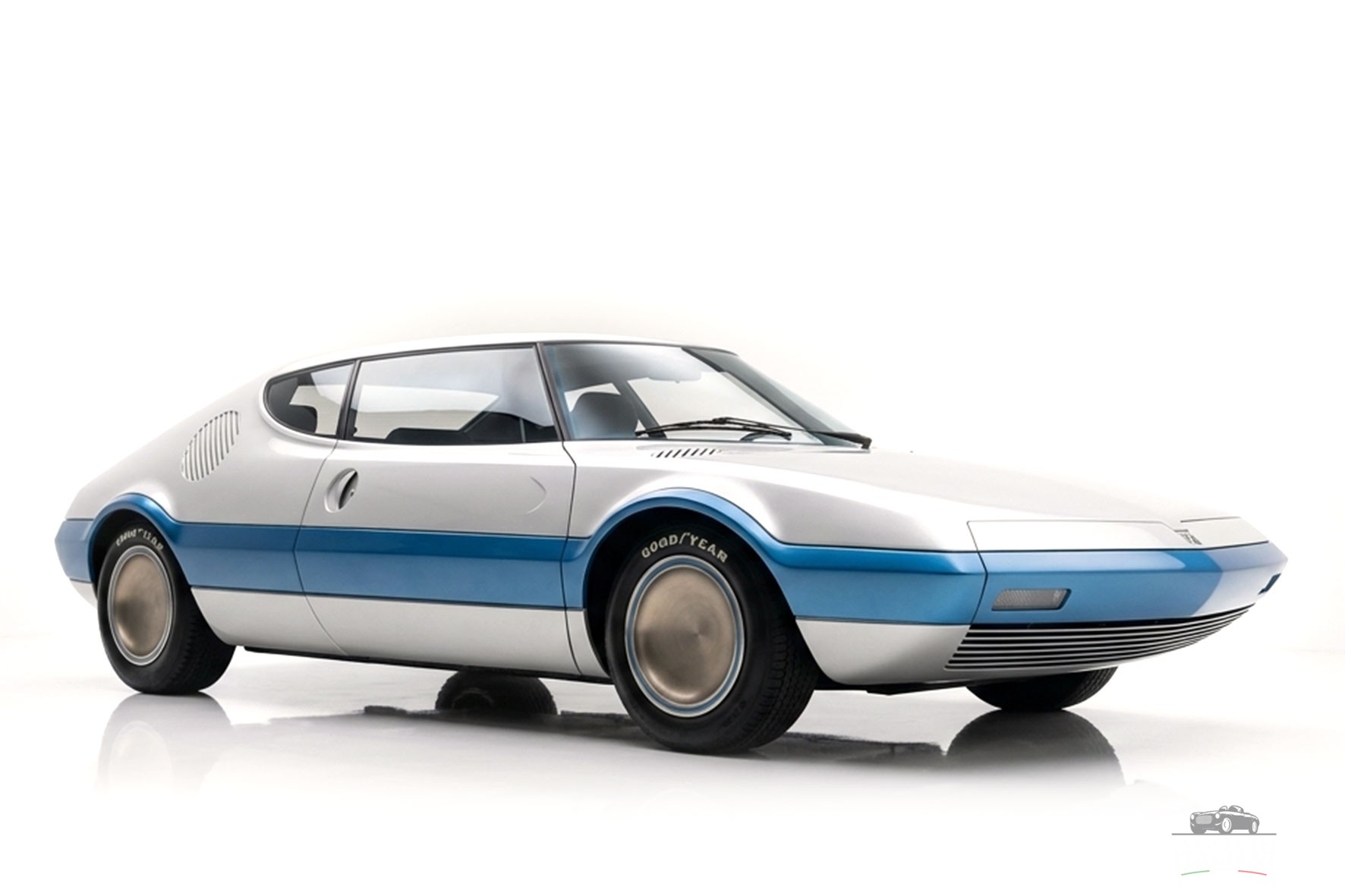
Unveiled at the Paris Motor Show in October 1973, the NSU Trapeze was a one-off experimental coupé conceived and built by Bertone, with its styling attributed to Marcello Gandini. Rather than creating another conventional two-seat sports car, Bertone used the compact rotary engine of the NSU Ro 80 to investigate how four occupants could be accommodated within the proportions of a mid-engined grand tourer. The project belongs to the same period of geometric experimentation as Gandini’s Lancia Stratos HF prototype, but the Trapeze addressed a different problem: passenger accommodation and side-impact protection in a low, compact body.
The defining feature was the trapezoidal arrangement of four individual seats. The front pair sat close to the centreline, while the rear seats were displaced outwards on either side of the longitudinally mounted rotary engine. In its October 1973 press release, Bertone argued that this arrangement offered the rear occupants a clearer forward view, room to extend their legs alongside the front seats and easier access. The additional space between the front seats and the doors was also presented as a potential safety benefit. The body combined a broad wraparound windscreen, six concealed rectangular headlamps and a continuous protective bumper band. Bertone’s contemporary specifications give a length of 4,080 mm, width of 1,830 mm, height of 1,100 mm and wheelbase of 2,430 mm.
The Trapeze employed a Ro 80-derived twin-rotor Wankel engine mounted ahead of the rear axle, driving the rear wheels. Specialist technical references report a nominal displacement of 995 cc and output of 115 PS, although these are not independently documented as measured specifications of the individual prototype. A three-speed transmission is also reported, without an original prototype gearbox record. The compact engine helped make the unusual seating plan possible, while the low roofline, extensive glazing and restrained interior details translated Bertone’s styling vocabulary into a four-seat experimental vehicle.
The origin of the seating arrangement warrants a separate qualification. A dossier published by French inventor Jean Celle reproduces a patent dated March 1967 for a related staggered four-seat automobile structure, together with a Bertone letter of April 1967 acknowledging receipt of his proposal. These documents establish an earlier proposal and correspondence, but do not by themselves resolve how the Trapeze’s design was developed or establish a legal finding of infringement. The concept remained a one-off as the 1973 energy crisis and the wider reorganisation of the NSU and Audi businesses changed the prospects for rotary-engined cars. Preserved in the ASI Bertone Collection, the Trapeze was exhibited again at Époqu’Auto in Lyon in November 2024.



THE CONVERSATION
Comments 0