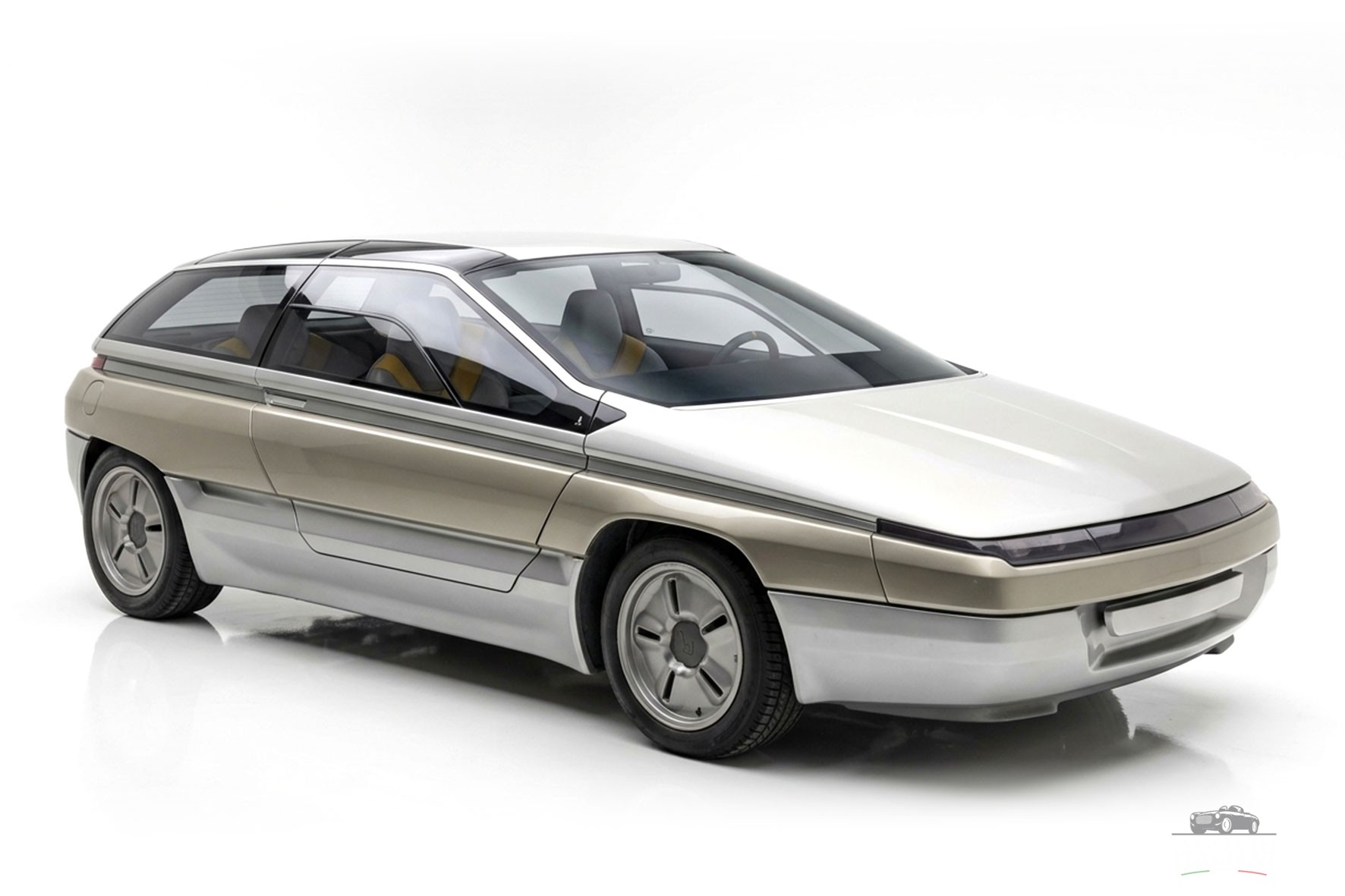
Presented at the 1986 Turin Motor Show, the Citroën Zabrus was a one-off experimental grand tourer developed by Bertone around the mechanical architecture of the Citroën BX 4TC. Rather than adapting the production Citroën BX into a conventional coupé, the Turin coachbuilder explored an entirely different body concept, with a low, sharply drawn nose, a broad glazed cabin and a distinctive fastback rear. Contemporary-style technical documentation preserved by Citroënët identifies a turbocharged 2,141 cc four-cylinder engine, four-wheel drive and a 2,650 mm wheelbase. The quoted output of 200 bhp and maximum speed of 220 km/h should be understood as published specifications, not independently verified performance tests.
Design and mechanical background
The Zabrus belonged to a period in which Bertone was exploring how expressive coachbuilt forms could be reconciled with practical accommodation. Marc Deschamps, who was then leading the firm’s styling work, is credited with the design in later specialist accounts. The body was 4,300 mm long, 1,880 mm wide and 1,370 mm high, with an elongated roofline and a rear treatment that placed it between a GT coupé and what would now be described as a shooting brake. Its unusually large upward-opening doors created a theatrical entry sequence. They can be understood within Bertone’s longer experimentation with unconventional access, represented by the earlier Alfa Romeo Carabo and Lamborghini Countach, without implying that these vehicles shared a chassis or an identical mechanism.
Accounts of the interior describe four individual seats and electronic controls, reflecting the effort to make the experimental shape usable rather than merely sculptural. Some descriptions of swivelling seats and infrared automatic driving-position adjustment survive in older editorial material, but the original technical documentation required to confirm those particular mechanisms has not yet been examined. The mechanical basis should likewise be identified at model level: the BX 4TC architecture is documented, while the identity of any individual donor chassis, engine serial number or registration remains unverified.
From Turin to the Bertone collection
The Zabrus was not developed into a production model. ASI, which preserves the Bertone collection, has noted stylistic elements subsequently echoed by the Citroën ZX, although this is a design-historical relationship rather than evidence of direct component transfer. The car also forms a later chapter in the Italian coachbuilder’s relationship with Citroën, following the GS Camargue of 1972. When the Bertone collection was acquired by ASI in 2015, the Zabrus was included among the 79 vehicles and related objects sold together under a cultural-heritage restriction. A contemporary bankruptcy inventory gave the Zabrus an indicative value of €12,000, but that figure was not an individual auction result or a separate sale price.


THE CONVERSATION
Comments 0