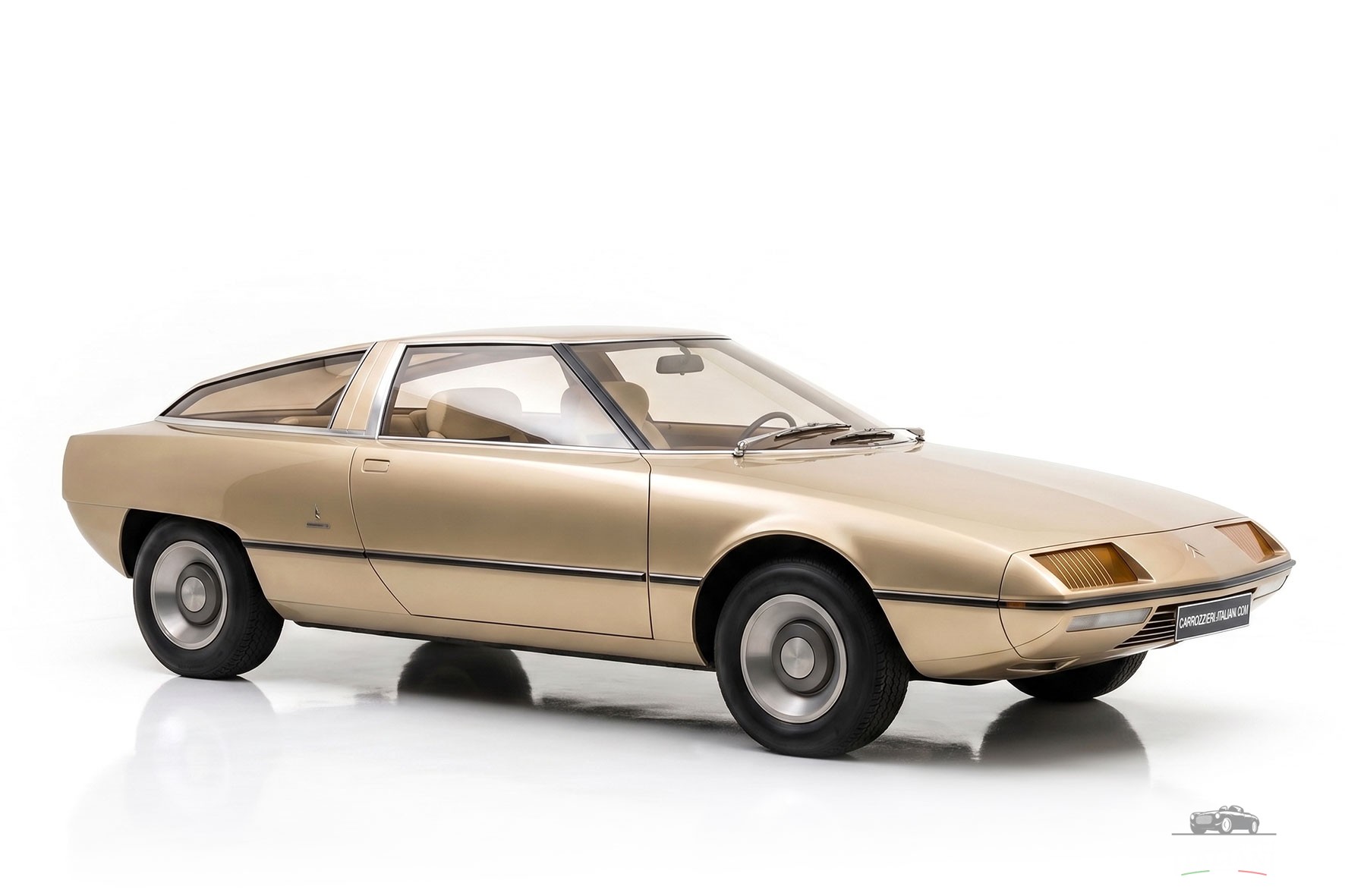
The Citroën GS Camargue was a fully functioning experimental coupé created by Bertone in 1972 using the mechanical architecture of the Citroën GS. The original Citroën centenary catalogue identifies its unveiling at the Geneva Motor Show in the spring of that year. With its low profile, expansive glazing and distinctive rear hatch, the Camargue was a deliberate departure from the sober family-car proportions of the GS, then only two years into production. It was not a production version of the GS, but an independent demonstration of how the French manufacturer’s front-wheel-drive and hydropneumatic technology could underpin a more adventurous body. Contemporary photography also documents the car at the London Motor Show in October 1972. Later Citroën press accounts additionally mention Paris, although the precise sequence of appearances is not consistently reported.
Bertone retained the GS’s fundamental mechanical arrangement while radically changing the visual balance. The front end had a low, tapered bonnet and prominent rectangular headlamps, with a panoramic windscreen flowing into a slender roof. The sides rose towards a short, almost truncated tail, where the large glazed hatch made the rear of the passenger compartment unusually transparent. Citroën’s own 2019 historical brochure gives the prototype’s dimensions as 4,120 mm long, 1,680 mm wide and 1,150 mm high. Its broad, low stance and the generous glass area were central to the composition, while the suspension system and steering remained derived from the GS. Accounts of the seating differ: Citroën’s later heritage material describes a two-seat sports coupé, whereas several specialist descriptions call it a 2+2. The exact configuration should therefore be distinguished from the well-documented external dimensions.
The question of individual design authorship is more complicated than the familiar attribution to Marcello Gandini. Citroën’s official retrospective credits Gandini, who headed styling at Bertone during this period. However, a later historical account drawing on Marc Deschamps’s recollections credits the younger designer with originating and developing the Camargue, while describing Gandini’s involvement in particular interior details. Deschamps had joined the Bertone studio during the early 1970s, and the conflicting accounts have not yet been reconciled against original design drawings or studio records. The secure attribution is to the Bertone design organisation; assigning sole authorship to either man would go beyond the currently consistent evidence.
The prototype used a front-mounted, air-cooled four-cylinder boxer engine and front-wheel drive, together with the hydropneumatic suspension characteristic of the GS. Specialist technical references identify the engine as the 1,015 cc GS unit, rated at approximately 55 horsepower, and report a 2,550 mm wheelbase and four-speed manual transmission. Those figures describe the reported configuration rather than an engine or chassis number independently read from the surviving prototype. Citroën’s original publication independently confirms the retention of the GS engine, steering and suspension, but does not provide a prototype-specific serial number. The Camargue was an operational design study, not an announced limited-production car, and no individual sale price or original list price has been established.
The Camargue also marked the beginning of a longer relationship between Citroën and Bertone. The subsequent Citroën BX emerged from a later design programme rather than as a direct mechanical derivative of the Camargue, while the Citroën Zabrus of 1986 revisited the idea of an experimental Citroën coupé under the Bertone name. Preserved within the Bertone Collection, the Camargue passed into the stewardship of the Automotoclub Storico Italiano when ASI acquired the collection in 2015. It was exhibited during Citroën’s centenary celebrations at Rétromobile in 2019 and was later documented at Volandia and at Villa Erba in 2024. The acquisition of the entire Bertone Collection must not be mistaken for an individual sale of the Camargue itself.



THE CONVERSATION
Comments 0