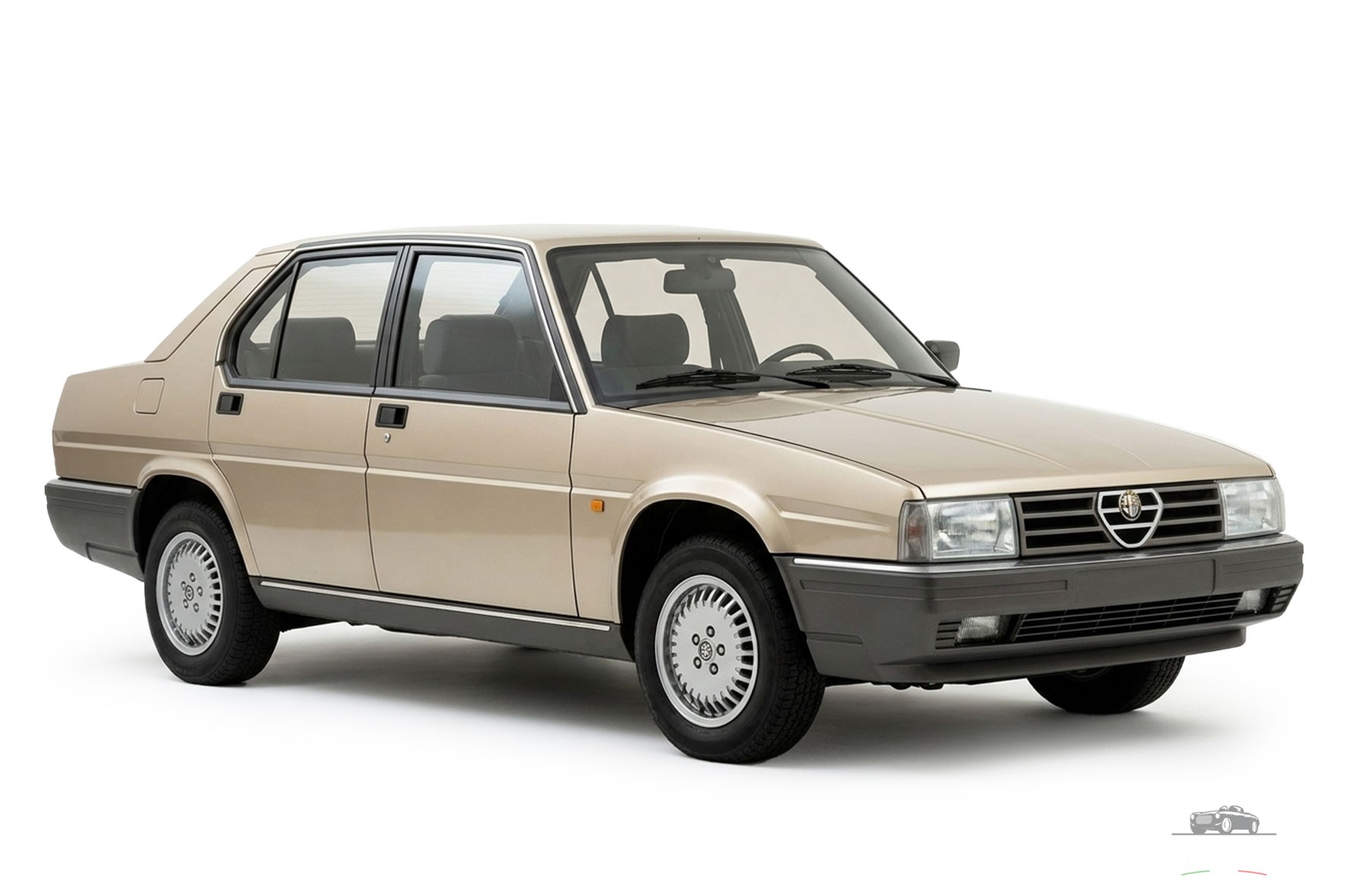
Introduced in September 1984, the Alfa Romeo 90 was the marque’s new executive saloon and the successor to the Alfetta. Developed under the 162A programme at a time when Alfa Romeo faced severe investment constraints, it combined established engineering with an exterior restyling entrusted to Bertone. Alfa Romeo, not Bertone, manufactured the production cars at Arese. The commission is documented by Alfa Romeo’s own historical account, but the evidence reviewed does not establish a single individual stylist as the author of the finished design.
Development and engineering
The 90 retained the Alfetta-derived front-engine, rear-wheel-drive layout with its five-speed gearbox and differential mounted together at the rear, a configuration intended to distribute mass between the axles. Its suspension continued the characteristic independent front arrangement and De Dion rear axle, while the body received more angular front and rear treatments, revised lighting and a distinctive profile. The small front spoiler was designed to deploy automatically at speeds above approximately 80 km/h. With a wheelbase of 2,510 mm and a length of 4,390 mm, the car remained close to its predecessor in its fundamental dimensions. Although the body was extensively revised, it was not an entirely new platform, and the precise extent of panel replacement reported in contemporary publicity requires separate documentary verification.
Five powertrain versions were available at the Italian launch: 1.8- and 2.0-litre four-cylinder petrol models with carburettors, a 2.0-litre injection model, the 2.5-litre V6 Quadrifoglio Oro and a 2.4-litre intercooled turbodiesel. The diesel engine was supplied by VM Motori of Cento, whose contribution concerned the powertrain rather than body manufacture. The 2.0 Iniezione was specified at 1,962 cc and 128 CV, while the 2.5-litre V6 offered 156 CV in the initial brochure. These figures belong to their respective versions rather than to every Alfa 90. The Quadrifoglio Oro’s electronic instrumentation and the model’s Alfa Control system reflected Alfa Romeo’s efforts to modernise its executive-car interior. The Super revisions introduced in 1986 brought further equipment and mechanical updates.
Presentation and production
The specialist press encountered the new saloon at Arese between 4 and 21 September 1984, with Nuccio Bertone taking part in the presentation. The car was also shown publicly at Monza, where Juan Manuel Fangio drove an Alfa 90 ahead of the Italian Grand Prix, and it was presented to President Sandro Pertini at the Quirinale on 21 September. Italian sales began on 28 September, and the model also appeared at the 1984 Turin Motor Show. These occasions describe the launch of the production family, not evidence of an independently coachbuilt show car.
Production ended in 1987 after a comparatively short career. Published totals must be interpreted carefully: the Museo Fratelli Cozzi records approximately 54,500 cars sold, whereas a later specialist retrospective gives 56,428 cars built. These are different measures and should not be treated as a single verified factory production figure. The subsequent Alfa Romeo 164 replaced the 90 in the executive segment with a fundamentally different, front-wheel-drive architecture. The 90 remains significant as one of the last Alfa Romeo saloons to combine Bertone styling with the traditional rear transaxle layout.


THE CONVERSATION
Comments 0