
Pininfarina
Founded by Battista Pinin Farina in Turin in 1930, Pininfarina became one of the most influential Italian styling and coachbuilding houses, particularly through its work for Ferrari and other international manufacturers.
Explore record ↗
1987
THE VEHICLE AT A GLANCE
THE PEOPLE BEHIND THE CAR
Founded by Battista Pinin Farina in Turin in 1930, Pininfarina became one of the most influential Italian styling and coachbuilding houses, particularly through its work for Ferrari and other international manufacturers.
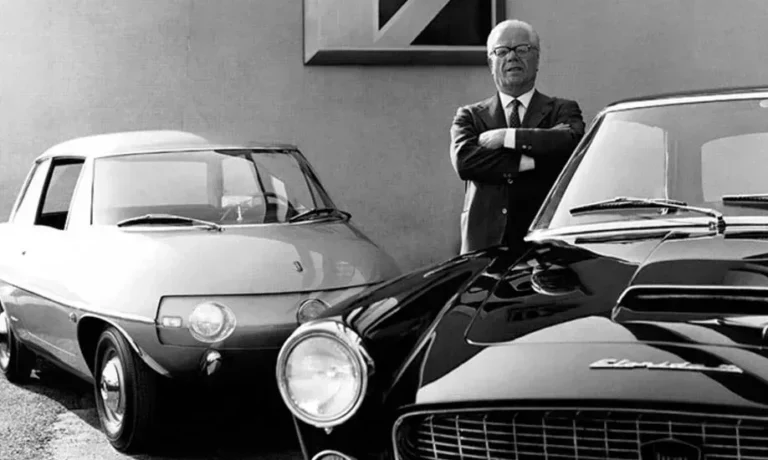
Explore record ↗Enrico Fumia is an Italian automotive designer associated with Pininfarina, the Alfa Romeo 164 and 916 GTV/Spider, Ferrari F90 and Lancia.
Explore record ↗01 / THE STORY
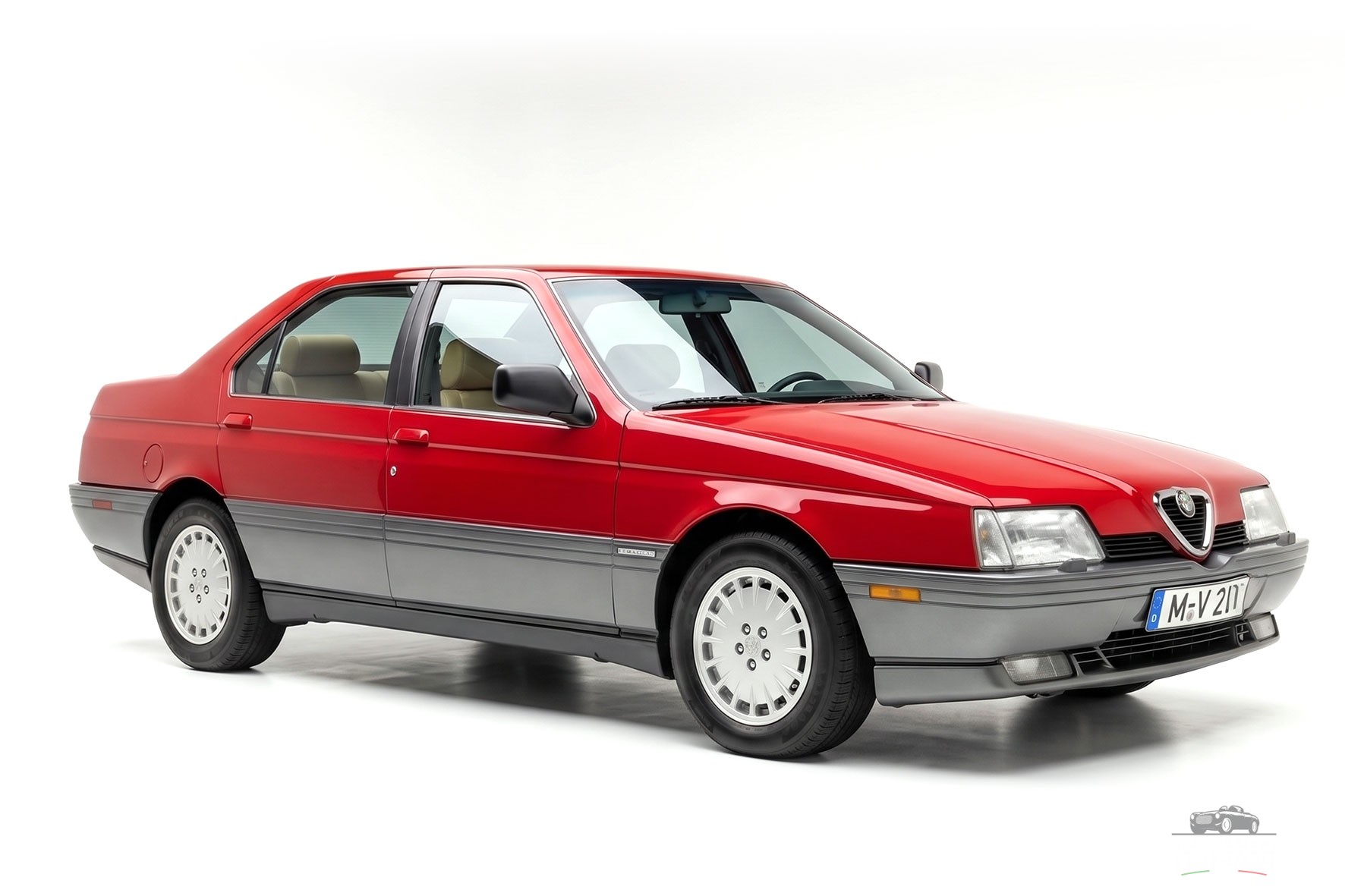
The Alfa Romeo 164 is a four-door executive saloon introduced at the 1987 Frankfurt Motor Show, styled by Enrico Fumia at Pininfarina and manufactured by Alfa Romeo at Arese. It replaced the Alfa 6 and Alfa 90 in the marque’s upper range and was based on the Type Four architecture also used by the Fiat Croma, Lancia Thema and Saab 9000. Pininfarina’s involvement was in the design of the production body, not the manufacture of every series car. This database entry refers to the production model as a whole and not to a particular chassis or surviving example.
Development of the model took place while Alfa Romeo was reorganising its executive-car programme. The shared Type Four project provided a common technical architecture, but the four resulting vehicles retained substantially different exterior identities. Alfa Romeo selected Pininfarina for the 164’s styling. Fumia recalled that the design evolved from an earlier proposal, identified as project 154, which he had developed around 1981–1982 for a different rear-wheel-drive Alfa Romeo programme. Adapting that formal language to the larger transverse-engine platform involved further design work rather than simply transferring an existing body shape.
Historical development accounts also distinguish an early internal Alfa Romeo body study from the Pininfarina proposal adopted for production. Technical development and styling therefore overlapped, and the finished 164 should not be regarded as the work of a single organisation in every aspect. The model was presented publicly in Frankfurt in 1987, after Alfa Romeo’s acquisition by Fiat in late 1986, although the underlying project had begun under the marque’s previous management.
The 164 has a sharply defined three-box profile with a low bonnet, almost planar surfaces, strongly horizontal features and a continuous line along the flanks. Fumia identified the sweeping side recess, or sguscio, as a defining graphic element. It visually links the side surfaces to the wide rear lamp assembly. The large, predominantly red rear lamps required feasibility work with component suppliers; the identity of every supplier involved has not been established in the surviving research records.
At the front, the Alfa Romeo shield was reinterpreted between narrow lateral openings rather than copied directly from an earlier model. A descending bonnet brought the painted surface towards the bumper and reinforced the car’s low, geometric appearance. The shape achieved a reported aerodynamic drag coefficient of 0.305. The original production body was a four-door saloon; separate Pininfarina proposals and prototypes, including the 164 Coupé, 164 Cabriolet and 164 Sport Wagon, have distinct records and are not counted as regular production body styles.
The 164 has a transverse front engine and, in most versions, front-wheel drive. Alfa Romeo’s published dimensional information gives a 2,660 mm wheelbase and 1,760 mm overall width; length and height vary with trim and model year. The engine range developed through the production period and included Twin Spark four-cylinder petrol engines, turbocharged petrol engines, Alfa Romeo V6 units and 2.5-litre turbodiesels. Engine displacement, power, transmission and weight cannot be assigned as one uniform specification to the entire model family.
Early cars used five-speed manual or, on selected versions, four-speed automatic transmissions. Later high-performance versions included the 24-valve V6 and the Q4 with all-wheel drive and a six-speed manual gearbox. The 1991 mechanical revision, the introduction of the Super body treatment from 1993 and the broader appearance changes of 1994 mark distinguishable phases in the model’s development. These phases should be considered separately when comparing surviving vehicles, registration records or technical specifications.
The 164 was assembled by Alfa Romeo at Arese, where production processes included increased automation and corrosion-protection measures. Alfa Romeo’s historical production summary records 268,757 cars built from 1987 to June 1997. This differs from the 273,857 units reported in the older Carrozzieri Italiani entry; the manufacturer figure is used here because it is accompanied by a model-by-model production breakdown. The Alfa Romeo 166 succeeded the 164.
The model’s appearance also provided a point of departure for later Pininfarina work, including the 164 RT design study. These separate exercises do not establish additional production configurations or a chassis history for this model-level record. The model’s exhibition at Frankfurt in 1987 is documented; private ownership, restoration and individual auction transactions should instead be attached to separately identified cars, not extrapolated from the production programme.
02 / TECHNICAL IDENTITY
03 / DESIGN, BODY & SUPPLIERS
Coachbuilder / Design studio
Founded by Battista Pinin Farina in Turin in 1930, Pininfarina became one of the most influential Italian styling and coachbuilding houses, particularly through its work for Ferrari and other international manufacturers.
Explore record ↗Attributed designer
Enrico Fumia is an Italian automotive designer associated with Pininfarina, the Alfa Romeo 164 and 916 GTV/Spider, Ferrari F90 and Lancia.
Explore record ↗04 / CHRONOLOGY
05 / PEOPLE, COLLECTIONS & MUSEUMS
07 / CHASSIS REGISTER
08 / GALLERY
CONTINUE READING
The story of Pininfarina and Alfa Romeo is one of mutual admiration and a shared passion for innovation in automotive design that spans nearly eighty years. This remarkable partnership, which began in…
Read storyThe Tipo Quattro (Type Four) program was launched in the late 1970s as a joint venture to develop a family of executive-class sedans efficiently. Fiat (including its Lancia and soon-to-be-acquired Alfa Romeo…
Read storyDiscover the fascinating journey of Pininfarina, a name synonymous with luxury automotive design and innovation. From its inception in 1930 to its status as a leader in the industry, this article explores…
Read story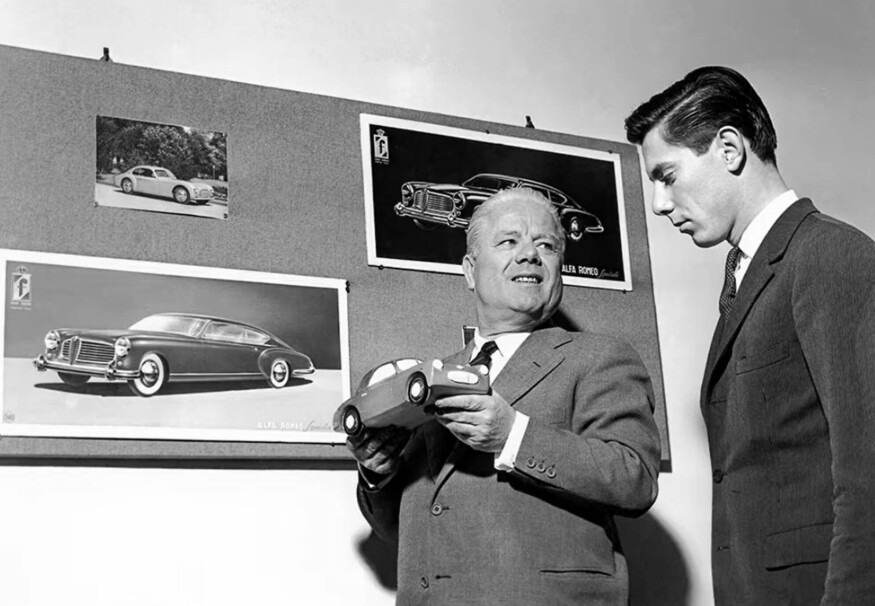

THE CONVERSATION
Comments 0