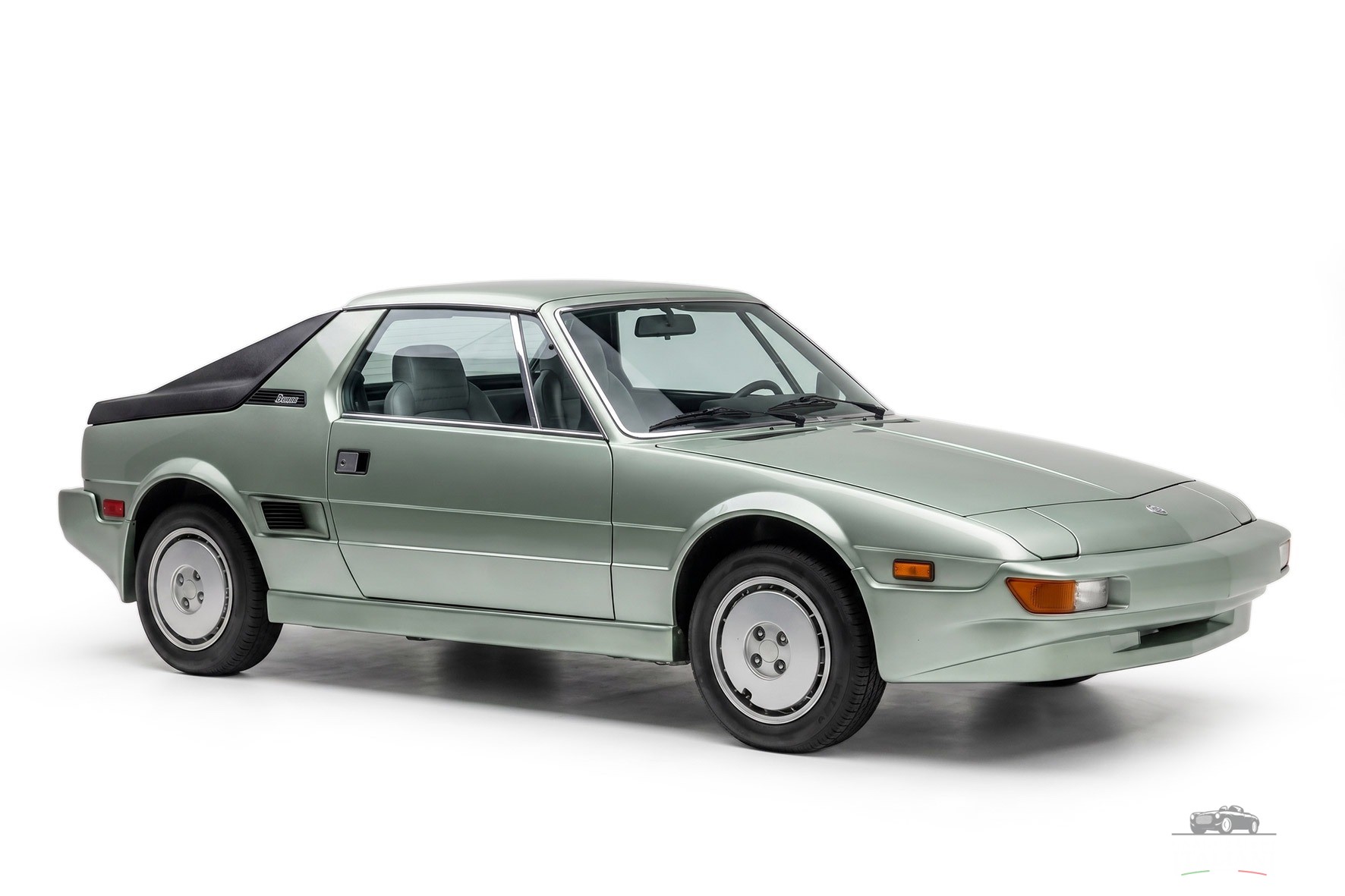
The Fiat X1/9 Bubble-Back belongs to the final attempts to reconsider the small mid-engined sports car before its withdrawal from production. Although the familiar Fiat X1/9 had remained recognisably close to its original 1972 form, the later studies explored a more enclosed rear body, contemporary bumpers and improved luggage accommodation. The history of the Bubble-Back is known principally through a retrospective account written by Renato Guida for the X1/9 Club Italia, rather than through a surviving factory dossier.
Prototipo restyling 90
Guida describes a restyling programme whose appearance had been anticipated in the magazine Gente e Motori in 1985. He also reports that a prototype was photographed on the streets of Turin by Quattroruote towards the end of the decade. Neither original magazine issue has yet been examined, so these references establish promising research leads rather than independently confirmed publication dates for a particular chassis. The reported styling combined a broad glazed rear cover with integrated wraparound bumpers, side skirts, altered lighting and revised mirrors. The project did not become a production model; Guida also mentions heat management under the glazing as a concern, without supplying engineering test data.
The X1/9 Young account
The same club article introduces a separately headed section entitled X1/9 Young, based on documents reportedly supplied by an enthusiast. It describes a lower-cost proposal prepared by Fiat technicians working with Bertone, using a silver X1/9 Five Speed as its starting point. In this account, a smaller A112 Abarth-derived engine and associated mechanical changes would have released space for luggage and a reorganised cooling system. A large thermoformed Plexiglas rear canopy, an aluminium engine cover and a retractable cargo curtain are also described. These details have frequently been repeated as specifications of the Bubble-Back, but the available material does not conclusively establish whether the Young and Prototipo 90 descriptions concern the same physical vehicle, different development stages or two separate studies.
The club account gives the Young engine as approximately 1,000 cc and 75 CV, while the earlier English-language listing described 1,050 cc and 70 hp. Neither figure can presently be accepted as an authenticated specification of an identified Bubble-Back chassis. Likewise, the exact designer, construction date, chassis number, registration, dimensions, materials and final fate remain undocumented. The suggestion that the prototype was scrapped is expressly uncertain.
Place in the X1/9 programme
The Bubble-Back should be distinguished from other experimental X1/9 derivatives, including the earlier Passo Lungo, which investigated a longer wheelbase and additional accommodation. These projects demonstrate different approaches to extending the usefulness of the original mid-engined layout, but do not establish a common chassis or continuous engineering programme. Until the relevant period magazines or original Fiat–Bertone drawings are examined, the Bubble-Back is best catalogued as a late-1980s restyling study with unresolved identity and technical particulars.


THE CONVERSATION
Comments 0