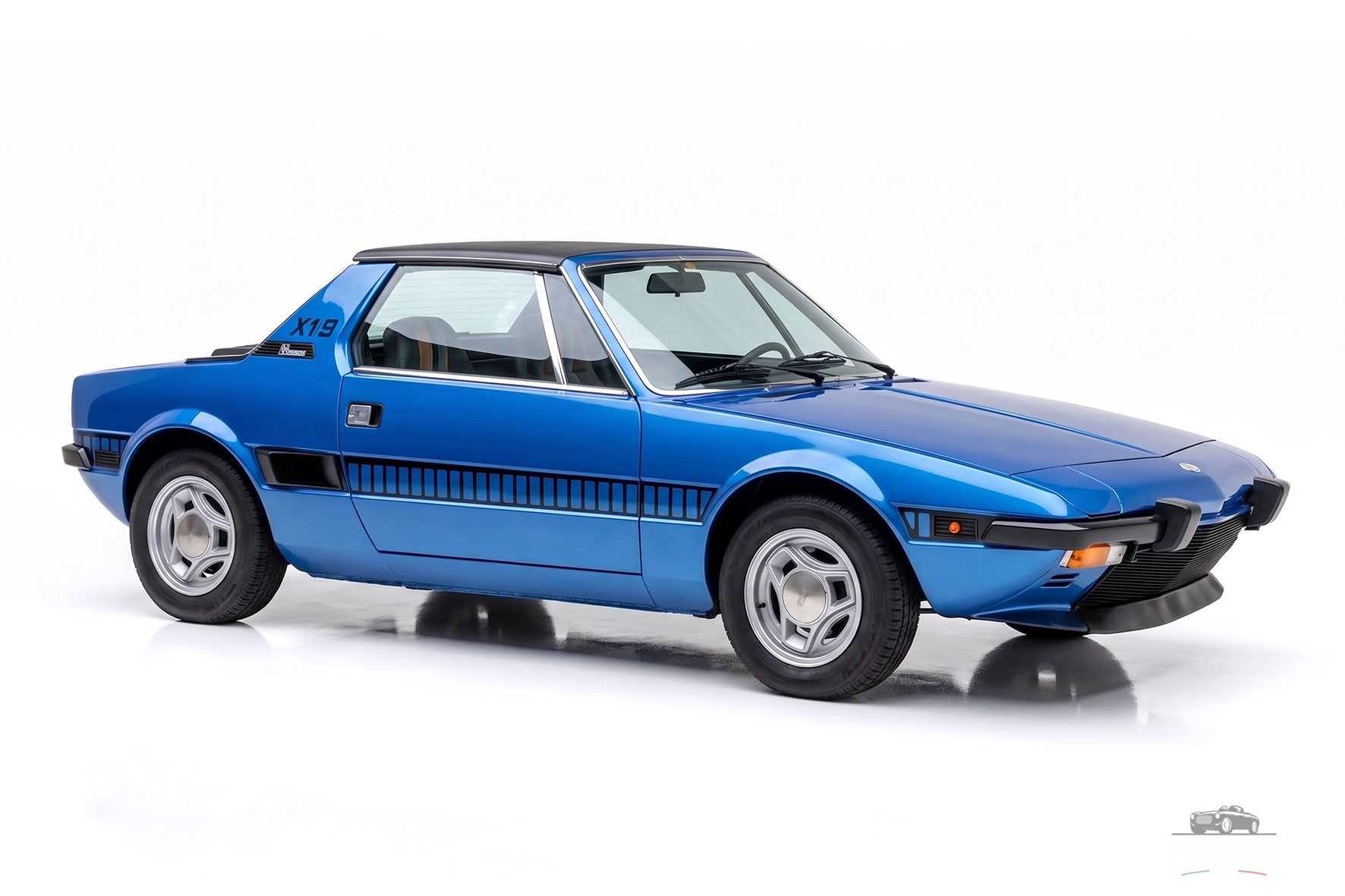
The Fiat X1/9 was one of the most distinctive small sports cars of the 1970s, combining the mechanical economy of Fiat’s mass-produced models with the proportions of a mid-engined exotic. Conceived at Bertone and styled by Marcello Gandini, it succeeded the Fiat 850 Spider while moving beyond the conventional front-engine roadster formula. The experimental Autobianchi Runabout of 1969 had already explored a low, wedge-shaped barchetta with a transverse engine behind the seats; the X1/9 translated that design direction into a practical, fully enclosed production sports car with a removable roof.
The engineering was based on Fiat 128-family components, not on a Lancia Stratos chassis as sometimes claimed. Its four-cylinder engine and transaxle were mounted transversely behind the two-seat cabin to drive the rear wheels, while the steel monocoque provided a strong passenger compartment. The sharply pointed nose housed retractable headlamps and the radiator, leaving a luggage compartment that could accommodate the detachable targa roof panel. A second luggage space lay behind the engine. Gandini’s disciplined geometric surfaces, short overhangs and substantial rear pillars gave the car a character quite unlike the more traditional Fiat 850 Spider.
Introduced in late 1972, the original X1/9 used a 1,290 cc single-overhead-camshaft engine derived from the Fiat 128, generally quoted at 75 PS, coupled to a four-speed manual gearbox. The second series, introduced in 1978 as the X1/9 Five Speed, adopted the 1,498 cc engine associated with the Fiat Ritmo, rated at approximately 85 PS in European specification, together with a five-speed transmission. Details of output, equipment and bumpers varied between export markets and emissions regulations, so these figures describe model variants rather than a particular surviving chassis.
The X1/9 was also an important example of the industrial relationship between Fiat and Bertone. Initially Bertone built the bodies while Fiat completed assembly at Lingotto; in 1982 Bertone took responsibility for the entire production process and subsequently sold the car under its own name. Manufacture continued until 1989. Fiat’s fiftieth-anniversary historical account gives an approximate total of 150,000 cars, although other published production totals differ and should not be treated as exact without a reconciled factory register. The X1/9 also provided the basis for specialist competition projects, including the separate X1/9 Dallara, whose engineering and racing specification should not be confused with those of the road-going production family.



THE CONVERSATION
Comments 0